
Why Litecoin Mining Still Matters in 2026?
Litecoin was created in 2011 by Charlie Lee as a “lighter” version of Bitcoin. It was designed to be faster, cheaper, and more accessible—the silver to Bitcoin’s gold. More than a decade later, Litecoin remains one of the most established and widely traded cryptocurrencies in the world.
As of 2026, Litecoin maintains a market capitalization in the billions, trades on every major exchange, and has a loyal community that has weathered multiple market cycles. But for miners, Litecoin offers something that many other cryptocurrencies cannot match: a stable, predictable mining environment with a fixed block reward and a mature ecosystem.
Litecoin uses the Scrypt proof-of-work algorithm, which was specifically designed to be memory-intensive and resistant to the kind of ASIC dominance that has consumed Bitcoin mining. While Scrypt ASICs do exist today, the algorithm’s memory-hard nature means that the mining landscape remains more accessible than SHA-256 mining. For miners who want to participate in a well-established, blue-chip cryptocurrency without the industrial-scale barriers of Bitcoin, Litecoin mining offers a compelling alternative.
But there is a catch. Like Bitcoin, Litecoin undergoes halving events approximately every four years. The current block reward sits at 6.25 LTC per block, but the next halving in July 2027 will cut that reward to 3.125 LTC. This means 2026 is a critical year for miners looking to maximize their returns before the reward reduction takes effect.
This guide covers everything you need to know about Litecoin mining in 2026: how Scrypt works, which ASIC miners lead the market, how to calculate profitability, how to set up your miner, and whether LTC mining still makes sense.
What Is Litecoin Mining? Understanding the Basics
Litecoin mining is the Scrypt proof-of-work process that confirms transactions and mints new LTC Miner. Miners use specialized computers to race to add a new block of transactions to the Litecoin blockchain. Win the round, get 6.25 LTC plus whatever transaction fees are in that block.
Under the hood, miners run a proof-of-work algorithm. Their hardware tries trillions of numeric guesses per second, shoves each input into the Scrypt hash function, and waits for one that lands below a moving target. Each miner also runs as a node, meaning it validates transactions while it hashes.
The Scrypt Algorithm
Litecoin runs on the Scrypt hashing algorithm. Scrypt is memory-intensive by design, which once let hobbyists mine on ordinary graphics cards. Those days ended years ago. Specialized Scrypt application-specific integrated circuit (ASIC) machines now dominate the network.
Scrypt was built to be memory-hard—meaning the hashing process needs CPU time AND a lot of fast RAM per calculation. Back in the early days, that barrier made commodity GPUs a reasonable choice for Scrypt mining. By 2016, specialized ASIC miners arrived and wiped GPU profitability off the map. Today, CPU and GPU mining of Litecoin is technically possible but economically pointless.
The Block Reward
The current block reward sits at 6.25 LTC per block. Blocks are generated approximately every 146 seconds, enabling timely transactions. This adds up to roughly 3,700 LTC entering circulation every day.
The next halving is scheduled for July 2027, when the reward will drop to 3.125 LTC per block. This means 2026 represents the final full year of mining at the current reward level—a fact that serious miners are already factoring into their hardware decisions.
The Scrypt Algorithm: Why It Shapes Every Mining Decision?
Litecoin does not use the SHA-256 algorithm that secures Bitcoin. It uses Scrypt, a proof-of-work algorithm developed in 2009.
What Makes Scrypt Different
Scrypt was designed to be memory-hard. Rather than requiring raw computational speed, it demands a large amount of RAM to generate a valid proof. The original intention was to keep mining accessible to GPU and CPU miners by making it prohibitively expensive to build application-specific hardware. The logic was straightforward: memory is expensive and standardized, so dedicated chips would offer less advantage over commodity hardware.
The ASIC Reality
Despite these intentions, purpose-built Scrypt ASICs now dominate Litecoin mining. Today, most Litecoin hashrate sits on merge-mined Scrypt ASIC pools.
The competitive landscape shifted when ASICs entered the ecosystem, and by 2026, Litecoin mining is not just recommended for serious Litecoin miners—it is essentially the only viable path for anyone who wants to earn consistent rewards against the current network difficulty.
Network Hashrate
As of mid-2026, the Litecoin network hashrate sits near 3.12 PH/s, with difficulty around 103.27 M. Recent peaks have hit over 3-4 PH/s. This level of computational power makes attacks economically impossible for bad actors, but it also means that individual miners need efficient hardware to remain competitive.
Litecoin’s hashrate near 3.12 PH/s is a clear reminder that Scrypt mining in 2026 is competitive. It does not eliminate opportunity, but it raises the bar for hardware selection.
Merged Mining: The Two-for-One Secret
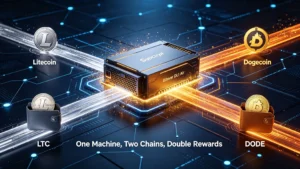
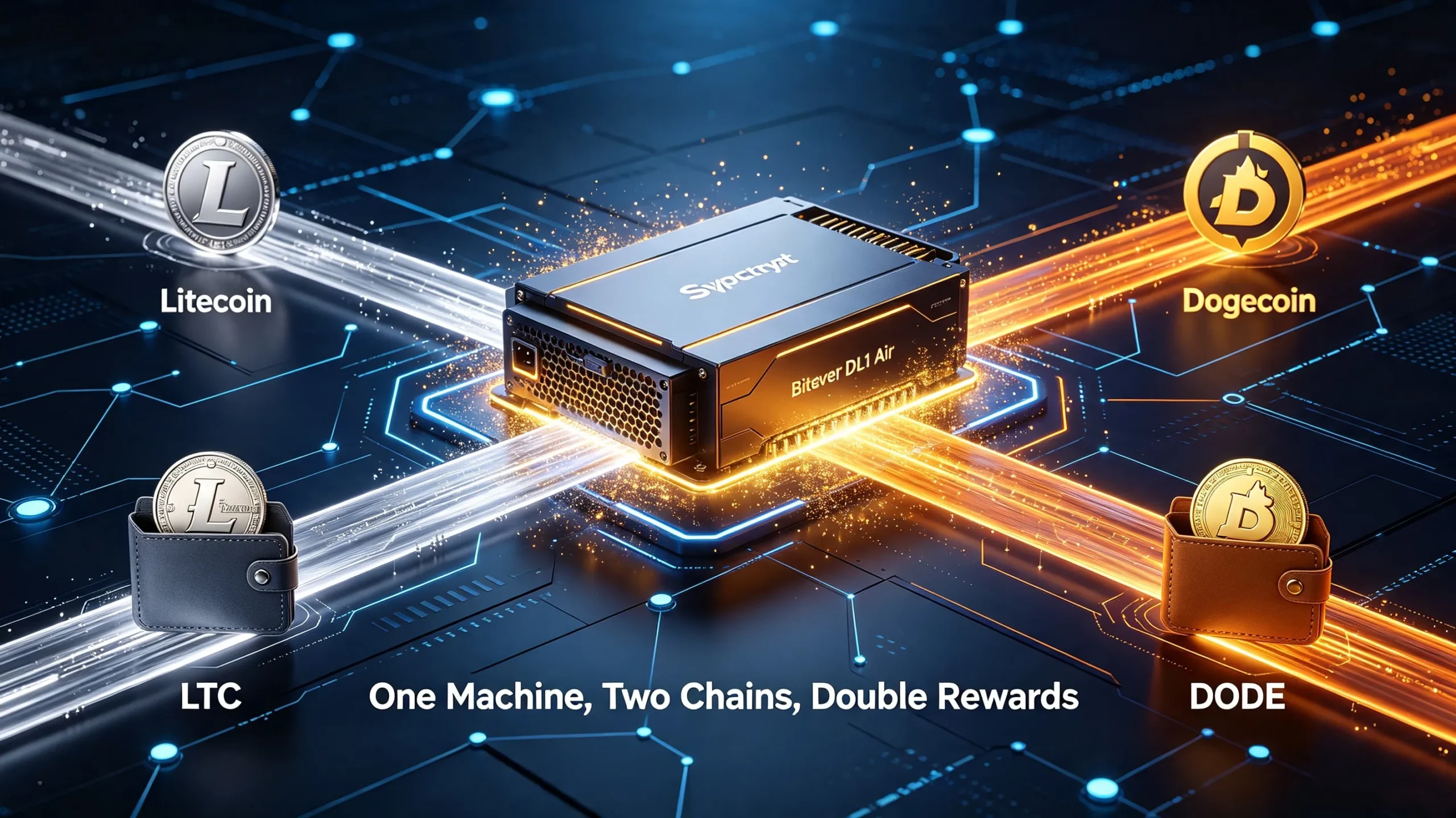
This is where Litecoin mining gets interesting. Dogecoin was forked from Litecoin back in 2013, so both chains speak the same language: the Scrypt hashing algorithm. Since 2014, a protocol called Auxiliary Proof of Work (AuxPoW) has let them be mined together.
Your machine does one job, and that single proof-of-work is checked against both chains at the same time. The pool handles all of it. You point your miner at a merged-mining pool, set a Litecoin payout address and a Dogecoin payout address, and rewards from both chains flow in automatically. As one pool sums it up: “No extra power, no double work, just one effort with two rewards”.
That is why almost nobody mines Litecoin on its own. Today, the large majority of Dogecoin’s hashpower comes from Litecoin miners merge-mining the two. A single Scrypt ASIC pointed at the right pool earns both coins at once from the same electricity.
In a merged setup, the Dogecoin rewards are effectively a bonus stream stacked on top of your Litecoin earnings, at no extra power cost. The combined LTC + DOGE revenue is what makes Scrypt mining work in 2026.
For most miners, the practical operation is simple: configure your Scrypt ASIC to an LTC pool that supports DOGE rewards, without needing to run a separate Dogecoin miner or split your hashrate.
How to Calculate Litecoin Mining Profitability?
Profitability is the most important question for any miner. The formula is simple:
Profit = Revenue – Electricity Cost – Pool Fees
But the variables are anything but simple.
The Key Variables
Hashrate: Measured in GH/s (gigahashes per second) for Scrypt mining. Higher hashrate means more chances to solve blocks.
Power Consumption: Measured in watts. This determines your electricity cost.
Efficiency: Measured in J/GH (joules per gigahash). Lower is better—it means less electricity spent per unit of work.
Electricity Cost: The single most influential factor in LTC/DOGE mining profitability. At $0.05/kWh almost any modern ASIC is profitable; at $0.10 only the most efficient models survive; above $0.15 you need free power or top-tier hardware.
LTC Miner Price: Revenue is directly tied to LTC’s market price.
Network Difficulty: As more miners join, difficulty increases, reducing the amount of LTC earned per gigahash.
Pool Fees: Most pools charge 1–3% of earnings.
The Break-Even Calculation
The difference between two miners running identical hardware can be entirely explained by where they live and what they pay for power. A higher LTC price may increase the predicted value of rewards, while higher network difficulty may reduce the expected reward share for the same miner.
Using a Mining Calculator
The easiest way to calculate profitability is to use a Litecoin mining calculator. Tools like Asicminervalue, WhatToMine, and ViaBTC‘s calculator let you enter your ltc miner’s hashrate, power usage, energy cost, and the current price of LTC to get an estimate.
A Litecoin mining profitability calculator helps estimate revenue, power costs, pool fees, and merged-mining rewards before you mine. The key is distinguishing between revenue and profit.
Run those specs through the calculator at your electricity rate and use the output as a rough guide, not a guarantee.
The Top 7 LTC Miners of 2026
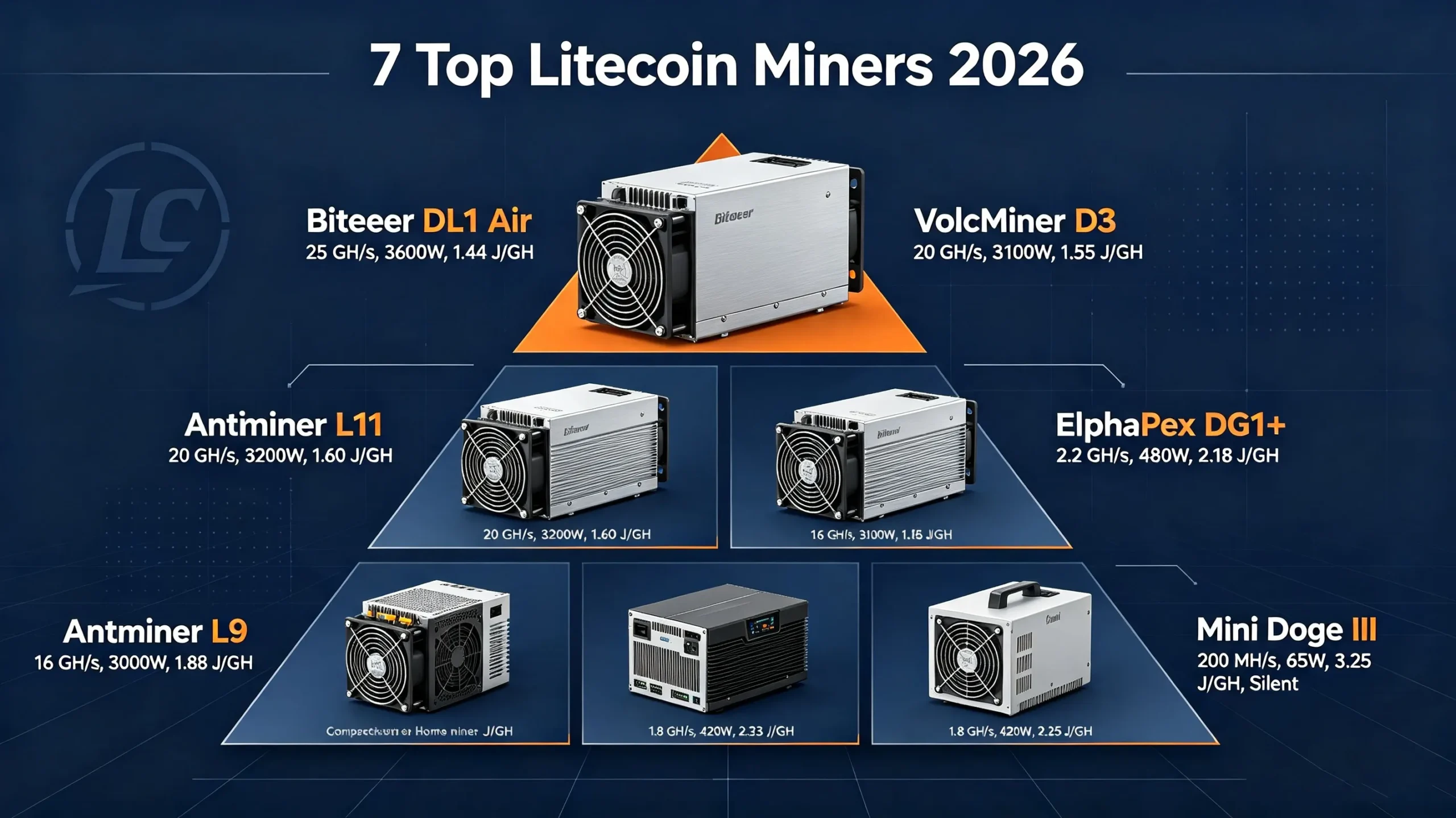
The Scrypt mining market in 2026 offers options ranging from industrial-scale powerhouses to quiet desktop devices. For three years, if you wanted to mine Litecoin and Dogecoin at professional scale, you bought a Bitmain Antminer or you bought nothing. That changed on March 16, 2026, when Bitdeer Technologies Group shipped the SEALMINER DL1 Air, its first dedicated Scrypt machine.
Here are the top seven Litecoin miners you should know in 2026.
Bitdeer SEALMINER DL1 Air – The Efficiency King
In March 2026, Bitdeer Technologies Group (NASDAQ: BTDR) launched the SEALMINER DL1 Air, the company’s first dedicated Scrypt hardware. It entered the market with a clear value proposition: unmatched efficiency.
Key Specifications
| Attribute | Details |
|---|---|
| Hashrate | 25 GH/s |
| Power Consumption | 3,725 W |
| Efficiency | 149 J/GH |
| Supported Coins | LTC, DOGE, BELLS, JKC, LKY, PEP |
| Dimensions | 197 × 365 × 292 mm |
| Weight | 15.5 kg |
Performance
The SEALMINER DL1 Air delivers 25 GH/s with an industry-leading efficiency of 149 J/GH. This makes it approximately 30% more efficient per gigahash than the Antminer L9.
The DL1 Air features three distinct operating modes:
-
Normal Mode: Standard performance at 25 GH/s
-
High Hashrate Mode: Maximum output for cheap-power operators
-
Low Power Mode: Drops to 20.5 GH/s and 136 J/GH for expensive-rate periods
The Low Power Mode offers a strategic advantage for cost optimization or navigating grid constraints. The unit inherits Bitdeer’s validated SEALMINER Air Cooling architecture, featuring compact dimensions for ease of maintenance and high-density deployment.
The Efficiency Advantage
A miner at 149 J/GH does the same work as one at 210 J/GH for roughly 30% less power. Over a year of 24/7 operation, that efficiency gap translates into thousands of dollars in electricity savings.
Who It’s For
The DL1 Air is for serious miners who prioritize efficiency above all else. At 25 GH/s and 149 J/GH, it is the most efficient Scrypt miner on the market. It competes directly with the Antminer L9, offering higher hashrate and better efficiency.
Bitdeer spent its first years building SHA-256 Bitcoin hardware, then turned that chip-design capability toward Scrypt. The DL1 Air arrives from a NASDAQ-listed manufacturer with active data centers across the United States, Norway, Bhutan, and Ethiopia.
Bitmain Antminer L9 – The Industry Standard
The Antminer L9 is the most widely used Scrypt ASIC in 2026. More miners use this machine than any other Scrypt ASIC. If you want to mine Litecoin and Dogecoin at scale, this is the machine you buy.
Key Specifications
| Attribute | Details |
|---|---|
| Hashrate | 17 GH/s |
| Power Consumption | 3,570 W |
| Efficiency | 210 J/GH |
| Noise Level | 75 dB |
| Voltage | 100-240V |
| Weight | 13.5 kg |
| Price | ~$4,490 |
Performance
The Bitmain Antminer L9 is Bitmain’s air-cooled Scrypt miner for Litecoin and Dogecoin. Its defining feature is merged mining: one machine mines both coins at once from the same power, with no split in hashrate.
It runs 17 GH/s at 3,570 W and 210 J/GH on Bitmain’s BM1485 chips. It sits above the older L7 (9.5 GH/s) and below the higher-output L11 (20 GH/s).
The L9’s case is maturity and value: the deepest support and resale market in Scrypt mining at the lowest entry cost in its class.
Profitability
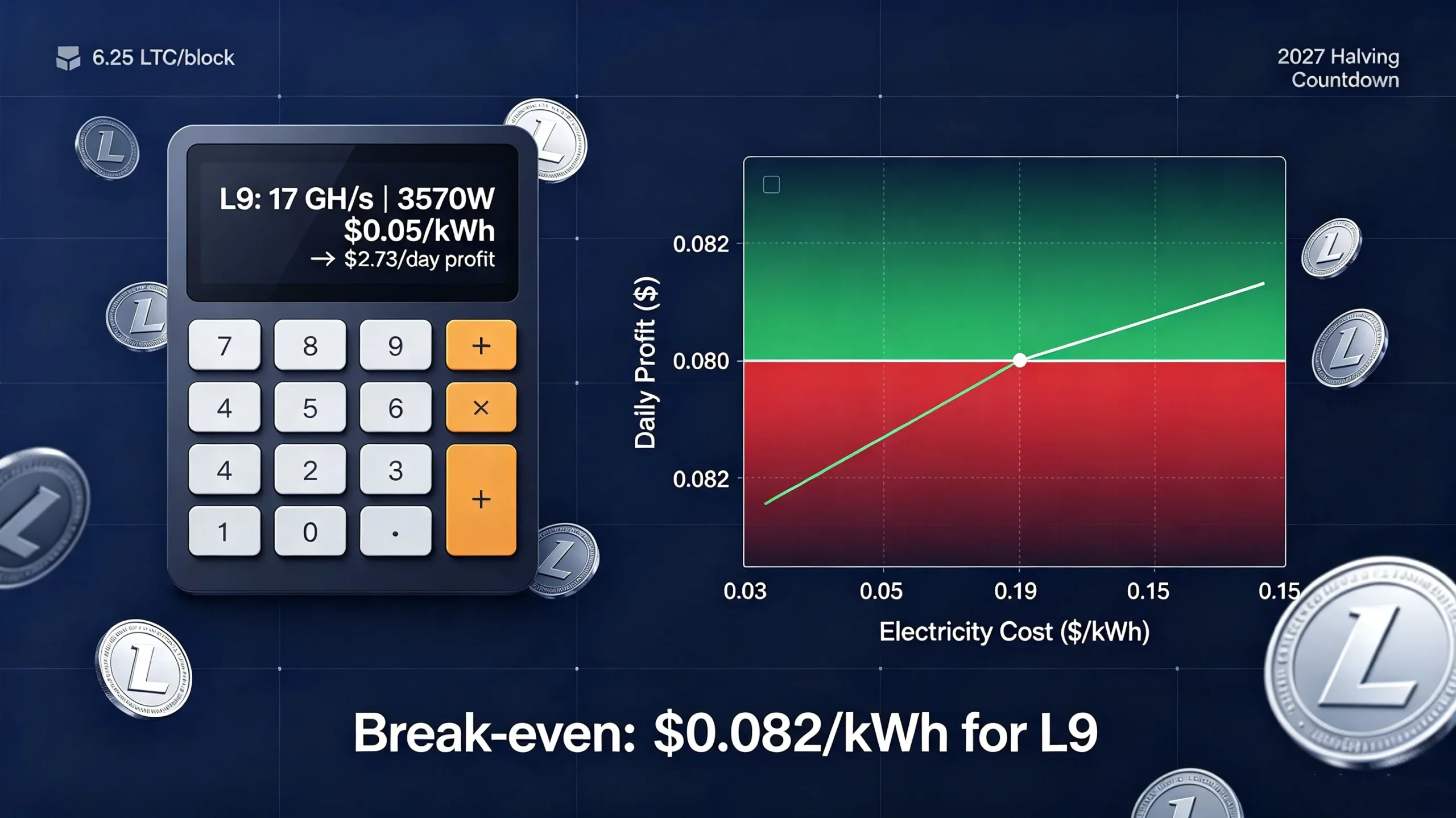
At $0.05/kWh, an Antminer L9 produces approximately $2.73 in daily net profit. At $0.08/kWh, the daily profit drops to about $1.02. At $0.10/kWh, the same rig loses roughly $1.09 per day. At $0.12/kWh, it runs at a loss.
The break-even electricity rate for the L9 is approximately $0.082/kWh. Below that, it makes money; above that, it loses money.
Who It’s For
The Antminer L9 is for small-to-mid farms at $0.05–$0.10/kWh, where moderate efficiency meets reasonable upfront cost. It is not a home miner—75 dB of noise is roughly equivalent to a vacuum cleaner. It runs on 220 to 277V single-phase.
Availability
The Antminer L9 17 GH/s air-cooled model is available with 5–7 day shipping. The L9 Hyd 2U (27 GH/s, water-cooled) is also available for operators who prefer liquid cooling.
Bitmain Antminer L11 – The High-Output Workhorse
The Antminer L11 is Bitmain’s higher-output Scrypt solution, targeting miners focused on maximizing output per machine.
Key Specifications
| Attribute | Details |
|---|---|
| Hashrate | 20 GH/s |
| Power Consumption | 3,680 W |
| Efficiency | 184 J/GH |
| Supported Coins | LTC, DOGE, Scrypt-based coins |
| Dimensions | 430 × 195 × 290 mm |
| Weight | 16.5 kg |
Performance
The Antminer L11 delivers approximately 20 GH/s at 3,680 W, achieving an efficiency of 184 J/GH. This represents a 15-25% improvement over the L7 series.
The L11 targets miners focused on maximizing output per machine, especially in regions where electricity pricing and rack space are limiting factors.
Who It’s For
The Antminer L11 is for miners focused on higher efficiency and output density. It offers a clear upgrade path from the L9 for miners who need more hashrate per machine.
VolcMiner D3 – The New Contender
The VolcMiner D3 is a high-performance ASIC miner built for the Scrypt algorithm, specifically optimized for Dogecoin and Litecoin mining. Launched in January 2026, it delivers impressive output at competitive efficiency.
Key Specifications
| Attribute | Details |
|---|---|
| Hashrate | 20 GH/s |
| Power Consumption | 3,580 W |
| Efficiency | 179 J/GH |
| Noise Level | 75 dB |
| Voltage | 200-300V |
| Weight | 17.55 kg |
| Price | ~$7,850 |
Performance
The VolcMiner D3 delivers 20 GH/s of Scrypt hashrate at 3,580 W, achieving an efficiency of 0.179 J/MH. It supports merged mining for Litecoin, Dogecoin, Bellscoin, Luckycoin, Pepecoin, Junkcoin, and other Scrypt-based coins.
With dual-fan cooling, durable build quality, and Ethernet connectivity, the VolcMiner D3 is engineered for stable 24/7 performance in large mining farms.
Who It’s For
The VolcMiner D3 is for miners who want higher hashrate at a competitive price point. At 20 GH/s, it matches the L11’s output while offering slightly better efficiency (179 vs 184 J/GH). It is designed for industrial-scale Scrypt mining operations.
ElphaPex DG1+ – The Budget Industrial Option
ElphaPex has emerged as a serious competitor in the Scrypt ASIC market. The DG1+ is the mid-range industrial offering, supporting multiple Scrypt coins simultaneously.
Key Specifications
| Attribute | Details |
|---|---|
| Hashrate | 13–14.4 GH/s |
| Power Consumption | 3,920 W |
| Efficiency | ~310 J/GH |
| Noise Level | 75 dB |
| Supported Coins | 7+ Scrypt coins |
Performance
The DG1+ mines 7 cryptocurrencies at the same time—Litecoin, Dogecoin, Bellscoin, Pepecoin, Luckycoin, Junkcoin, and Dingocoin—using the same Scrypt algorithm and the same power consumption.
At 13–14.4 GH/s and approximately 310 J/GH, it is less efficient than the top-tier miners but offers a more accessible entry point.
Who It’s For
The DG1+ is for operators looking for a budget-friendly entry into industrial Scrypt mining. It costs less than the L9 or DL1 Air while delivering respectable hashrate. The machine is recommended for industrial/office/garage/warehouse use.
Goldshell LT6 – The Mid-Range Choice
Goldshell’s LT6 sits in the middle of the Scrypt mining market—more powerful than home miners but less demanding than top-tier industrial ASICs.
Key Specifications
| Attribute | Details |
|---|---|
| Hashrate | 3.35 GH/s |
| Power Consumption | 3,200 W |
| Efficiency | ~955 J/GH |
| Noise Level | 80 dB |
| Dimensions | 264 × 200 × 290 mm |
| Weight | 12.5 kg |
Performance
The LT6 delivers 3.35 GH/s at 3,200 W. It can mine Litecoin, Dogecoin, and several other Scrypt-based coins.
Who It’s For
The LT6 is for miners who want more hashrate than home miners but cannot accommodate the power and cooling requirements of top-tier industrial ASICs. At 80 dB, it is loud and not suitable for home use.
Goldshell Mini Doge III – The Quiet Home Miner
Goldshell is best known for compact, quiet miners that sit on desks. The Mini Doge III is the flagship of this lineup—a tiny Scrypt ASIC that runs quietly and fits in the palm of your hand.
Key Specifications
| Attribute | Details |
|---|---|
| Hashrate | 650–700 MH/s |
| Power Consumption | 371–400 W |
| Efficiency | ~0.57 J/MH |
| Noise Level | Low (home-friendly) |
| Connectivity | Wi-Fi |
Performance
The Mini Doge III is not a high-output machine—650 MH/s is 0.65 GH/s, a fraction of the L9’s 17,000 MH/s. But that is not the point. The Mini Doge III is designed for home use. It is quiet enough to run in a living room, draws standard household power, and produces minimal heat.
The Mini Doge III supports merged mining for Litecoin, Dogecoin, Bellscoin, Dingocoin, Pepecoin, Luckycoin, and Junkcoin all at once.
Who It’s For
The Mini Doge III is for home miners who value quiet, compact hardware over raw hashrate. It is ideal for:
-
Learning about mining without a major investment
-
Running in an apartment or office
-
Supporting the network as a hobby
Side-by-Side Comparison LTC Miner Table
| Miner | Hashrate | Power | Efficiency | Noise | Price (est.) | Best For |
|---|---|---|---|---|---|---|
| Bitdeer DL1 Air | 25 GH/s | 3,725W | 149 J/GH | ~75 dB | Higher | Efficiency-focused industrial |
| Bitmain Antminer L9 | 17 GH/s | 3,570W | 210 J/GH | 75 dB | ~$4,490 | Industry standard, 1-10 units |
| Bitmain Antminer L11 | 20 GH/s | 3,680W | 184 J/GH | ~75 dB | ~$4,250 | High-output industrial |
| VolcMiner D3 | 20 GH/s | 3,580W | 179 J/GH | 75 dB | ~$7,850 | New high-output contender |
| ElphaPex DG1+ | 13–14.4 GH/s | 3,920W | ~310 J/GH | 75 dB | Lower | Budget industrial |
| Goldshell LT6 | 3.35 GH/s | 3,200W | ~955 J/GH | 80 dB | Mid | Mid-range mining |
| Goldshell Mini Doge III | 0.65 GH/s | ~400W | ~0.57 J/MH | Low | Low | Quiet home mining, hobbyists |
How to Set Up Your Litecoin Miner?
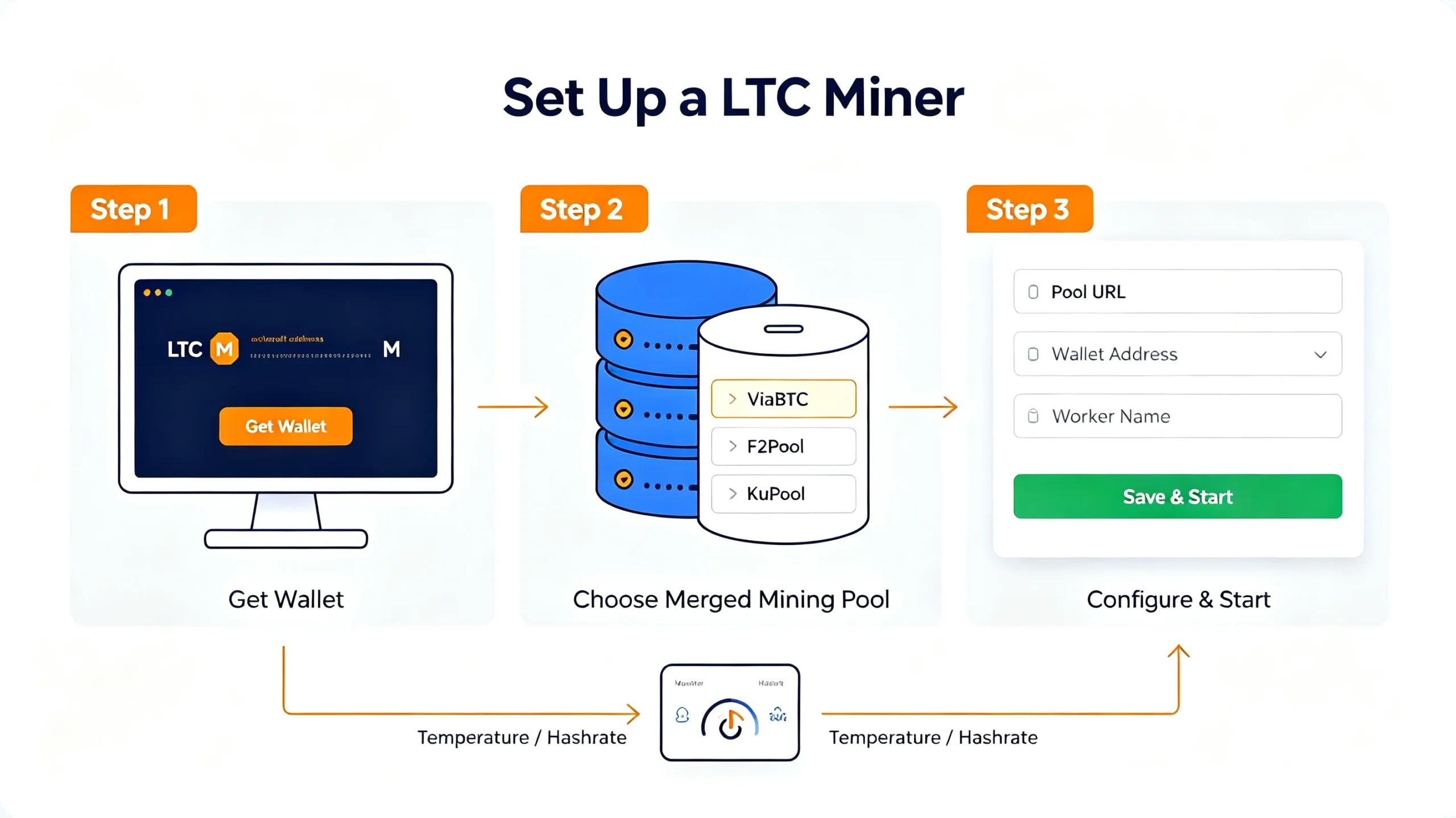
Setting up a Litecoin miner in 2026 is straightforward. Here is a step-by-step guide.
What You Need Before You Start
-
A Scrypt ASIC miner
-
A Litecoin wallet address (and a Dogecoin address for merged mining)
-
A merged-mining pool account
-
A 220V circuit for industrial miners (or 110V for home miners)
-
Wired Ethernet
-
Adequate cooling and ventilation
Step 1: Get a Litecoin Wallet
You need a wallet to receive your rewards. Options include:
-
Software wallets (apps): Convenient for frequent access
-
Hardware wallets (most secure): Best for long-term storage
-
Exchange wallets: Less recommended for long-term storage
For merged mining, you also need a Dogecoin wallet address.
Step 2: Choose a Mining Pool
Mining solo is extremely difficult today. Pools increase your chances of earning consistent rewards. Choose a pool that supports merged mining for both LTC and DOGE.
Step 3: Install Mining Software
Mining software connects your hardware to the blockchain or mining pool. For ASIC miners, the software is often built into the miner’s web interface.
Step 4: Configure Your Miner
Here is the quick setup process for most ASIC miners:
-
Connect the power supply to the miner and plug it into the outlet
-
Connect the Ethernet cable to your router or switch
-
Find the miner’s IP address via your router’s admin interface or an IP scanner tool
-
Open the web interface by entering the IP address in your browser
-
Enter the pool URL, wallet address, and worker name in the configuration page
-
Click “Save & Apply” to start mining
To ensure stable mining, it is recommended to set multiple ports. When one of them fails to connect, the machine will automatically switch to the next group of ports to continue running.
Step 5: Monitor Your Performance
Check the pool’s website to verify your worker is submitting shares. Monitor temperature and fan speeds. Watch for rejected shares (should be less than 1–2%).
Choosing a Mining Pool
The pool you choose affects your earnings, payout frequency, and overall mining experience.
Top Litecoin Mining Pools in 2026
ViaBTC: One of the world’s top mining pools, serving over 1 million users across 150+ countries. Supports merged mining for LTC and DOGE.
F2Pool: The world’s leading mining pool, serving miners in more than 100 countries. Supports Litecoin, Dogecoin, and many other cryptocurrencies.
KuPool: Crypto exchange KuCoin rolled out a new mining pool service in 2026 with support for DOGE, LTC, and merged mining assets.
Pool Selection Criteria
-
Fee: Most pools charge 1–3%
-
Payout frequency: Daily, weekly, or per-block
-
Minimum payout: Lower is better for small miners
-
Reliability: Uptime and stability
-
Merged mining support: Essential for earning both LTC and DOGE
Payout Methods
Most pools offer different payment methods:
-
PPS+ (Pay-Per-Share Plus): Fixed payment per share, plus transaction fees
-
PPLNS (Pay-Per-Last-N-Shares): Payment based on contributed shares over a rolling window
In ViaBTC’s LTC merged mining, rewards are distributed using PPLNS. This distinction matters when comparing different pools.
What to Check Before Joining
First, confirm that the pool currently provides merged mining rewards for LTC miners. Then check the required payout method.
Litecoin Mining of the 2027 Halving: What It Means for Miners
The next Litecoin halving is scheduled for July 2027, when block rewards will drop from 6.25 LTC to 3.125 LTC per block.
The Impact
When the event arrives, the impact on Litecoin miners will be immediate and significant. Miner compensation will change from 6.25 LTC per block to 3.125 LTC per block, reducing new LTC issued per block by half. This happens after every 840,000 blocks are mined, approximately every four years.
Litecoin faces the same long-term security budget challenge as Bitcoin—block rewards halve every four years, and transaction fees must eventually replace subsidies to sustain mining.
The 2026 Window
From the perspective of 2026, Litecoin mining has evolved from early “high-profit” days to a mature, competitive industry. However, in the eyes of veteran hashrate operators, 2026 is actually the optimal “window period” for LTC mining deployment.
The logic is straightforward: 2026 represents the final full year of mining at the current 6.25 LTC block reward. Miners who deploy hardware in 2026 can capture a full year of higher rewards before the halving reduces payouts.
Strategic Implications
For serious miners, the halving creates an asymmetry: those who deploy before the halving can acquire coins at lower difficulty and with higher block rewards. Those who wait may face higher hardware prices and reduced rewards.
Key Risks of Litecoin Mining
Before investing in Litecoin mining hardware, understand these significant risks.
1. Electricity Cost Risk
Electricity cost is the single most influential factor in profitability. A rise in electricity prices can turn a profitable operation into a loss-making one overnight.
2. LTC Price Volatility
Litecoin’s lower market cap means price pressure is more acute than for Bitcoin—each halving reduces miner revenue, and prices must rise to compensate. A drop in LTC price directly reduces revenue.
3. Network Difficulty Increases
As more miners join the network, difficulty increases, reducing each miner’s share of the rewards. If more miners deploy powerful units, network difficulty is likely to continue surging.
4. Hardware Obsolescence
ASIC miners have a limited lifespan. Newer, more efficient models can make older hardware unprofitable. The L9 replaced the L7; the next generation will eventually replace the L9.
5. Halving Risk
The July 2027 halving will cut block rewards in half, reducing revenue. Miners need to plan for this event.
6. Regulatory Risk
Cryptocurrency mining faces increasing regulatory scrutiny in many jurisdictions. Changes in regulations could impact profitability or legality.
7. Infrastructure Requirements
Industrial ASICs require 220V circuits, adequate amperage, and professional-grade cooling. Not every home or facility can accommodate these requirements.
8. Noise and Heat
Industrial ASICs run at 75 dB—equivalent to a vacuum cleaner—and produce significant heat. They are not suitable for living spaces.
9. Pool and Payout Risks
Mining profitability depends on pool fee structures and payout methods. In ViaBTC’s LTC merged mining, rewards are distributed using PPLNS. Understanding these mechanics is essential.
Final Verdict: Should You Mine Litecoin in 2026?
Litecoin mining in 2026 is a specialized, hardware-driven industry. It is not the casual hobby it once was. But for the right person with the right circumstances, it can still be worthwhile.
The Case for Mining Litecoin
Merged Mining Advantage: One machine earns both LTC and DOGE from the same electricity. The combined revenue is what makes Scrypt mining work in 2026.
Established Market: Litecoin is one of the oldest and most recognized cryptocurrencies in the world, with deep liquidity and a loyal community.
The 2026 Window: With the July 2027 halving approaching, 2026 represents the optimal “window period” for LTC mining deployment. Miners can capture a full year of higher rewards before the halving reduces payouts.
Hardware Options: From quiet home miners to industrial powerhouses, there is a Litecoin miner for every budget and setting.
The Case Against Mining Litecoin
Marginal Profitability: For most home miners with average electricity costs, Litecoin mining is not profitable. The margins are thin and shrinking.
High Hardware Costs: Industrial ASICs cost thousands of dollars. Home miners cost less but produce minimal returns.
Infrastructure Requirements: Industrial miners require 220V circuits and professional cooling. Not suitable for most homes.
Halving Risk: The July 2027 halving will cut block rewards in half, reducing revenue.
Intense Competition: Litecoin’s hashrate near 3.12 PH/s means competition is fierce.
The Verdict
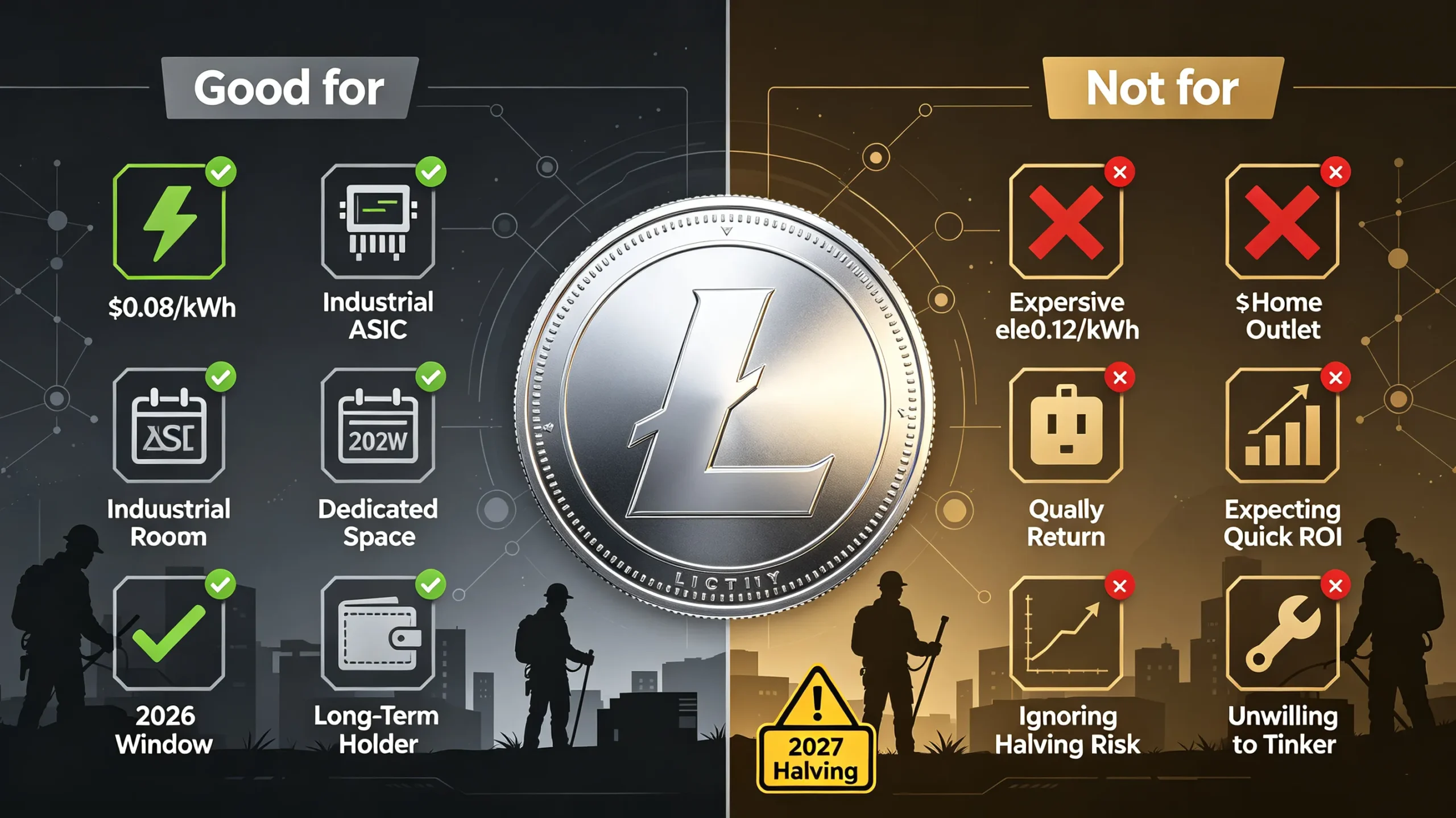
Mine Litecoin if you:
-
Have access to electricity below $0.08/kWh
-
Can afford the hardware investment
-
Have a dedicated space with proper cooling and ventilation
-
Understand that 2026 is the final full year before the halving
-
Want to accumulate LTC and DOGE through merged mining
Don’t mine Litecoin if you:
-
Have average or above-average electricity costs
-
Expect significant short-term profits
-
Aren’t willing to deal with setup, maintenance, and noise
-
Are looking for passive income with minimal effort
The Bottom Line
Litecoin mining in 2026 is not what it used to be. The days of mining LTC on a laptop are long gone. Today, it is a hardware and power-cost decision.
For miners with cheap electricity and efficient hardware, Litecoin mining offers a legitimate way to accumulate LTC and DOGE through merged mining. The 2026 window is particularly attractive, as it represents the final full year before the July 2027 halving cuts block rewards in half.
For everyone else, it is a hobby at best—and a money-losing proposition at worst. If you are considering Litecoin mining, start with a mining calculator. Plug in your hashrate, power consumption, electricity rate, and pool fee. If the numbers work at your electricity rate, the hardware might be worth the investment. If they don’t, you are better off buying LTC directly on an exchange.
Litecoin was built as the silver to Bitcoin’s gold. Mining it in 2026 is serious business—but for the right miner, it can still be worth the effort.
Frequently Asked Questions Of LTC Miner
What is the best Litecoin miner in 2026?
For efficiency, the Bitdeer SEALMINER DL1 Air (25 GH/s, 149 J/GH) is the current leader. For proven reliability and market depth, the Antminer L9 (17 GH/s) is the industry standard. For maximum output, the Antminer L11 (20 GH/s) and VolcMiner D3 (20 GH/s) are strong contenders.
Can I mine Litecoin with a GPU in 2026?
Technically yes, but economically no. CPU and GPU mining of Litecoin is technically possible but has been effectively obsolete since Scrypt ASICs arrived in 2014.
What is merged mining?
Merged mining lets one Scrypt ASIC earn both Litecoin and Dogecoin at the same time, at no extra electricity cost. Your machine does one job, and that single proof-of-work is checked against both chains.
How much does a Litecoin miner cost?
Prices range from under $500 for home miners like the Goldshell Mini Doge III to $4,250–$7,850+ for industrial ASICs like the Antminer L11 and VolcMiner D3.
Is Litecoin mining profitable in 2026?
It depends on your electricity cost. At $0.05/kWh, most modern ASICs are profitable. At $0.10/kWh, only the most efficient models survive. At average US residential rates (~$0.12–$0.15/kWh), Litecoin mining is generally not profitable.
What is Litecoin’s block reward?
Litecoin’s current block reward is 6.25 LTC per block. The next halving in July 2027 will reduce this to 3.125 LTC.
What mining pools support Litecoin?
ViaBTC, F2Pool, KuPool, and many other pools support Litecoin mining. For merged mining, choose a pool that supports both LTC and DOGE.
How do I set up a Litecoin miner?
Connect the power supply, connect Ethernet, find the miner’s IP address, open the web interface, enter pool URL and wallet address, and click “Save & Apply”.
What is the most efficient Litecoin miner?
The Bitdeer SEALMINER DL1 Air at 149 J/GH is the most efficient Scrypt miner available. Its Low Power Mode achieves 136 J/GH at 20.5 GH/s.
What is the next Litecoin halving?
The next Litecoin halving is scheduled for July 2027, reducing block rewards from 6.25 LTC to 3.125 LTC per block.