
“Can I still mine Bitcoin?”
It is the question that every newcomer to cryptocurrency eventually asks. It is also the question that most guides answer dishonestly—burying the bad news under layers of setup instructions and vague promises of future profits.
The honest answer is more complicated than a simple yes or no. Technically, yes, you can still mine Bitcoin in 2026. You can plug in hardware, download mining software, join a pool, and start hashing within minutes. But whether you should mine Bitcoin—whether it makes any financial sense—is an entirely different question. If you want to know about Bitcoin mining machines priced under $500, you can refer to this guide.
Bitcoin mining has undergone a transformation that would be unrecognizable to anyone who last looked at it in 2015. The network hashrate now operates in the zettahash range (1 ZH/s = 1,000 exahashes per second). In February 2026, the network saw a historic 14.73% surge in mining difficulty, hitting a record 144.4 trillion. By July 2026, the network hashrate sat around 868 EH/s, with difficulty around 127 trillion.
What used to be friendly competition among home users has become a high-stakes contest among large dedicated data centers, institutional mining companies, and operators who secure cheap energy deals and efficient equipment.
This guide provides the honest, data-driven answer to whether you can still mine Bitcoin in 2026—and whether you should.
The Short Answer: Yes, But…
Technically yes. Profitably, no—for most people.
You can absolutely plug in an ASIC miner at home, join a pool, and start hashing within minutes. The problem shows up on the power bill.
At most US home electricity rates (12 to 18 cents per kilowatt-hour), the cost of producing one Bitcoin exceeds $100,000, while it trades at roughly $63,000—meaning daily losses.
Bitcoin mining in 2026 requires three things:
-
An ASIC miner (starting from roughly $3,000)
-
Electricity below $0.08/kWh to be profitable
-
Membership in a mining pool
The April 2024 halving cut block rewards from 6.25 to 3.125 BTC, reducing miner revenue by approximately 51% in BTC terms overnight. This single event made Bitcoin mining significantly harder for everyone, but it was devastating for small-scale operators.
Mining did not disappear. It grew up, and it grew expensive. The question is whether you can afford to play in this new reality.
What Bitcoin Mining Actually Is in 2026
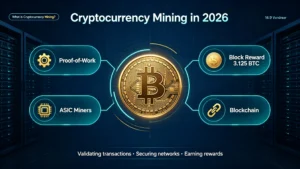
Bitcoin mining is the process by which new Bitcoin transactions are verified, added to the blockchain, and new BTC is issued into circulation. Miners compete to solve a complex cryptographic puzzle—called the Proof of Work (PoW) problem—using specialized computing hardware.
The first miner to find a valid solution broadcasts it to the network, earns the block reward (3.125 BTC) plus all transaction fees in that block, and the process repeats approximately every 10 minutes.
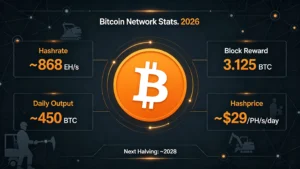
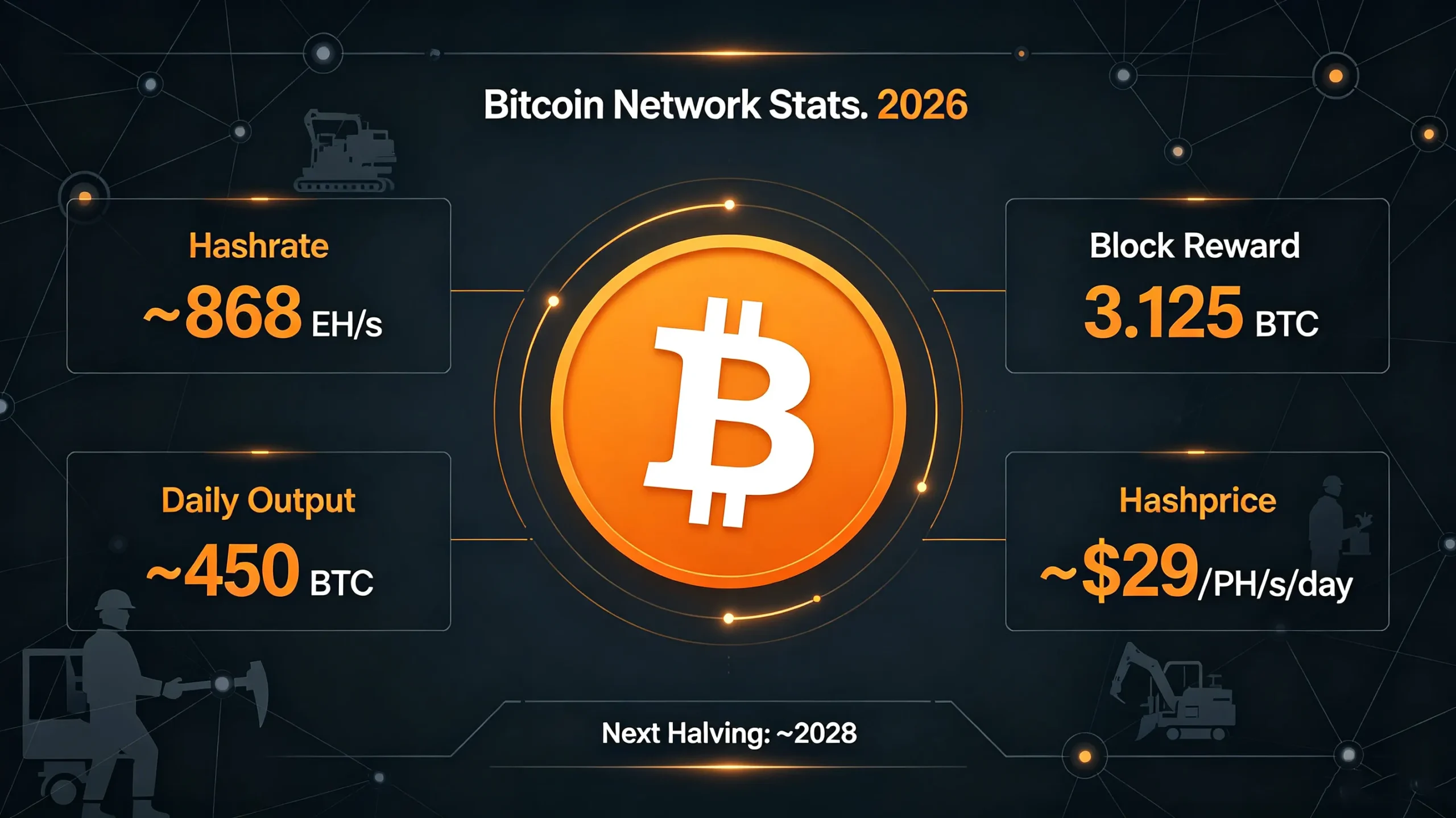
Current Network Stats (July 2026)
| Metric | Value |
|---|---|
| BTC Price | ~$59,000–$63,500 |
| Block Reward | 3.125 BTC |
| Network Difficulty | ~127 trillion |
| Network Hashrate | ~868 EH/s |
| Daily Blocks Mined | ~144 |
| Daily BTC Issued | ~450 BTC |
| Hashprice | ~$29/PH/s/day |
| Next Halving | ~April 2028 |
The network mines about 144 blocks per day, and each one pays a 3.125 BTC subsidy (fixed until the next halving in 2028) plus transaction fees.
Hashprice: The Most Important Metric You’ve Never Heard Of
Hashprice is the revenue generated per unit of computing power. In July 2026, it hovers around $29/PH/s/day. To put that in perspective: in 2020, hashprice was around $70/PH/s/day. This illustrates the enormous economic pressure now weighing on Bitcoin miners.
Mining Hardware in 2026: ASIC vs. GPU vs. CPU
The hardware you use determines everything—your hashrate, your electricity consumption, your upfront costs, and ultimately your profitability.
The Three Categories
ASIC (Application-Specific Integrated Circuit) : Specialized hardware built exclusively for Bitcoin’s SHA-256 algorithm. These are the only machines that can mine Bitcoin profitably in 2026.
- Bitcoin: Bitmain Antminer S19j XP (~151Th/s , 3,247W)
- Litecoin/Dogecoin: Bitmain Antminer L9 (~16 GH/s, 3,360W)
- Ethereum Classic: iPollo V2H (~3400 Mh/s, 475W)
- Dash: Antminer D9 (~1.7 TH/s, 2,836W)
- Zcash: Antminer Z15 Pro (~840 KSol/s, 2,780W)
GPU (Graphics Processing Unit) : High-end graphics cards designed for gaming and rendering. They can mine altcoins profitably but are completely uncompetitive for Bitcoin.
CPU (Central Processing Unit) : The general-purpose processor in your computer. Completely irrelevant for Bitcoin mining in 2026.
The Scale of the Gap
The difference between these categories is not a percentage difference. It is a difference of several orders of magnitude.
-
A high-end consumer CPU might do a few kilohashes per second
-
A top-tier consumer GPU like the RTX 4090 produces roughly 100 to 200 MH/s for SHA-256
-
One 2026 ASIC pushes through hundreds of terahashes per second
The gap between a CPU and an ASIC is roughly a hundred billion to one.
You would need thousands of GPUs to match a single warehouse row of S21 XPs, and the electricity bill would be catastrophic.
ASIC Mining: The Only Real Path
If you are serious about mining Bitcoin in 2026, you need an ASIC. There is no alternative.
Top Bitcoin ASIC Miners in 2026
| Model | Hashrate | Power | Efficiency | Cooling |
|---|---|---|---|---|
| Bitmain Antminer S23 Hydro | 580 TH/s | ~5,500W | 9.5 J/TH | Liquid |
| MicroBT WhatsMiner M63S | 390 TH/s | ~7,000W | ~18 J/TH | Hydro |
| Bitmain Antminer S21 XP | 270 TH/s | ~3,645W | 13.5 J/TH | Air |
| Bitmain Antminer S21 Pro | 234 TH/s | ~3,510W | 15 J/TH | Air |
| Canaan Avalon A15 | ~200 TH/s | ~4,000W | ~20 J/TH | Air |
Efficiencies under 20 J/TH have become the new benchmark for staying profitable in a post-halving environment.
The Efficiency Revolution
The Bitmain Antminer S23 Hydro is the first production machine to break the sub-10 J/TH barrier at 9.5 J/TH and 580 TH/s. The S21 XP is the proven workhorse at 13.5 J/TH, air-cooled.
Older machines like the Antminer S19 series were once the industry darlings, but the market reaction to lower rewards has seen a sharp pivot toward the S21 and T21 models, which offer the superior power-to-hash ratios required to survive current macro conditions.
The S19 Problem
The Antminer S19 XP runs at 21.5 J/TH—significantly less efficient than the S21 series. At current hashprice, S19-class machines need electricity below roughly $0.055/kWh to break even. That is at or below standard industrial rates. For a home miner paying $0.12/kWh, an S19 is a guaranteed money-loser.
Break-Even Electricity Rates
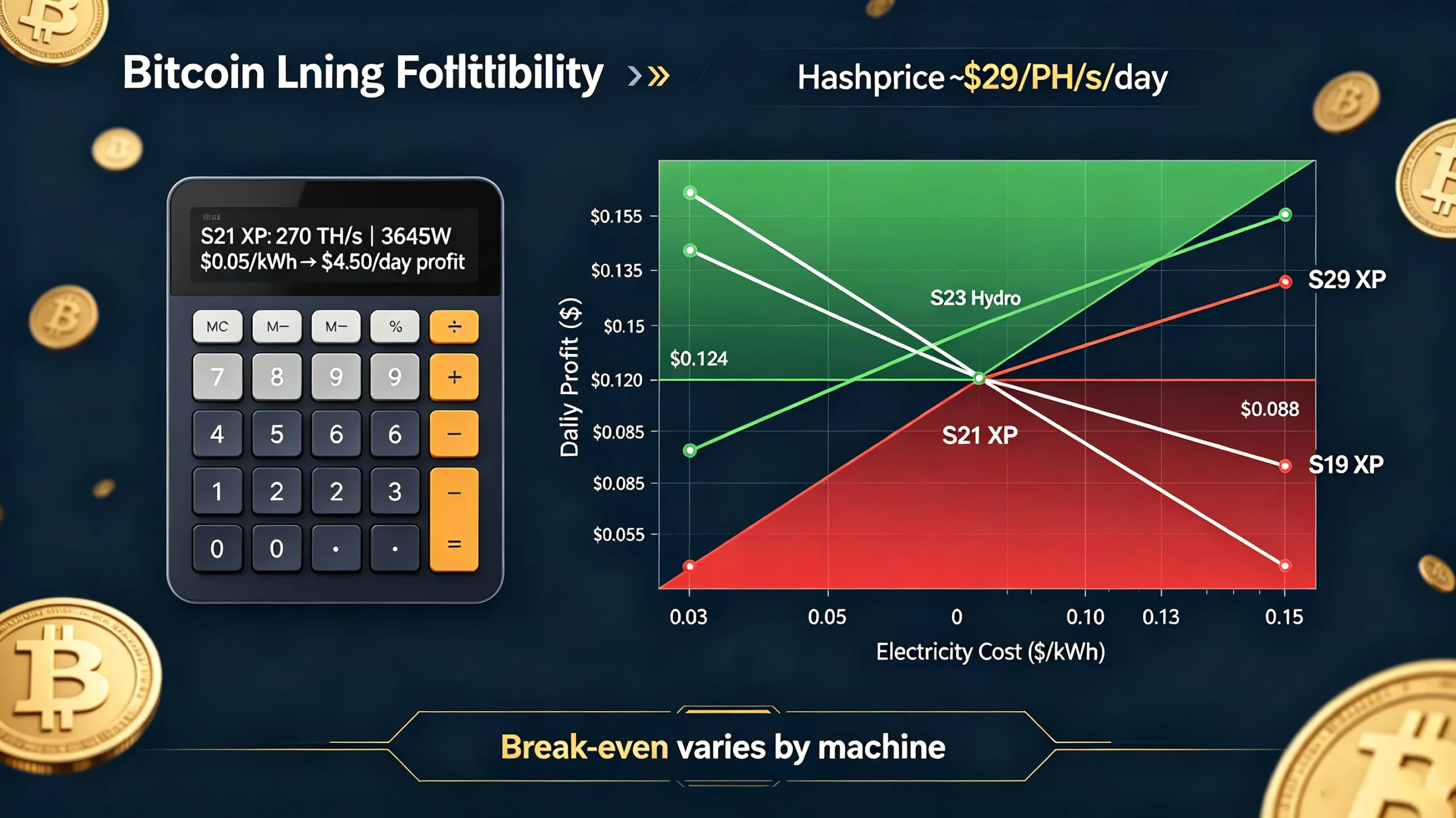
Different machines have different break-even electricity rates:
-
S23 Hydro: ~$0.124/kWh
-
S21 XP: ~$0.088/kWh
-
S21 Pro: ~$0.065–$0.08/kWh
-
S19 XP: ~$0.055/kWh
A new S21 XP at 5-cent power mines a coin for about $33,000. An older S19 XP at 9-cent power needs about $96,000. Same Bitcoin, nearly three times the cost.
What It Costs
A new Antminer S21 Pro retails for roughly $3,000–$4,500 depending on configuration and supplier. The S23 Hydro is significantly more expensive. Used S19 units can be found for much less—but there is a reason they are cheap.
The S21 Series Shutdown Price
The Antminer S21 series displays shutdown prices in a higher band, approximately $69,000–$74,000 per BTC. This means that if Bitcoin drops below that range, even S21 miners start losing money. The most resilient models currently include the U3S23H and S23 Hydro, which remain profitable even if Bitcoin falls to approximately $44,000.
GPU Mining: Technically Possible, Economically Pointless
You cannot mine Bitcoin profitably—or in any meaningful way—on a GPU in 2026. Bitcoin mining is dominated by ASICs purpose-built to compute the SHA-256 hash function and nothing else.
The Numbers
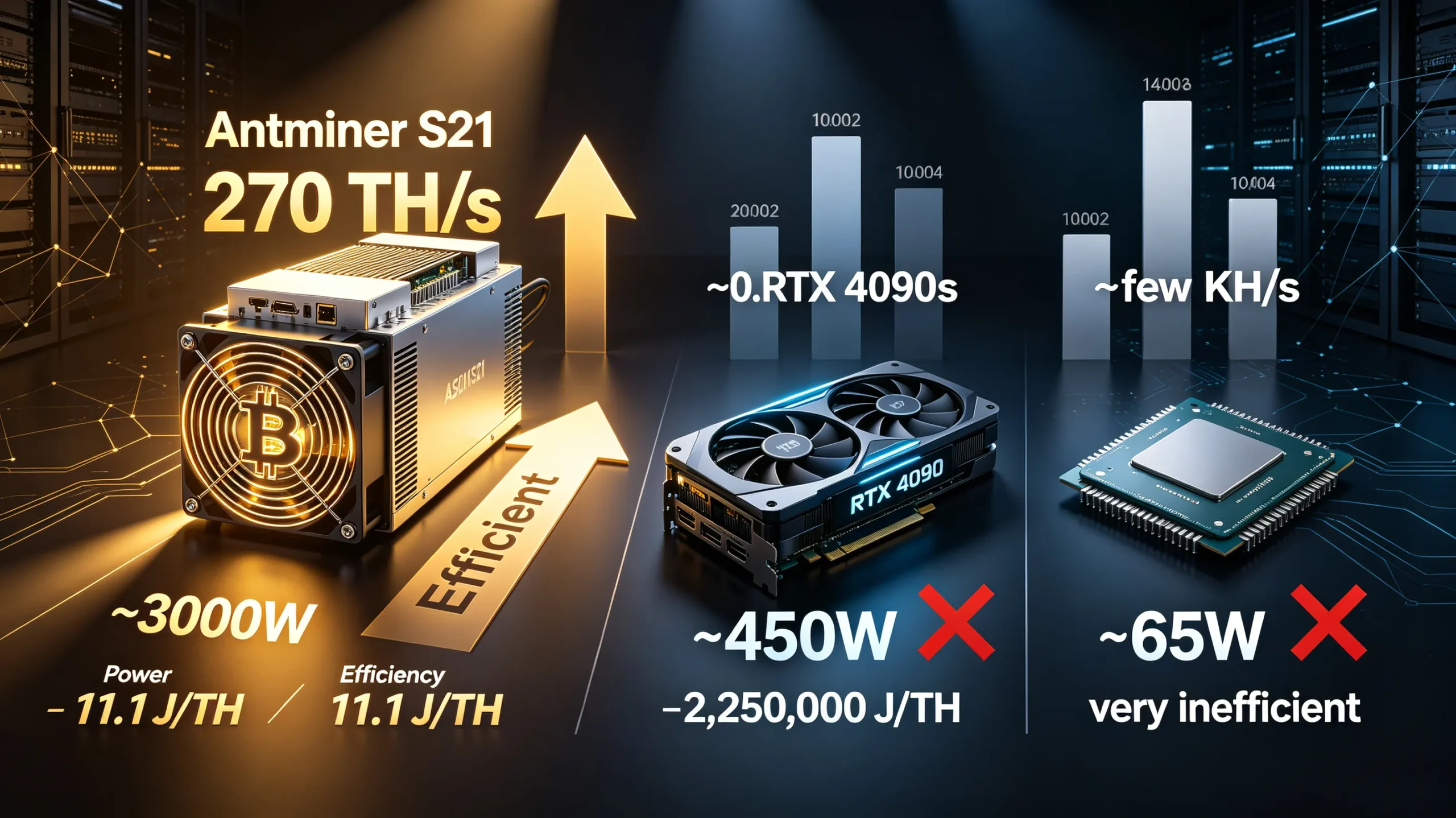
A top-tier consumer graphics card like the NVIDIA RTX 4090 produces roughly 100 to 200 MH/s when processing the SHA-256 algorithm. That is 0.0002 TH/s.
A modern Bitcoin ASIC like the S21 XP produces 270 TH/s.
The gap is approximately 1.35 million to one.
The Electricity Disaster
An RTX 4090 draws approximately 450W. At that power draw, even if it could produce 200 MH/s, the efficiency would be roughly 225,000 J/TH. By comparison, the S21 XP runs at 13.5 J/TH—more than 16,000 times more efficient.
The electricity cost alone would make GPU Bitcoin mining catastrophic. You would burn far more in electricity than you could ever earn in Bitcoin.
What GPUs Are Actually For?
GPUs are still viable for altcoins like Kaspa, Ergo, and Ravencoin. A typical 6-GPU rig with RTX 3070s might earn $3–6 daily after electricity at $0.10/kWh. An RTX 4090 mining a GPU-friendly algorithm can earn roughly $5.60 per day.
But for Bitcoin specifically, a GPU was never designed for SHA-256, so it burns a lot of electricity for almost no Bitcoin output.
CPU Mining: A Complete Waste of Time
CPU mining for Bitcoin is hopeless. A high-end consumer CPU might do a few kilohashes per second. One 2026 ASIC pushes through hundreds of terahashes. We are talking about a gap of roughly a hundred billion to one.
You could leave a brand-new gaming PC running on Bitcoin for years and earn less than the electricity cost of a single day.
While you can still participate in Bitcoin mining for educational or experimental reasons, profitable Bitcoin mining on a regular PC in 2026 is highly unlikely.
The Exception: Monero Coin
A few projects like Monero (XMR) use the RandomX algorithm specifically designed to keep CPU mining competitive by resisting ASIC and GPU optimization. If you want to mine with a CPU, mine Monero—not Bitcoin.
How to Calculate Mining Profitability?
The formula is simple:
Profit = Revenue – Electricity Cost – Pool Fees
But the variables are anything but simple.
The Inputs You Need
To calculate profitability, you need four numbers:
-
Hashrate (TH/s): How much computing power your machine provides
-
Power consumption (watts): How much electricity it draws
-
Electricity rate ($/kWh): What you pay for power
-
Pool fee (%): What the pool takes from your earnings
The Calculation
A Bitcoin mining calculator takes these inputs and estimates:
-
Revenue = hashrate share × daily block rewards × BTC price
-
Electricity cost = (power × 24 hours × electricity rate) / 1000
-
Profit = revenue – electricity cost – (revenue × pool fee)
A Real Example
An Antminer S23 at 318 TH/s, 3,498W, and 11 J/TH produces approximately $2.80 in daily net profit at current network conditions and $0.05/kWh electricity. At $0.10/kWh, the same machine produces roughly $0.50 per day. At $0.15/kWh, it loses money.
Where to Calculate
Use a Bitcoin mining calculator like:
-
ViaBTC ASIC Miner Profitability Calculator
-
MillionMiner Bitcoin Mining Calculator
Plug in your specific numbers. The output is a rough guide, not a guarantee.
Coin-by-Coin Profitability Breakdown
Bitcoin is not the only minable cryptocurrency. Here is how different coins compare in 2026.
Bitcoin (BTC)
-
Hardware: ASIC only (SHA-256)
-
Profitability: Profitable only with current-generation ASICs and electricity below $0.08/kWh
-
Block reward: 3.125 BTC
-
Hashprice: ~$29/PH/s/day
-
Best for: Large-scale operations, cheap power
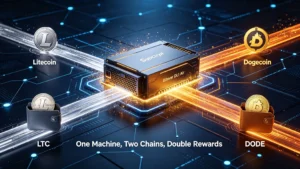
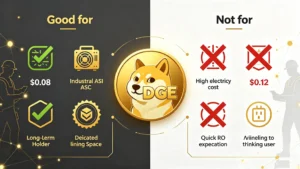
Litecoin (LTC) / Dogecoin (DOGE)
-
Hardware: ASIC only (Scrypt)
-
Profitability: Merged mining lets one machine earn both coins
-
Block reward: 6.25 LTC + ~10,000 DOGE
-
Best for: Miners with Scrypt ASICs, cheap power
Monero Coin(XMR)
-
Hardware: CPU (RandomX)
-
Profitability: Marginal for most home setups
-
Block reward: 0.6 XMR (tail emission, no halving)
-
Best for: Privacy advocates, hobbyists, cheap power
Kaspa (KAS)
-
Hardware: GPU-friendly, some ASICs emerging
-
Profitability: One of the better GPU options
-
Best for: GPU miners looking for alternatives
Ergo (ERG) / Ravencoin (RVN)
-
Hardware: GPU-friendly
-
Profitability: Moderate, depending on electricity costs
-
Best for: GPU miners who want to avoid ASIC-dominated coins
Wolver Inu
Recently, a new type of currency has emerged and has immediately gained popularity among many people. I do not have an opinion on whether this currency is good or bad. You miners can make your own judgment. Please read this article to learn about the specific information of Wolver Inu.
The Bottom Line
Bitcoin leads for revenue potential with efficient ASICs and sub-$0.05/kWh power. But for GPU miners, altcoins offer the only realistic path to profitability.
The Electricity Factor: Why It Decides Everything
Electricity cost is the single most influential factor in mining profitability. A miner runs around the clock, so electricity is its largest ongoing cost by far.
The $0.10/kWh Decision Threshold
The single most important number in home Bitcoin mining is your residential electricity rate.
If your rate is at or below $0.10 per kWh on current-generation efficient hardware, home mining is viable. If your rate is above $0.10 per kWh, home mining becomes increasingly marginal as the rate rises. At $0.15 per kWh or above, home mining on standard air-cooled ASIC hardware is essentially never profitable regardless of optimization.
The Real-World Impact
At typical US home rates (12 to 18 cents per kWh), even the most efficient air-cooled Bitcoin miner produces negative daily net profit. A miner in Phoenix at $0.142/kWh would pay approximately $11.93 per day in electricity to generate approximately $11.22 per day in Bitcoin revenue. She would lose money daily, forever.
The same hardware at a Pacific Northwest electricity rate of $0.08/kWh produces approximately $4.50 per day in net profit. Same machine. Different state. Profitable or unprofitable. The electricity rate is the only variable that matters at the deciding-to-start phase.
The Cost of Mining One Bitcoin
At 5-cent power, a new S21 XP mines a coin for about $33,000. At 9-cent power, an older S19 XP needs about $96,000. Same Bitcoin, nearly three times the cost.
Operations below $0.06/kWh are competitive; above $0.10/kWh is generally unprofitable with any current hardware.
The Only Way Home Mining Works
Home mining works only if your rate is unusually low, roughly under $0.10 per kWh, or you have free or heavily subsidized power such as surplus solar.
Home Mining in 2026: The Honest Reality
The picture most people have of Bitcoin mining—a metal frame holding a row of graphics cards in someone’s spare bedroom, fans roaring, electricity bill quietly climbing—is mostly history now.
The Five Operational Realities
Most home mining guides skip these realities:
1. Noise
Industrial ASICs run at 75 dB—equivalent to a vacuum cleaner or garbage disposal. Running one in a living space is not realistic.
2. Heat
A 3,500W miner produces approximately 12,000 BTU of heat per hour—enough to heat a small room in winter but unbearable in summer without dedicated ventilation.
3. Electrical Infrastructure
Current-generation miners draw 3 to 5 kilowatts continuously. At 220V, that is 14–23 amps—requiring a dedicated circuit. Most homes are not wired for this.
4. ROI Velocity
Even at $0.05/kWh, the break-even timeline on hardware takes years. At typical residential rates, you may never break even.
5. The Hosted Alternative
If the numbers do not work at home, hosted mining—where you colocate hardware in a professional facility with cheap electricity—may be the better play.
What Home Mining Actually Looks Like?
At typical US home rates, a modern miner loses money or barely breaks even. Home electricity costs two to four times what a mining facility pays.
A current-generation miner draws somewhere around 3 to 5 kilowatts continuously. Run that non-stop and it eats roughly 72 to 120 kilowatt-hours a day—on the order of what an entire average US household uses in a day, sometimes more. At the national average residential rate of about $0.18 per kWh, a single machine can add well over a hundred dollars a month to your bill in power alone.
The Home-Friendly Stuff
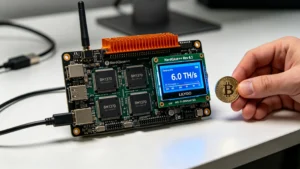
Small-scale hobby setups like low-power USB devices or compact miners exist, but they produce negligible hashrate. Monero on a CPU is the only realistic home mining option for most people.
Setting Up Your Bitcoin Miner
If you have decided to mine Bitcoin despite the challenges, here is how to set up.
What You Need Before You Start
-
A Bitcoin ASIC miner
-
A Bitcoin wallet address
-
A mining pool account
-
A 220V circuit (for most industrial ASICs)
-
Wired Ethernet
-
Adequate cooling and ventilation
Step 1: Get a Bitcoin Wallet
You need a wallet to receive your rewards. Options include:
-
Software wallets: Convenient for frequent access
-
Hardware wallets: Most secure for long-term storage
-
Exchange wallets: Less recommended for long-term storage
Step 2: Choose a Mining Pool
Solo mining is statistically equivalent to a lottery with near-zero odds. Almost nobody mines alone anymore.
Step 3: Set Up the Hardware
-
Connect the power supply to the miner
-
Connect the Ethernet cable
-
Find the miner’s IP address via your router’s admin interface
-
Open the web interface in your browser
-
Enter pool URL, wallet address, and worker name
-
Save and start mining
Step 4: Monitor Performance
Check the pool’s website to verify your worker is submitting shares. Monitor temperature and fan speeds. Watch for rejected shares (should be less than 1–2%).
Choosing a Mining Pool
A mining pool combines hashrate from many miners, so payouts come more regularly than they do with solo mining.
Top Bitcoin Mining Pools in 2026
The four largest Bitcoin mining pools control over 70% of the network’s hashrate:
| Pool | Hashrate Share |
|---|---|
| Foundry USA | ~31% |
| AntPool | ~18% |
| ViaBTC | ~13% |
| F2Pool | ~10% |
Other notable pools include Braiins Pool, Luxor, and OCEAN Pool.
How to Choose a Pool?
-
Foundry USA: Best suited to large mining farms
-
ViaBTC: Easiest beginner pick
-
Luxor: Stronger for professional operators
-
Braiins Pool and OCEAN Pool: Better for miners who care about decentralization and miner control
Pool Fee Structure
Most pools charge 1–3% of earnings. Payout methods vary:
-
FPPS (Full Pay-Per-Share): Most common, includes transaction fees
-
PPS (Pay-Per-Share): Fixed payment per share
-
PPLNS (Pay-Per-Last-N-Shares): Payment based on contributed shares over a rolling window
Always check live terms inside the pool account before you move hashrate.
Cloud Mining: A Lower-Barrier Alternative
Cloud mining offers a lower-barrier alternative to buying and running your own hardware. You rent hashrate from a provider instead of buying and maintaining physical miners.
The Problem
Most cloud mining contracts are unprofitable unless BTC price rises significantly. The provider takes a cut, electricity costs are baked in, and you have no control over the hardware.
What to Watch For
-
Contract length: Longer contracts lock you in
-
Hidden fees: Maintenance fees, withdrawal fees, etc.
-
Provider reputation: Many cloud mining services are scams
-
BTC price dependence: If BTC price drops, you lose money
The Bottom Line
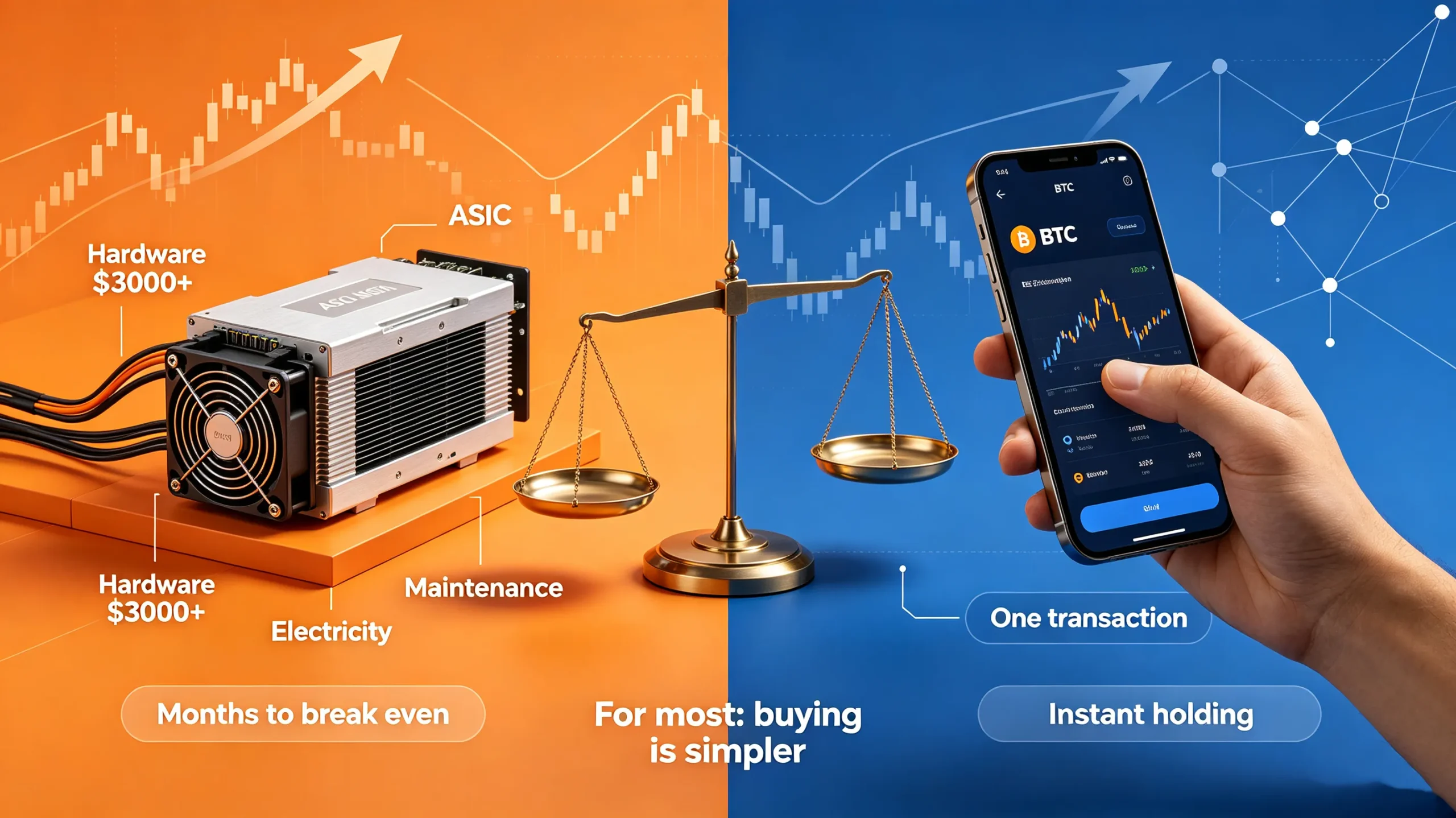
Cloud mining can work if you find a reputable provider and BTC price appreciates. But for most people, buying BTC directly on an exchange is simpler and more cost-effective.
Is Bitcoin Mining Still Worth It in 2026?
The honest answer depends entirely on your situation.
The Bull Case
Access to cheap electricity: If you have electricity below $0.05–$0.08/kWh, Bitcoin mining can be genuinely profitable.
Access to current-generation hardware: If you can source S21 series or S23 Hydro machines at reasonable prices.
Long-term conviction: If you believe Bitcoin’s price will appreciate significantly, mining allows you to accumulate BTC at a discount (if profitable).
The 2026 window: With difficulty adjustments creating periodic opportunities, some miners are still finding profitable windows.
The Bear Case
Most home miners lose money: At typical US residential rates, modern miners lose money.
High hardware costs: New ASICs cost thousands of dollars. Used ASICs are cheaper but less efficient.
Intense competition: The network hashrate near 868 EH/s means competition is fierce.
Halving pressure: The April 2024 halving cut rewards by 51%. The next halving in 2028 will cut them again.
Regulatory uncertainty: Mining faces increasing scrutiny in many jurisdictions.
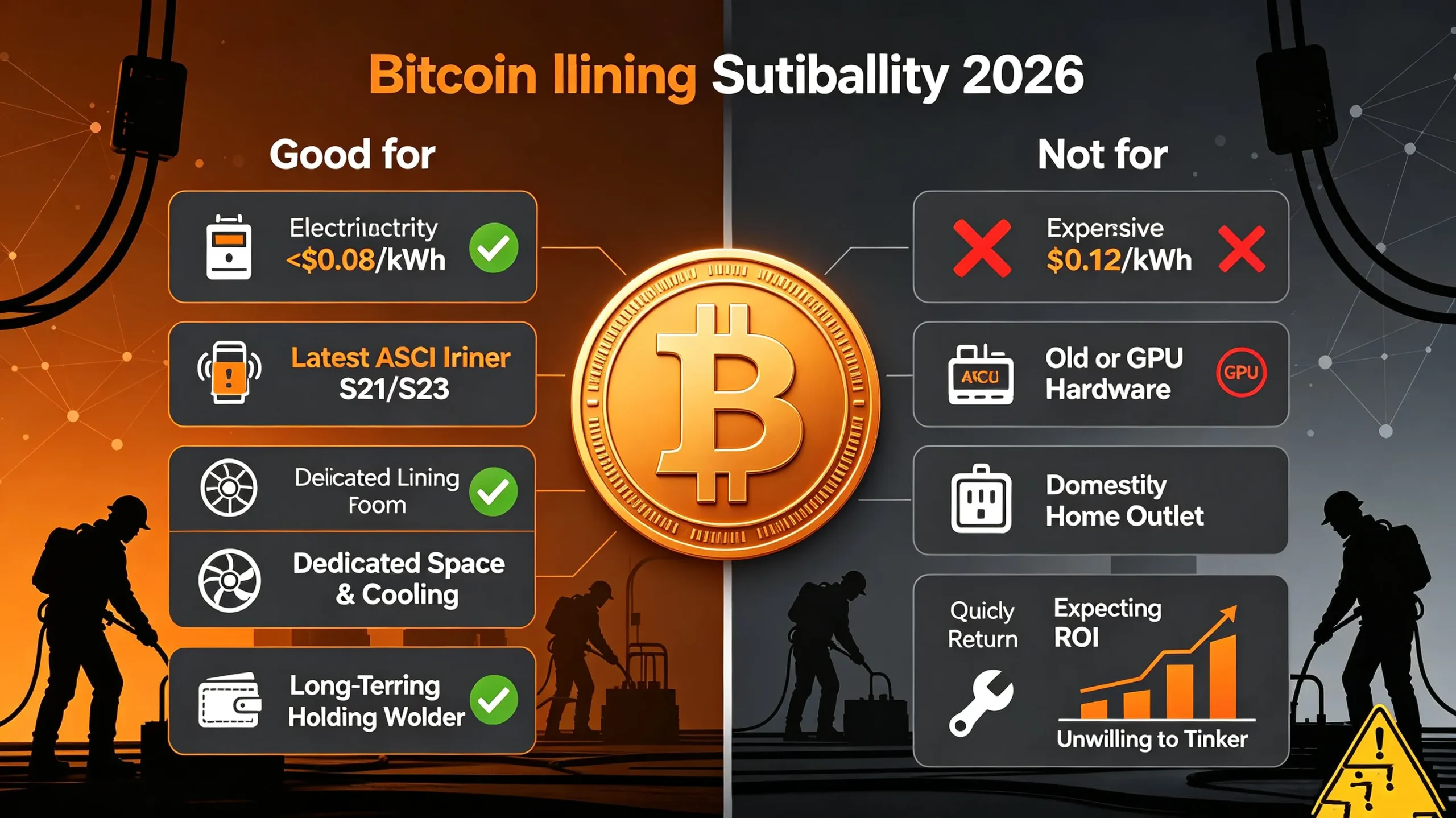
Who Should Mine Bitcoin?
Mine Bitcoin if you:
-
Have access to electricity below $0.05–$0.08/kWh
-
Can afford the hardware investment ($3,000+)
-
Have a dedicated space with proper cooling and electrical infrastructure
-
Understand that mining is a long-term commitment, not a get-rich-quick scheme
-
Are willing to deal with noise, heat, and maintenance
Don’t mine Bitcoin if you:
-
Have average or above-average residential electricity costs
-
Expect significant short-term profits
-
Aren’t willing to deal with setup, maintenance, and noise
-
Are looking for passive income with minimal effort
-
Can’t accommodate the electrical and cooling requirements
Final Verdict
Bitcoin mining in 2026 is not what it used to be. The days of mining BTC on a laptop are long gone. Today, it is a hardware and power-cost decision that requires serious capital, infrastructure, and risk tolerance.
The Bottom Line
For most people: No, you should not mine Bitcoin.
At typical residential electricity rates, you will lose money. The hardware is expensive, the noise and heat are significant, and the competition is relentless.
For a small minority: Yes, you can still mine Bitcoin profitably.
If you have access to electricity below $0.05–$0.08/kWh, can source current-generation hardware, and have the infrastructure to run it, Bitcoin mining can still be profitable. But you are competing against industrial-scale operations with economies of scale you cannot match.
What to Do Instead
If you want exposure to Bitcoin:
-
Buy Bitcoin directly on a reputable exchange
-
Consider mining altcoins like Monero (CPU) or Kaspa (GPU) if you already have the hardware
-
Explore cloud mining with extreme caution
-
Invest in mining stocks instead of running hardware yourself
The Honest Truth
Bitcoin mining in 2026 is slow, capital-intensive, and increasingly professionalized. It is not a hobby. It is not passive income. It is a business—and like any business, it requires a business plan, capital, and a competitive advantage.
If your competitive advantage is cheap electricity and efficient hardware, mining can work. If your competitive advantage is a spare bedroom and a gaming PC, it will not.
The question is not whether you can mine Bitcoin. The question is whether you should. For most people, the answer is no.
Frequently Asked Questions
Can I still mine Bitcoin in 2026?
Technically yes. Profitably, no—for most people. Bitcoin mining in 2026 requires an ASIC miner, electricity below $0.08/kWh, and membership in a mining pool.
Can I mine Bitcoin with a GPU in 2026?
No. You cannot mine Bitcoin profitably—or in any meaningful way—on a GPU in 2026. Bitcoin mining is dominated by ASICs purpose-built for SHA-256.
Can I mine Bitcoin with a CPU in 2026?
No. CPU mining for Bitcoin is hopeless. The gap between a CPU and an ASIC is roughly a hundred billion to one.
What is the best Bitcoin miner in 2026?
The Antminer S23 Hydro is the most efficient at 9.5 J/TH and 580 TH/s. The S21 XP is the proven air-cooled workhorse at 13.5 J/TH.
How much does a Bitcoin miner cost?
New ASICs range from roughly $3,000 to $6,000+ depending on model and configuration. Used S19 units can be found for much less.
Is Bitcoin mining profitable in 2026?
It depends on your electricity cost. At $0.05/kWh, most modern ASICs are profitable. At $0.08/kWh, margins are thin. At $0.10/kWh or above, home mining generally loses money.
What is hashprice?
Hashprice is the revenue generated per unit of computing power. In July 2026, it is approximately $29/PH/s/day.
What is the current Bitcoin network hashrate?
As of July 2026, the network hashrate is approximately 868 EH/s.
What is the current Bitcoin block reward?
3.125 BTC per block (post-April 2024 halving). The next halving is estimated for April 2028.
What is the best mining pool for beginners?
ViaBTC is the easiest beginner pick. Foundry USA is best for large farms.
Should I mine Bitcoin or buy it?
For most people, buying Bitcoin directly on an exchange is simpler and more cost-effective than mining. Mining only makes sense if you have access to very cheap electricity and current-generation hardware.