
Why Dogecoin Mining Still Matters in 2026
Dogecoin started as a joke. In 2013, software engineers Billy Markus and Jackson Palmer created a cryptocurrency featuring the Shiba Inu dog from the “Doge” meme as a satirical take on the crypto craze. It was never meant to be taken seriously. Yet more than a decade later, Dogecoin has become one of the most recognized and widely traded cryptocurrencies in the world.
As of 2026, Dogecoin maintains a market capitalization in the tens of billions of dollars, trades on every major exchange, and has a passionate community that refuses to let the joke die. But for miners, Dogecoin offers something far more practical than meme value: a fixed block reward of 10,000 DOGE that never halves.
Unlike Bitcoin, which cuts its block reward in half approximately every four years, Dogecoin removed its halving schedule back in 2015. Every block—mined roughly every 60 seconds—pays exactly 10,000 DOGE. That adds up to about 14.4 million fresh DOGE entering circulation every day. No supply cap. No halving. Just a steady, predictable stream of rewards.
But there is a catch. Dogecoin mining in 2026 is no longer something you can do on a spare laptop. The days of GPU mining are long gone. Specialized Scrypt ASIC miners now dominate the network, and any competitive Dogecoin miner runs one. The network hashrate runs near 2.7 PH/s, and margins now turn on a single number: the price of electricity.
This guide covers everything you need to know about Dogecoin mining in 2026: how Scrypt and merged mining work, which ASIC miners lead the market, how to calculate profitability, how to set up your miner, and whether DOGE mining still makes sense.
What Is Dogecoin Mining? Understanding the Basics
Dogecoin mining is the Scrypt proof-of-work process that confirms transactions and mints new DOGE. Miners use specialized computers to race to add a new block of transactions to the Dogecoin blockchain. Think of it as a lottery that runs every 60 seconds. Win the round, get 10,000 DOGE plus whatever transaction fees are in that block. Lose, your rig grabs the next ticket without complaining.
Under the hood, miners run a proof-of-work algorithm. Their hardware tries trillions of numeric guesses per second, shoves each input into the Scrypt hash function, and waits for one that lands below a moving target. Each miner also runs as a node, meaning it validates transactions while it hashes.
The Scrypt Algorithm
Dogecoin runs on the Scrypt hashing algorithm, the same one Litecoin uses. Scrypt is memory-intensive by design, which once let hobbyists mine on ordinary graphics cards. Those days ended years ago. Specialized Scrypt application-specific integrated circuit (ASIC) machines now dominate the network.
Scrypt was built in 2009 to be memory-hard—meaning the hashing process needs CPU time AND a lot of fast RAM per calculation. Back in 2014 that barrier made commodity GPUs a reasonable choice for Scrypt mining. By 2016 specialized ASIC miners arrived and wiped GPU profitability off the map. Today, CPU and GPU mining of Dogecoin is technically possible but economically pointless. Plug an RTX 4080 into DOGE and you will burn more electricity in a week than the coin produces in a year.
The Fixed Block Reward
The block reward sits at 10,000 DOGE and never halves. Dogecoin removed its reward schedule in 2015 and has paid a flat 10,000 DOGE per block ever since, with no supply cap. This gives miners predictable issuance—about 14.4 million DOGE daily and roughly 3.5% annual inflation that falls each year as the supply grows. Revenue risk in Dogecoin mining is almost entirely price risk, not protocol risk.
Scrypt Miner Merged Mining: The Two-for-One Secret
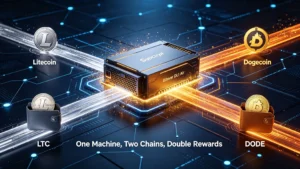
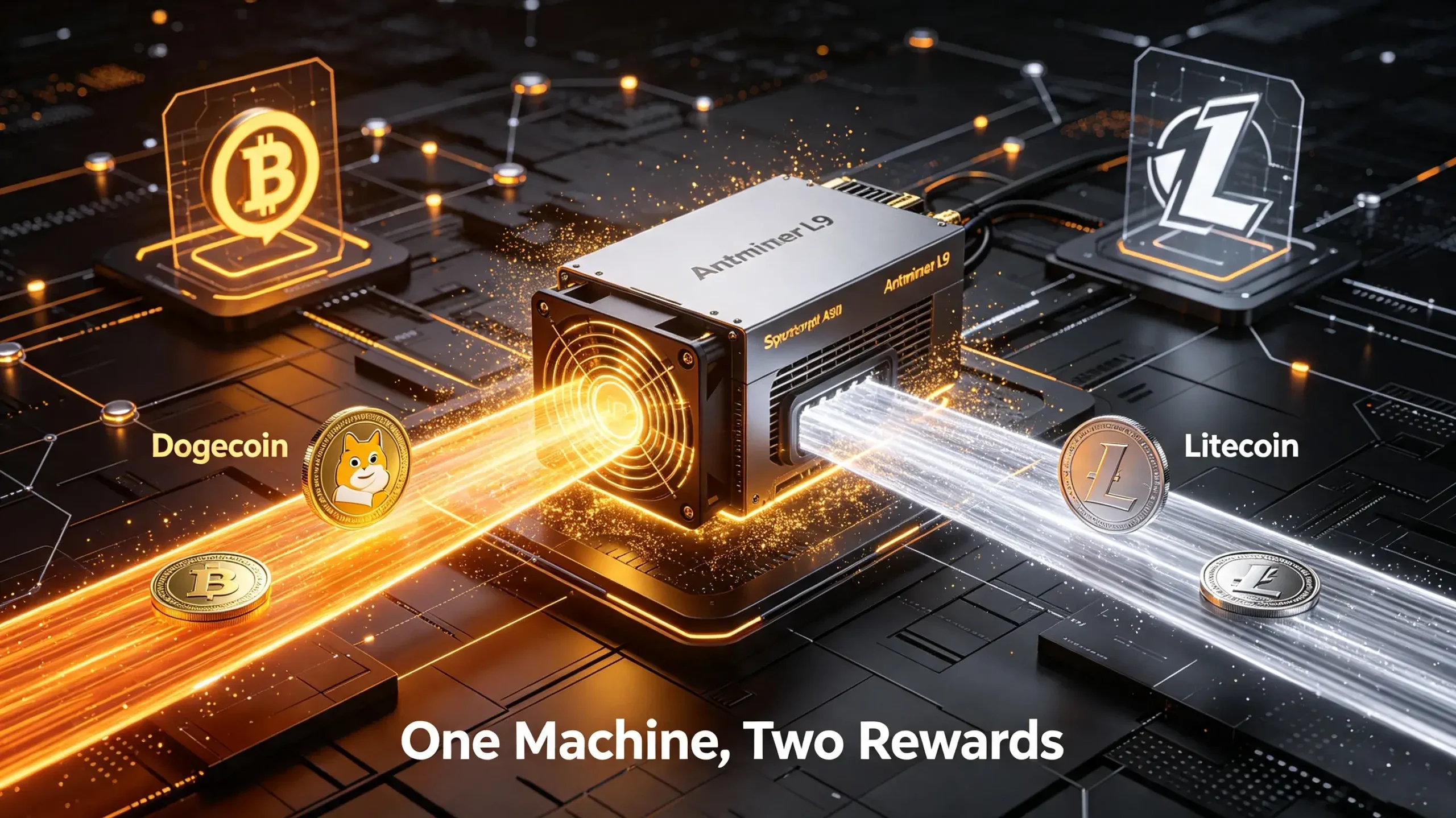
This is where Dogecoin mining gets interesting. Dogecoin was forked from Litecoin back in 2013, so both chains speak the same language: the Scrypt hashing algorithm. Since 2014, a protocol called Auxiliary Proof of Work (AuxPoW) has let them be mined together.
Your machine does one job, and that single proof-of-work is checked against both chains at the same time. The pool handles all of it. You point your miner at a merged-mining pool, set a Litecoin payout address and a Dogecoin payout address, and rewards from both chains flow in automatically. As one pool sums it up: “No extra power, no double work, just one effort with two rewards”.
That is why almost nobody mines Dogecoin on its own. Today the large majority of Dogecoin’s hashpower comes from Litecoin miners merge-mining the two. A single Scrypt ASIC pointed at the right pool earns both coins at once from the same electricity. One machine, two payouts.
Merged mining via AuxPoW lets one Scrypt ASIC earn both DOGE and Litecoin at once, with DOGE contributing approximately 35–45% of revenue. This dual-reward system is a major profitability driver for ASIC operators worldwide.
How to Calculate Dogecoin Mining Profitability?
Profitability is the most important question for any miner. The formula is simple:
Profit = Revenue – Electricity Cost – Pool Fees
But the variables are anything but simple.
The Key Variables
Hashrate: Measured in GH/s (gigahashes per second) for Scrypt mining. Higher hashrate means more chances to solve blocks.
Power Consumption: Measured in watts. This determines your electricity cost.
Efficiency: Measured in J/GH (joules per gigahash). Lower is better—it means less electricity spent per unit of work.
Electricity Cost: The single most influential factor in LTC/DOGE mining profitability. Miners pay rates anywhere from $0.03/kWh in low-cost industrial regions to over $0.15/kWh in standard commercial areas.
DOGE Price: Revenue is directly tied to DOGE’s market price.
Network Difficulty: As more miners join, difficulty increases, reducing the amount of DOGE earned per gigahash.
Pool Fees: Most pools charge 1–3% of earnings.
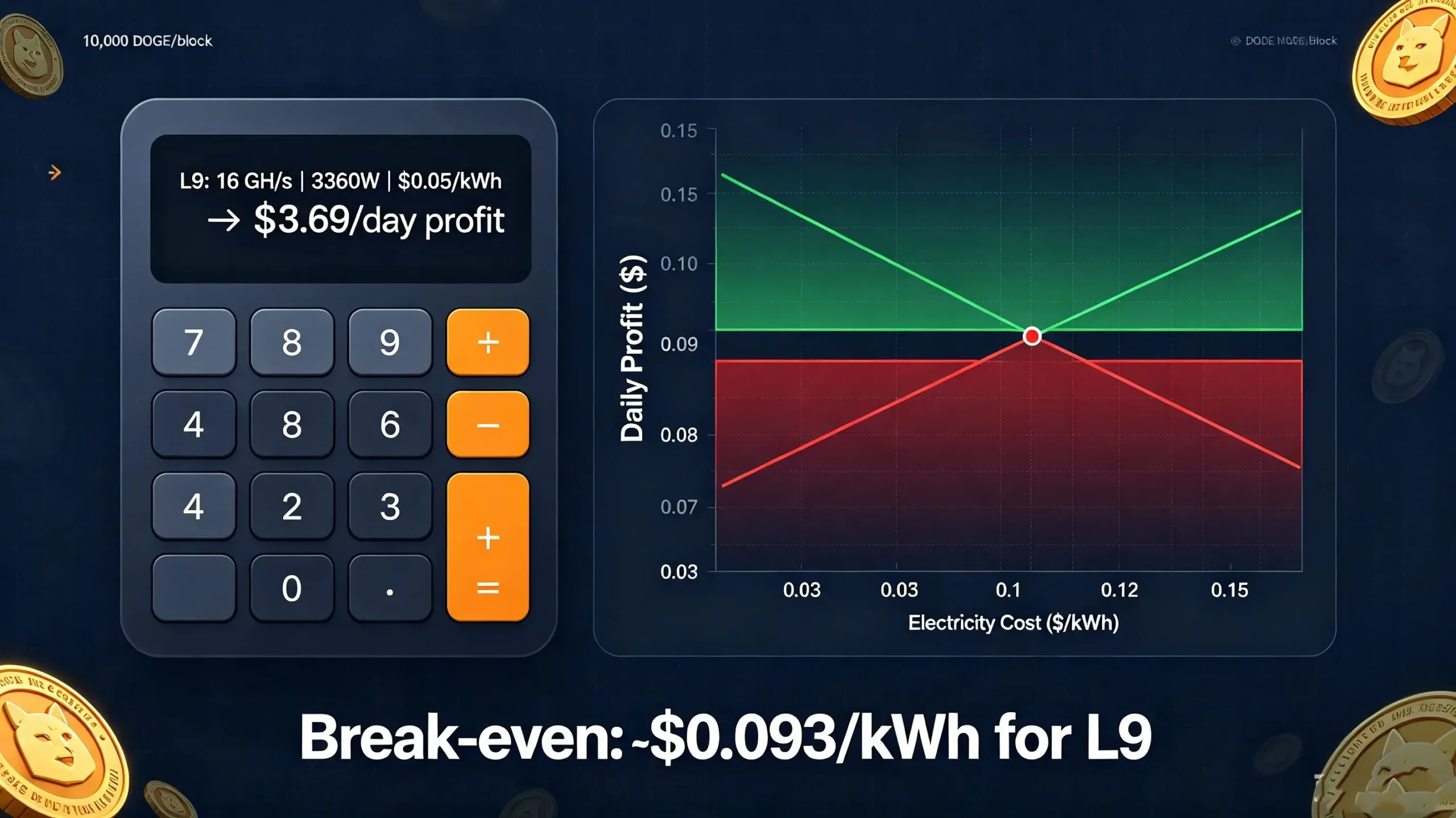
The Break-Even Calculation
At $0.05/kWh almost any modern ASIC is profitable; at $0.10 only the most efficient models survive; above $0.15 you need free power or top-tier hardware.
A single Bitmain Antminer L9 loses roughly $1.09 per day if you consume power at $0.10/kWh. Below $0.048/kWh the same rig makes money. The difference between two miners running identical hardware can be entirely explained by where they live and what they pay for power.
Using a Mining Calculator
The easiest way to calculate profitability is to use a Dogecoin mining calculator. Tools like WhatToMine, CoinWarz, and ValueHash let you enter your miner’s hashrate, power usage, energy cost, and the current price of DOGE to get an estimate.
Run those specs through the Dogecoin mining calculator at your electricity rate and use the output as a rough guide, not a guarantee.
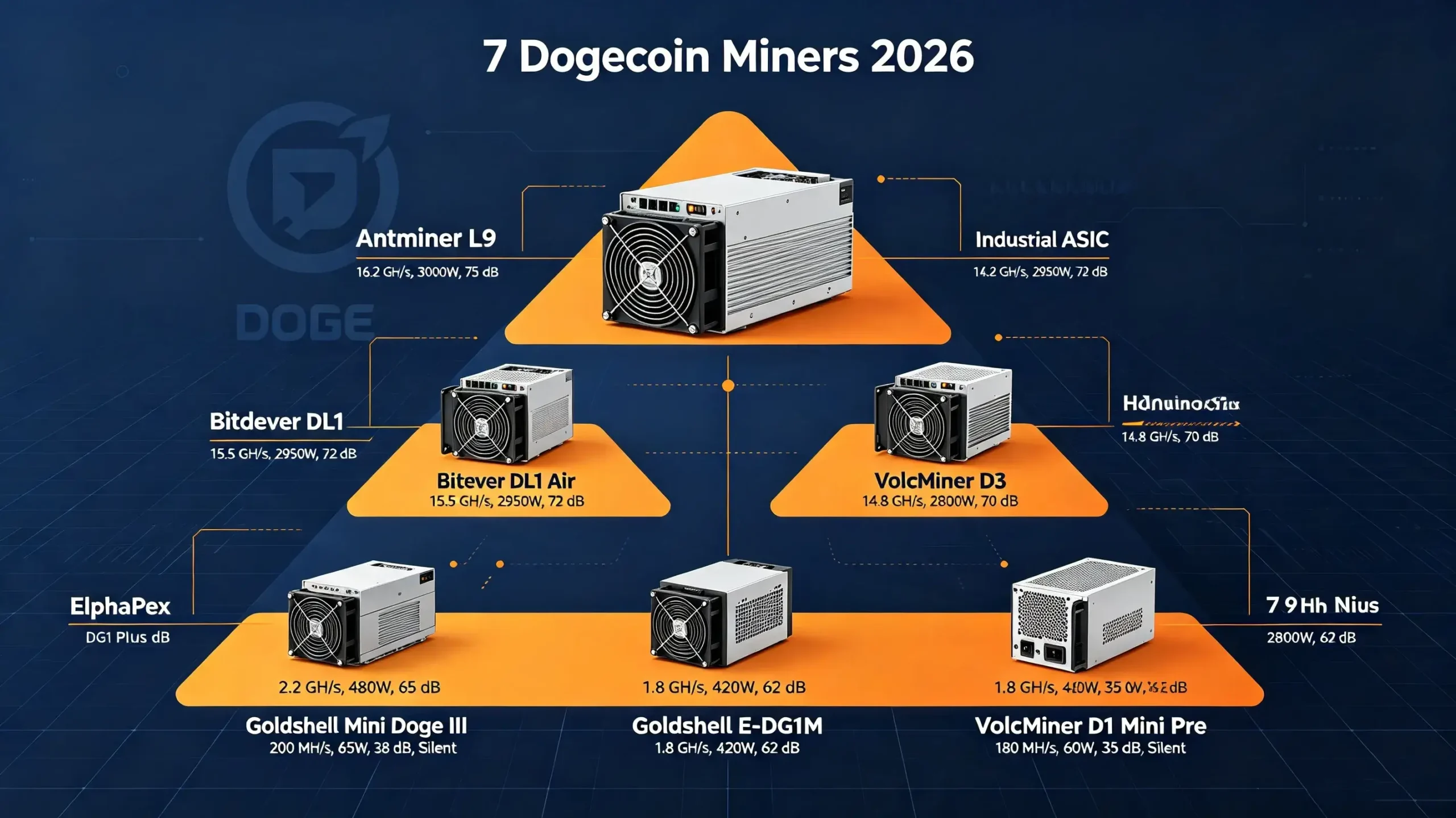
The Top 7 Dogecoin Miners of 2026
The Scrypt mining market in 2026 offers options ranging from industrial-scale powerhouses to quiet desktop devices. Here are the top seven Dogecoin miners you should know.
Bitmain Antminer L9 – The Industry Standard
The Antminer L9 is the most widely used Scrypt ASIC in 2026. More miners use this machine than any other Scrypt ASIC. If you want to mine Dogecoin and Litecoin at scale, this is the machine you buy.
Key Specifications
| Attribute | Details |
|---|---|
| Hashrate | 16–17 GH/s |
| Power Consumption | 3,360–3,570 W |
| Efficiency | ~210 J/GH |
| Noise Level | 75 dB |
| Voltage | 100–240V |
| Weight | 13.5 kg |
| Price | ~$4,490 |
Performance
The Antminer L9 is the most powerful Scrypt miner available today. It delivers 15 to 17 GH/s at roughly 0.21 J/MH, making it Bitmain’s most efficient Litecoin and Dogecoin miner. At 16 GH/s, it is the current sweet-spot air-cooled unit for operators running 1–10 units at hosted or sub-$0.10/kWh residential rates.
The L9’s hashrate is approximately 15–17 GH/s, compared to roughly 9.5 GH/s for the older Antminer L7. The efficiency improvement is also significant—the L7 runs at roughly 0.36 J/MH while the L9 achieves approximately 0.21 J/MH.
Profitability
At $0.05/kWh, an Antminer L9 produces approximately $3.4 in daily net profit. At $0.08/kWh, the daily profit drops to about $0.83. At $0.10/kWh, the same rig loses roughly $0.88 per day. At $0.12/kWh, it runs at a loss of approximately $2.6 per day.
The break-even electricity rate for the L9 is approximately $0.093/kWh. Below that, it makes money; above that, it loses money.
The data is sourced from asicminervalue.com.
Who It’s For
The Antminer L9 is for serious miners running 1–10 units in a dedicated mining space or hosted facility. It is not a home miner—75 dB of noise is roughly equivalent to a vacuum cleaner or garbage disposal. It requires a 20-amp circuit at 220V and professional-grade cooling.
Availability
The Antminer L9 17 GH/s air-cooled model is available with 5–7 day shipping. The L9 Hyd 2U (27 GH/s, water-cooled) is also available for operators who prefer liquid cooling.
Bitdeer SEALMINER DL1 Air – The Efficiency King
In March 2026, Bitdeer Technologies Group (NASDAQ: BTDR) announced the launch of the SEALMINER DL1 Air, the company’s first dedicated Scrypt hardware. It entered the market with a clear value proposition: unmatched efficiency.
Key Specifications
| Attribute | Details |
|---|---|
| Hashrate | 25 GH/s |
| Power Consumption | 3,725 W |
| Efficiency | 149 J/GH |
| Supported Coins | LTC, DOGE, BELLS, JKC, LKY, PEP |
| Dimensions | 197 × 365 × 292 mm |
| Weight | 15.5 kg |
Performance
The SEALMINER DL1 Air delivers 25 GH/s with an industry-leading efficiency of 149 J/GH. This makes it approximately 30% more efficient per gigahash than the Antminer L9.
The DL1 Air features three distinct operating modes:
-
Normal Mode: Standard performance
-
High Hashrate Mode: Maximum output
-
Low Power Mode: 20.5 GH/s at 136 J/GH—even better efficiency
The unit inherits Bitdeer’s validated SEALMINER Air Cooling architecture, featuring compact dimensions for ease of maintenance and high-density deployment.
The DL1 Hydro
For industrial-scale operations, Bitdeer also launched the SEALMINER DL1 Hydro, delivering 52.5 GH/s at 7,823 W with the same 149 J/GH efficiency. This is the highest-hashrate Scrypt miner available in 2026.
Who It’s For
The DL1 Air is for serious miners who prioritize efficiency above all else. At 25 GH/s and 149 J/GH, it is the most efficient Scrypt miner on the market. It competes directly with the Antminer L9, offering higher hashrate and better efficiency at a higher price point. The DL1 Hydro is for industrial-scale operations with liquid cooling infrastructure.
The Efficiency Advantage
A miner at 149 J/GH does the same work as one at 210 J/GH for roughly 30% less power. Over a year of 24/7 operation, that efficiency gap translates into thousands of dollars in electricity savings.
VolcMiner D3 – The High-Output Contender
The VolcMiner D3 is a high-performance ASIC miner built for the Scrypt algorithm, specifically optimized for Dogecoin and Litecoin mining. Launched in January 2026, it delivers impressive output at competitive efficiency.
Key Specifications
| Attribute | Details |
|---|---|
| Hashrate | 20 GH/s |
| Power Consumption | 3,580 W |
| Efficiency | 179 J/GH (0.179 J/MH) |
| Noise Level | 75 dB |
| Dimensions | 384 × 217 × 316 mm |
| Weight | 22 kg |
Performance
The VolcMiner D3 delivers 20 GH/s of Scrypt hashrate at 3,580 W, achieving an efficiency of 0.179 J/MH. This places it between the Antminer L9 (16–17 GH/s at ~210 J/GH) and the Bitdeer DL1 Air (25 GH/s at 149 J/GH) in both performance and efficiency.
The D3 features dual-fan cooling and Ethernet connectivity, engineered for stable 24/7 performance in large mining farms.
Who It’s For
The VolcMiner D3 is for miners who want higher hashrate than the L9 at a competitive price point. At 20 GH/s, it outperforms the L9 by approximately 20% while using roughly the same power. The efficiency (179 J/GH) is better than the L9 (210 J/GH) but worse than the DL1 Air (149 J/GH).
ElphaPex DG1+ – The Budget Industrial Option
ElphaPex has emerged as a serious competitor in the Scrypt ASIC market. The DG1 Plus sits at 14 GH/s as the mid-range industrial offering, splitting the gap between the DG1 at 11 GH/s and the DG2 at 16 GH/s.
Key Specifications
| Attribute | Details |
|---|---|
| Hashrate | 14 GH/s |
| Power Consumption | 3,950 W |
| Efficiency | 282 J/GH |
| Noise Level | 75 dB |
| Voltage | 200–240V |
| Weight | 18.3 kg |
| Price | ~$2,799 |
Performance
The DG1 Plus delivers 14 GH/s at 3,950 W. What makes this noteworthy is the direct comparison with VolcMiner: the D1 Lite also produces 14 GH/s but at 4,150 W. ElphaPex delivers the same hashrate at 200 W less power.
At 220V, the DG1 Plus draws about 18 amps on a dedicated 20-amp circuit. No 110V compatibility. 75 dB industrial noise.
The DG1 Plus supports merged mining for Litecoin, Dogecoin, and Bellscoin from the same 14 GH/s.
Profitability
At $0.05/kWh, the DG1 Plus produces approximately $2.76 in daily net profit. At $0.08/kWh, profitability drops significantly.
Who It’s For
The DG1 Plus is for operators looking for a budget-friendly entry into industrial Scrypt mining. At $1500、, it costs significantly less than the L9 ($4,490) while delivering 14 GH/s of hashrate. If it costs less per gigahash than the L9 or VolcMiner, fleet economics can favor it.
Goldshell Mini Doge III – The Quiet Home Miner
Goldshell is best known for compact, quiet miners that sit on desks. The Mini Doge III is the flagship of this lineup—a tiny Scrypt ASIC that runs at 35 dB and fits in the palm of your hand.
Key Specifications
| Attribute | Details |
|---|---|
| Hashrate | ~400–420 MH/s |
| Power Consumption | ~400 W |
| Noise Level | ~35 dB |
| Voltage | 100–240V |
Performance
The Mini Doge III is not a high-output machine—400 MH/s is 0.4 GH/s, a fraction of the L9’s 16,000 MH/s. But that is not the point. The Mini Doge III is designed for home use. It is quiet enough to run in a living room, draws standard household power, and produces minimal heat.
The Mini Doge III supports merged mining for Litecoin, Dogecoin, Bellscoin, Pepecoin, Luckycoin, and Junkcoin all at once.
Profitability
The Mini Doge III will not make you rich. At 400 MH/s, daily earnings are measured in cents, not dollars. But the electricity cost is also minimal—approximately $1 per day at average US rates. For hobbyists, it is a fun way to participate in the network without the noise, heat, and power requirements of industrial hardware.
Who It’s For
The Mini Doge III is for home miners who value quiet, compact hardware over raw hashrate. It is ideal for:
-
Learning about mining without a major investment
-
Running in an apartment or office
-
Supporting the Dogecoin network as a hobby
Goldshell E-DG1M – The Mid-Range Compromise
The Goldshell E-DG1M sits in the middle of the Scrypt mining market—more powerful than the Mini Doge but less demanding than industrial ASICs.
Key Specifications
| Attribute | Details |
|---|---|
| Hashrate | 3.4 GH/s |
| Power Consumption | 1,800 W |
| Efficiency | 529 J/GH |
| Noise Level | 50 dB |
| Voltage | 100–240V |
| Weight | 16 kg |
Performance
The E-DG1M delivers 3.4 GH/s at 1,800 W. At 50 dB, it is quieter than industrial ASICs (75 dB) but louder than the Mini Doge (35 dB). It supports 100–240V, making it compatible with standard household outlets.
Profitability
The E-DG1M is not profitable at most residential electricity rates. At $0.05/kWh, it loses approximately $0.66 per day. The break-even rate is approximately $0.035/kWh. This means it is only profitable in regions with extremely cheap electricity or in hosted facilities.
Who It’s For
The E-DG1M is for home or small-office miners where noise and power are more important than pure output. At 3.4 GH/s, it offers a middle ground between the quiet Mini Doge and the industrial L9.
VolcMiner D1 Mini Pre – The True Home Scrypt Miner
The VolcMiner D1 Mini Pre is one of the best true home Scrypt miners in 2026. It delivers 2.2 GH/s at just 500 W, making it far more efficient than the Goldshell E-DG1M and significantly quieter.
Key Specifications
| Attribute | Details |
|---|---|
| Hashrate | 2.2 GH/s |
| Power Consumption | 500 W |
| Noise Level | 45 dB |
| Voltage | Standard household |
Performance
The D1 Mini Pre runs at 45 dB—quieter than a normal conversation—and draws only 500 W. It is described as the best choice between mini box miners and professional hardware. At 2.2 GH/s, it outperforms the Mini Doge III (0.4 GH/s) while remaining quiet enough for home use.
Profitability
The D1 Mini Pre’s low power consumption (500 W) means it can be profitable even at residential electricity rates, unlike the E-DG1M which requires extremely cheap power.
Who It’s For
The D1 Mini Pre is for home miners who want real hashrate without industrial noise and power requirements. It is the sweet spot between the toy-like Mini Doge and the professional industrial ASICs.
Side-by-Side Comparison Table
| Miner | Hashrate | Power | Efficiency | Noise | Price (est.) | Best For |
|---|---|---|---|---|---|---|
| Bitmain Antminer L9 | 16–17 GH/s | 3,360–3,570W | ~210 J/GH | 75 dB | ~$4000 | Industrial mining, 1–10 units |
| Bitdeer DL1 Air | 25 GH/s | 3,725W | 149 J/GH | ~75 dB | Higher | Efficiency-focused industrial |
| VolcMiner D3 | 20 GH/s | 3,580W | 179 J/GH | 75 dB | Mid | High-output industrial |
| ElphaPex DG1 Plus | 14 GH/s | 3,950W | 282 J/GH | 75 dB | ~$1500 | Budget industrial |
| Goldshell Mini Doge III | ~0.4 GH/s | ~400W | ~1,000 J/GH | ~35 dB | Low | Quiet home mining, hobbyists |
| Goldshell E-DG1M | 3.4 GH/s | 1,800W | 529 J/GH | 50 dB | Mid | Home/small office |
| VolcMiner D1 Mini Pre | 2.2 GH/s | 500W | 227 J/GH | 45 dB | Mid | True home mining |
How to Set Up Your Dogecoin Miner?
Setting up a Dogecoin miner in 2026 is straightforward. Here is a step-by-step guide.
What You Need Before You Start
Before the machine arrives, get these things lined up:
-
A Scrypt ASIC miner
-
A Dogecoin wallet address (and a Litecoin address for merged mining)
-
A merged-mining pool account
-
A 220V circuit for industrial miners (or 110V for home miners)
-
Wired Ethernet
-
Adequate cooling and ventilation
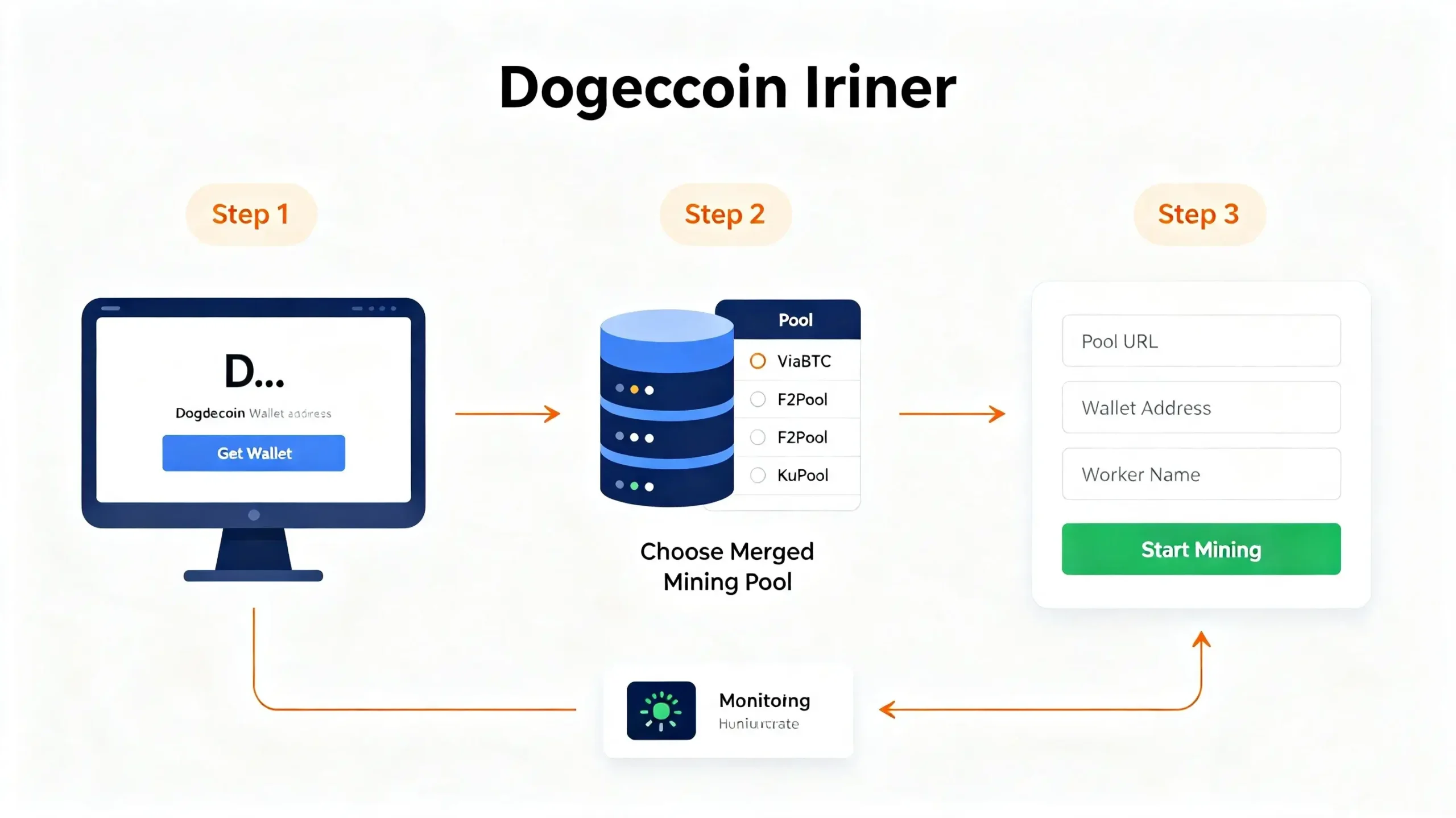
Step 1: Get a Dogecoin Wallet
You need a wallet to receive your rewards. Options include:
-
Software wallets (apps): Convenient for frequent access
-
Hardware wallets (most secure): Best for long-term storage
-
Exchange wallets: Less recommended for long-term storage
For merged mining, you also need a Litecoin wallet address.
Step 2: Choose a Mining Pool
Mining solo is extremely difficult today. Pools increase your chances of earning consistent rewards. Choose a pool that supports merged mining for both LTC and DOGE.
NiceHash is currently the largest hash power platform in the world, connecting the buyers and sellers of hash power, or miners.
NiceHash is not a mining pool because it does not utilize the miners’ computing power to support the operation of a specific blockchain. Instead, it forwards the computing power to the buyer’s designated mining pool. The most significant difference between NiceHash and mining pools is that miners receive returns directly from the buyer of computing power, rather than earning mining rewards from the overall rewards of the mining pool.
Step 3: Install Mining Software
Mining software connects your hardware to the blockchain or mining pool. Popular options include CGMiner, EasyMiner, and MultiMiner. For ASIC miners, the software is often built into the miner’s web interface.
Step 4: Configure Your Miner
Here is the quick setup process for most ASIC miners:
-
Connect the power supply to the miner and plug it into the outlet
-
Connect the Ethernet cable to your router or switch
-
Find the miner’s IP address via your router’s admin interface or an IP scanner tool
-
Open the web interface by entering the IP address in your browser
-
Enter the pool URL, wallet address, and worker name in the configuration page
-
Save and start mining
Step 5: Monitor Your Performance
Check the pool’s website to verify your worker is submitting shares. Monitor temperature and fan speeds. Watch for rejected shares (should be less than 1–2%).
Choosing a Mining Pool
The pool you choose affects your earnings, payout frequency, and overall mining experience.
Top Dogecoin Mining Pools in 2026
ViaBTC: One of the world’s top mining pools, serving over 1 million users across 150+ countries. Supports merged mining for LTC and DOGE.
F2Pool: The world’s leading mining pool, serving miners in more than 100 countries. Supports Bitcoin, Ethereum, Litecoin, Dogecoin, and about 40 other cryptos.
KuPool: Crypto exchange KuCoin rolled out a new mining pool service in 2026 with support for DOGE, LTC, and merged mining assets.
LitecoinPool: A dedicated Scrypt mining pool.
Pool Selection Criteria
-
Fee: Most pools charge 1–3%
-
Payout frequency: Daily, weekly, or per-block
-
Minimum payout: Lower is better for small miners
-
Reliability: Uptime and stability
-
Merged mining support: Essential for earning both LTC and DOGE
Payout Methods
Most pools offer different payment methods:
-
PPS (Pay-Per-Share): Fixed payment per share
-
PPLNS (Pay-Per-Last-N-Shares): Payment based on contributed shares over a rolling window
Is Dogecoin Mining Still Profitable in 2026?
The honest answer: it depends entirely on your electricity cost.
The Profitability Threshold
At $0.05/kWh almost any modern ASIC is profitable. At $0.08/kWh, an Antminer L9 nets about $2.71 a day. At $0.10/kWh, the same rig loses roughly $1.09 per day. Above $0.15 you need free power or top-tier hardware.
The break-even point for most modern Scrypt ASICs is somewhere between $0.05 and $0.10/kWh, depending on the machine’s efficiency.
The Merged Mining Advantage
Merged mining with Litecoin adds significant value. A single Scrypt ASIC earns both DOGE and Litecoin at once, with DOGE contributing 35–45% of revenue. This dual-reward system makes Scrypt mining more profitable than mining either coin alone.
The Reality for Home Miners
For most home miners with average electricity costs ($0.12–$0.15/kWh), Dogecoin mining is not profitable. The electricity cost exceeds the value of the coins mined. As one guide puts it: “Home mining is marginal”.
For miners with access to cheap electricity (below $0.08/kWh) and efficient hardware, Dogecoin mining can be profitable. But the margins are thin, and the hardware investment is significant.
The Long-Term View
Dogecoin mining in 2026 is no longer a hobby you can run on a spare laptop. It is a specialized, hardware-driven industry. However, with the right setup, access to cheap electricity, and a long-term mindset, it can still be a viable way to accumulate DOGE.
Key Risks of Dogecoin Mining
Before investing in Dogecoin mining hardware, understand these significant risks.
1. Electricity Cost Risk
Electricity cost is the single most influential factor in profitability. A rise in electricity prices can turn a profitable operation into a loss-making one overnight.
2. DOGE Price Volatility
DOGE has experienced significant price volatility. In 2026, DOGE has booked a 39% retreat as interest in meme coins has waned. A drop in DOGE price directly reduces revenue.
3. Network Difficulty Increases
As more miners join the network, difficulty increases, reducing each miner’s share of the rewards. If more miners deploy powerful units, network difficulty is likely to continue surging.
4. Hardware Obsolescence
ASIC miners have a limited lifespan. Newer, more efficient models can make older hardware unprofitable. The L9 replaced the L7; the next generation will eventually replace the L9.
5. Regulatory Risk
Cryptocurrency mining faces increasing regulatory scrutiny in many jurisdictions. Changes in regulations could impact profitability or legality.
6. Infrastructure Requirements
Industrial ASICs require 220V circuits, 20-amp breakers, and professional-grade cooling. Not every home or facility can accommodate these requirements.
7. Noise and Heat
Industrial ASICs run at 75 dB—equivalent to a vacuum cleaner—and produce significant heat. They are not suitable for living spaces.
Final Verdict: Should You Mine Dogecoin in 2026?
Dogecoin mining in 2026 is a specialized, hardware-driven industry. It is not the casual hobby it once was. But for the right person with the right circumstances, it can still be worthwhile.
The Case for Mining Dogecoin
Merged Mining Advantage: One machine earns both DOGE and LTC from the same electricity. This dual-reward system makes Scrypt mining more attractive than mining either coin alone.
Fixed Block Reward: Dogecoin’s 10,000 DOGE block reward never halves. No halving risk, no supply cap uncertainty.
Established Market: Dogecoin is one of the most recognized cryptocurrencies in the world, with deep liquidity and a passionate community.
Hardware Options: From quiet home miners to industrial powerhouses, there is a Dogecoin miner for every budget and setting.
The Case Against Mining Dogecoin
Marginal Profitability: For most home miners with average electricity costs, Dogecoin mining is not profitable. The margins are thin and shrinking.
High Hardware Costs: Industrial ASICs cost thousands of dollars. Home miners cost less but produce minimal returns.
Infrastructure Requirements: Industrial miners require 220V circuits and professional cooling. Not suitable for most homes.
Price Volatility: DOGE has retreated 39% in 2026. Price drops directly reduce revenue.
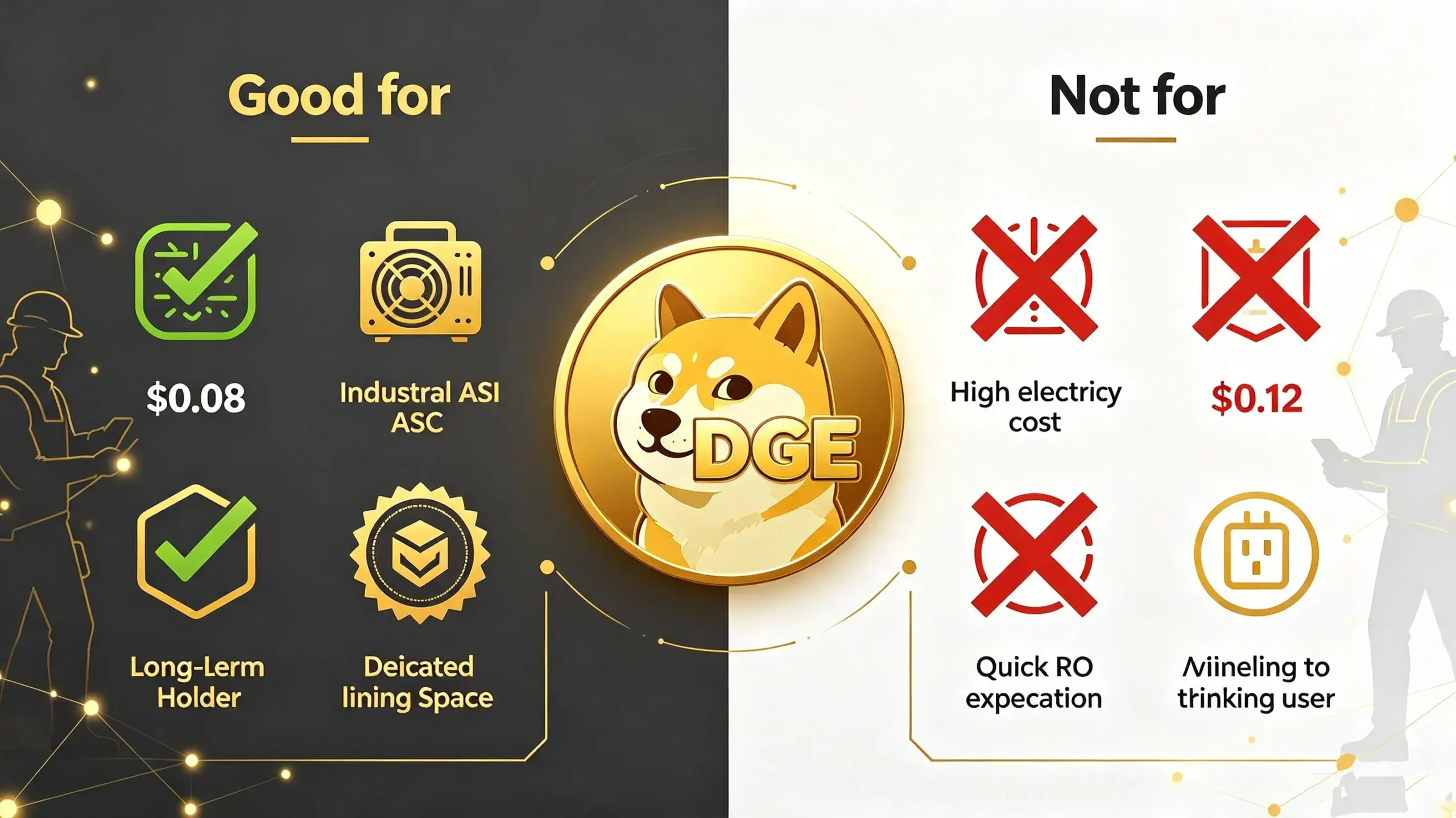
The Verdict
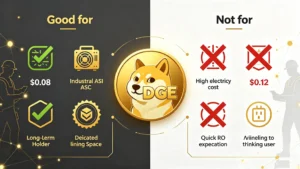
Mine Dogecoin if you:
-
Have access to electricity below $0.08/kWh
-
Can afford the hardware investment
-
Have a dedicated space with proper cooling and ventilation
-
Understand that mining is a long-term commitment, not a get-rich-quick scheme
-
Want to support the Dogecoin network and accumulate DOGE over time
Don’t mine Dogecoin if you:
-
Have average or above-average electricity costs
-
Expect significant short-term profits
-
Aren’t willing to deal with setup, maintenance, and noise
-
Are looking for passive income with minimal effort
The Bottom Line
Dogecoin mining in 2026 is not what it used to be. The days of mining DOGE on a laptop are long gone. Today, it is a hardware and power-cost decision.
For miners with cheap electricity and efficient hardware, Dogecoin mining offers a legitimate way to accumulate DOGE and LTC through merged mining. For everyone else, it is a hobby at best—and a money-losing proposition at worst.
If you are considering Dogecoin mining, start with a mining calculator. Plug in your hashrate, power consumption, electricity rate, and pool fee. Use the output as a rough guide. If the numbers work at your electricity rate, the hardware might be worth the investment. If they don’t, you are better off buying DOGE directly on an exchange.
Dogecoin started as a joke. But mining it in 2026 is serious business.