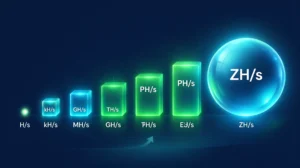
Hash rate is the speed at which a mining device performs hash calculations. It is measured in hashes per second (H/s) and its multiples, such as TH/s and EH/s. In Proof-of-Work mining, a higher hash rate gives a miner more chances to earn block rewards, but it does not automatically mean higher profit. Real mining economics depend on three factors working together: your machine’s hash rate, its energy efficiency in J/TH, and the network difficulty set by total global computing power.
This guide explains what hash rate means, how it works, how to read it on an ASIC miner specification sheet, and how to use it when choosing equipment for home mining or a larger operation.
Hash Rate in One Sentence
Hash rate is the number of hash computations a mining device can perform every second. A miner with 200 TH/s attempts 200 trillion hash calculations per second in its effort to find a valid block.
That single number tells you how fast a machine works. It does not tell you how efficiently it works. Two miners can share the same hash rate while consuming very different amounts of electricity. That difference decides whether a machine makes money or loses it.
How Hash Rate Works in Proof-of-Work Mining?
Proof-of-Work mining turns hash rate into a competitive guessing game. Each mining device runs a hash function on block data plus a changing number called a nonce. The goal is to produce a result below a target set by the network. The first miner to find a valid result broadcasts the block and claims the reward.
Hash rate determines how many guesses per second your machine contributes to that race. A higher hash rate means more attempts, which improves your odds of finding a valid block before anyone else.
The network adjusts its difficulty roughly every two weeks to keep block times near a target. When total network hash rate rises, difficulty rises with it. When hash rate falls, difficulty falls. This balancing mechanism means your share of total network hash rate—not your raw hash rate alone—determines how often you earn rewards.
Hash Rate Units Explained (H/s to ZH/s)
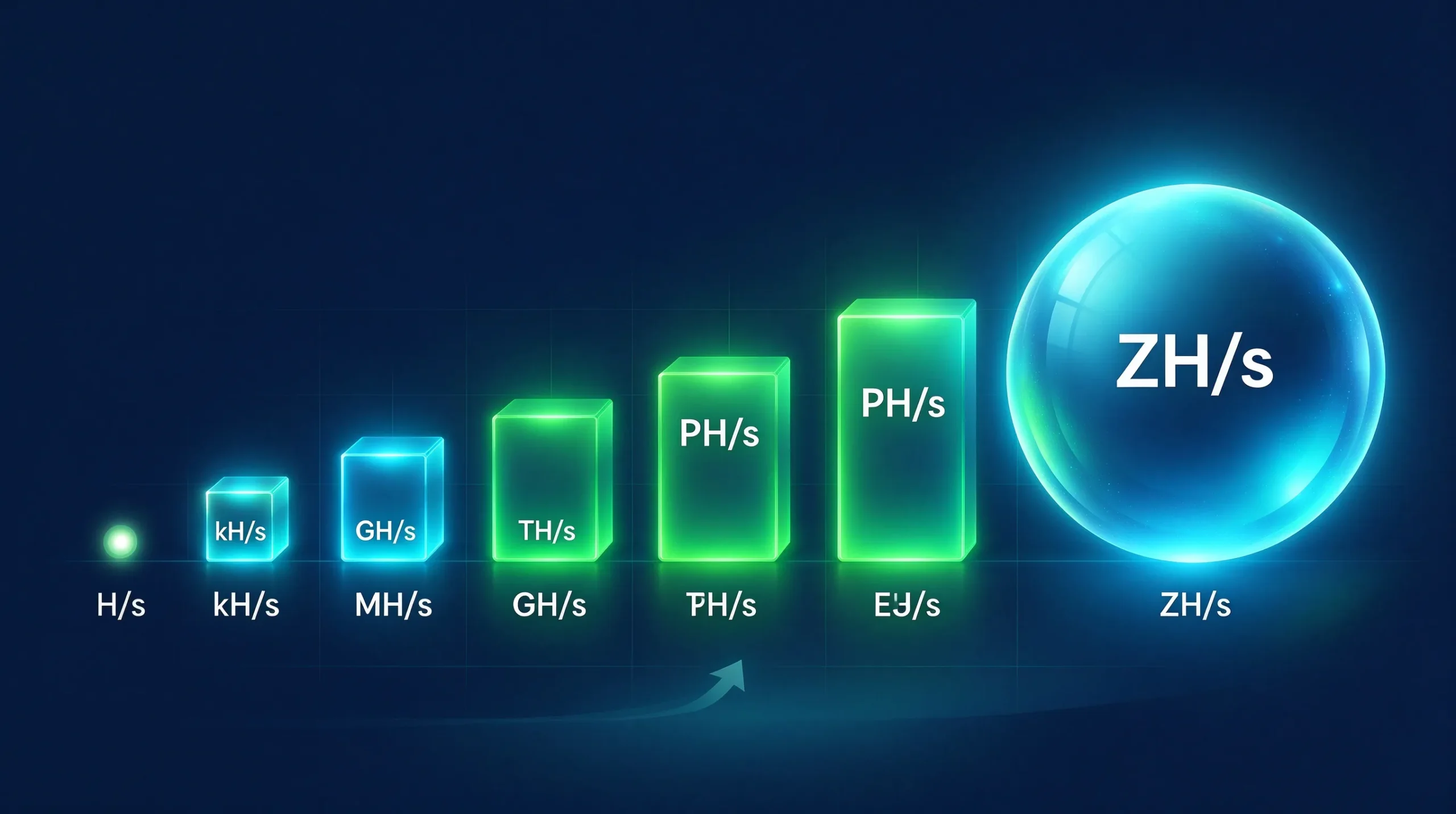
Hash rate numbers grow quickly, so the industry uses standardized prefixes. Understanding these units prevents confusion when comparing miner specifications or network statistics.
| Unit | Symbol | Hashes per Second |
|---|---|---|
| Hash per second | H/s | 1 |
| Kilohash per second | kH/s | 1,000 |
| Megahash per second | MH/s | 1,000,000 |
| Gigahash per second | GH/s | 1,000,000,000 |
| Terahash per second | TH/s | 1,000,000,000,000 |
| Petahash per second | PH/s | 1,000,000,000,000,000 |
| Exahash per second | EH/s | 1,000,000,000,000,000,000 |
| Zettahash per second | ZH/s | 1,000,000,000,000,000,000,000 |
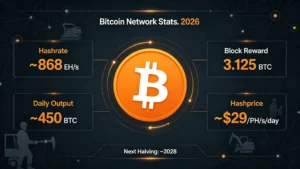
Bitcoin’s total network hash rate has grown into the zettahash range. As of late 2026, it has crossed the 1 ZH/s mark during difficulty adjustments, reflecting the scale of industrial mining operations worldwide . For individual miners, most modern ASIC specifications are expressed in TH/s. A home miner might run at 4.8 TH/s, while an industrial hydro-cooled unit can exceed 600 TH/s .
Hash Rate vs Difficulty: What’s the Difference?
Hash rate and difficulty are related but describe different things. Confusing them leads to incorrect profit expectations.
| Hash Rate | Difficulty | |
|---|---|---|
| What it measures | Speed of a mining device | Threshold the network sets for valid blocks |
| Who controls it | The miner (through hardware choice) | The network (automatically adjusted) |
| Unit | H/s and multiples (TH/s, EH/s) | A dimensionless number |
| Effect of increase | More guesses per second for your machine | Harder for any machine to find a valid block |
| Relationship | Higher network hash rate causes difficulty to rise | Difficulty adjusts to keep block times stable |
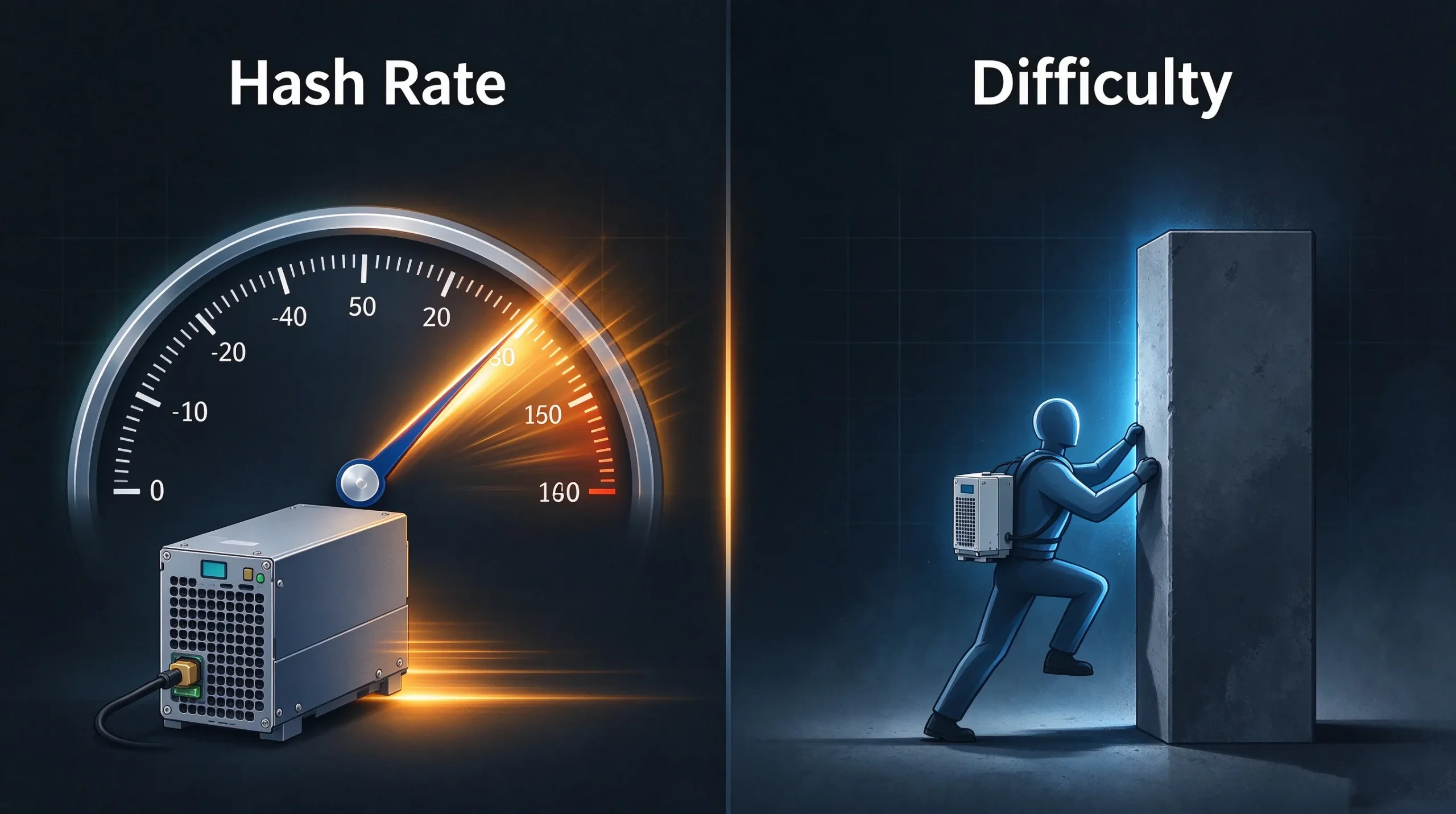
A simple way to remember the relationship: your hash rate is your speed. Difficulty is the height of the bar you must clear. When more miners join and total network hash rate rises, the network raises the bar so blocks keep arriving at the expected pace.
This relationship has a direct consequence for profitability. If your hash rate stays flat while network difficulty rises, your share of total rewards shrinks. Your electricity cost does not shrink with it.
How to Read an ASIC Miner’s Hash Rate Spec?
When you look at an ASIC miner specification sheet, three numbers matter most: hashrate, power consumption, and efficiency.
Hashrate is expressed in TH/s for most SHA-256 miners. The specification sheet typically states a “typical” value with a tolerance, such as ±3% or ±5% . This tolerance accounts for manufacturing variation and operating conditions. A machine rated at 600 TH/s ±3% may deliver between 582 and 618 TH/s in practice.
Power on wall is measured in watts. It tells you how much electricity the machine draws at the wall, including its power supply losses. A hydro-cooled 600 TH/s miner might draw around 5,340W .
Efficiency is the ratio of power to hashrate, expressed in joules per terahash (J/TH). This number matters more than raw hashrate for long-term profitability. A machine that delivers 600 TH/s at 8.9 J/TH consumes less electricity per unit of work than one delivering 400 TH/s at 15 J/TH. Over months of continuous operation, that efficiency gap determines your margin.
To browse mining hardware by these specifications, you can explore Bitmain Antminer models, which include air-cooled and hydro-cooled options across different hashrate ranges.
What Different TH/s Levels Mean for Real Mining?
Hash rate levels correspond to different mining scenarios. The right number depends on your power supply, cooling capacity, noise tolerance, and investment budget.
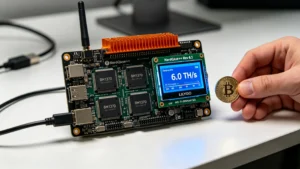
Home and desktop mining typically involves machines in the 4–15 TH/s range. These units are designed for low noise, air cooling, and standard household power circuits. The NerdQaxe++ Rev 7 delivers 4.8 TH/s at 69.5W with a 40dB noise level, suitable for desktop placement . The Nexus S1 reaches 10 TH/s at 100W, also designed for home solo mining . These machines let individuals participate without industrial infrastructure.
Entry-level professional mining covers roughly 100–300 TH/s. Machines in this range often use air cooling and draw several kilowatts. They suit small mining operations with dedicated power circuits and adequate ventilation.
Industrial and farm-scale mining involves machines above 500 TH/s. These units almost always use hydro cooling because air cannot remove heat fast enough at that density. The Antminer S23 XP Hyd delivers 600 TH/s at 8.9 J/TH, and the Whatsminer M7DS reaches 680 TH/s at 13.53 J/TH . Both require liquid cooling infrastructure and three-phase power.
If you are exploring options for home or small-scale Bitcoin mining, you can compare Bitcoin Miner models by hashrate and efficiency.
How Hash Rate Affects Mining Profitability?
Hash rate contributes to profitability, but it is not the only variable. The actual formula for daily revenue is:
Daily Revenue ≈ (Your Hash Rate ÷ Network Total Hash Rate) × Block Reward × Bitcoin Price × Blocks per Day
This formula shows why a higher hash rate alone does not guarantee higher profit. If everyone else also increases their hash rate, your share of the network stays the same. If network difficulty rises, your share shrinks even if your own hash rate is unchanged.
The cost side of the equation is simpler:
Daily Electricity Cost = (Power in Watts ÷ 1,000) × Hours × Electricity Rate
Your profit is daily revenue minus daily electricity cost. A machine with high hash rate but poor efficiency can have a higher electricity cost than a slower but more efficient machine.
This is why J/TH matters. Consider two machines: one at 200 TH/s and 20 J/TH, another at 150 TH/s and 12 J/TH. The first has more raw hash rate. The second consumes less power per unit of work. At any electricity price above a certain threshold, the more efficient machine keeps more of its revenue as profit.
Industry analysis in late 2026 showed that a projected difficulty increase could push less efficient rigs—those around 20 J/TH—into negative margin at electricity prices near $0.08/kWh . More efficient hardware maintains positive margin at the same power cost.
Before purchasing a miner, calculate your break-even electricity price by dividing the current hashprice (revenue per PH/s per day) by your machine’s J/TH rating. If your local power rate is above that number, the machine will likely operate at a loss at current difficulty and Bitcoin price.
To apply this framework to specific hardware, you can review detailed specifications on the Product pages.
Why Hash Rate Matters for Network Security?
Network hash rate serves a second purpose beyond mining economics: it protects the blockchain from attack.
In a Proof-of-Work system, an attacker who wants to rewrite transaction history must control more than half of the network’s total hash rate. This is known as a 51% attack. The higher the total network hash rate, the more computing hardware and electricity an attacker needs to acquire and operate.
This cost barrier is the core security mechanism of Proof-of-Work. A network with a high hash rate makes attacks economically impractical for most actors. A network with a low hash rate is more vulnerable because the required hardware investment is smaller.
Bitcoin’s network hash rate has grown to a scale that makes a 51% attack prohibitively expensive. The same principle applies to smaller Proof-of-Work networks, though at lower absolute hash rate levels. When evaluating any Proof-of-Work cryptocurrency, total network hash rate is a useful indicator of how much economic cost stands between the network and a potential attacker.
Choosing the Right Hash Rate for Your Operation
Hash rate is the starting point for understanding mining hardware, but it is not the finish line. The machines that work well for a home miner in a low-noise environment are different from those that work well in a hydro-cooled container with three-phase power.
If you are planning a mining setup, start by identifying your constraints: available power, cooling capacity, noise limits, and budget. Then look for machines whose hash rate and efficiency match those constraints.
XONMINING carries ASIC Miners across multiple hashrate ranges and cooling types. To get a specific recommendation, share your power supply details, cooling setup, and target deployment scale with our team. We can help you compare machines by their hash rate, J/TH, and physical requirements.

FAQ
What is a good hash rate?
There is no single “good” number. The right hash rate depends on your mining setup, power availability, and budget. For home mining, 4–10 TH/s machines can be practical. For professional operations, 200 TH/s and above is common. What matters more is the efficiency ratio (J/TH) and whether the machine’s output exceeds its electricity cost at your power rate.
Does higher hash rate mean more money?
Not necessarily. A higher hash rate gives you more chances to earn rewards, but your actual profit depends on your share of total network hash rate and your electricity cost. A high-hashrate machine with poor efficiency can lose money while a lower-hashrate machine with excellent efficiency remains profitable.
What is J/TH and why does it matter?
J/TH stands for joules per terahash. It measures how much energy a miner consumes to produce one terahash of computing power. Lower J/TH means better efficiency. This number matters because electricity is usually the largest ongoing cost in mining. A machine at 10 J/TH uses significantly less power than one at 20 J/TH to produce the same hash rate.
How is hash rate calculated?
Hash rate is determined by the mining hardware’s design and chip configuration. Manufacturers measure it under controlled conditions and publish a typical value with a tolerance range. Network hash rate is calculated by monitoring the total computational power of all miners connected to the network.
Can I mine Bitcoin with a low hash rate?
Yes, technically. A low-hashrate machine can still submit shares to a mining pool and earn proportional rewards. Solo mining with a low hash rate has a very low probability of finding a block, so most small miners join pools to receive steady payouts. Some home miners choose solo mining with small machines for the chance at a full block reward, accepting the lower probability.
What hash rate is needed for home mining?
The practical range for home mining is roughly 4–15 TH/s. Machines in this range run on standard household power, produce acceptable noise levels, and use air cooling. Higher-hashrate machines require more power and produce more heat and noise than most homes can accommodate.
Why does my miner’s actual hash rate differ from the specification?
Manufacturers state typical hash rate with a tolerance, often ±3% to ±5%. Actual output varies with chip quality, ambient temperature, power supply stability, and cooling conditions. Hydro-cooled miners operated within their specified coolant temperature range tend to show less variation than air-cooled miners in uncontrolled environments.