The NerdQAxe Phenomenon
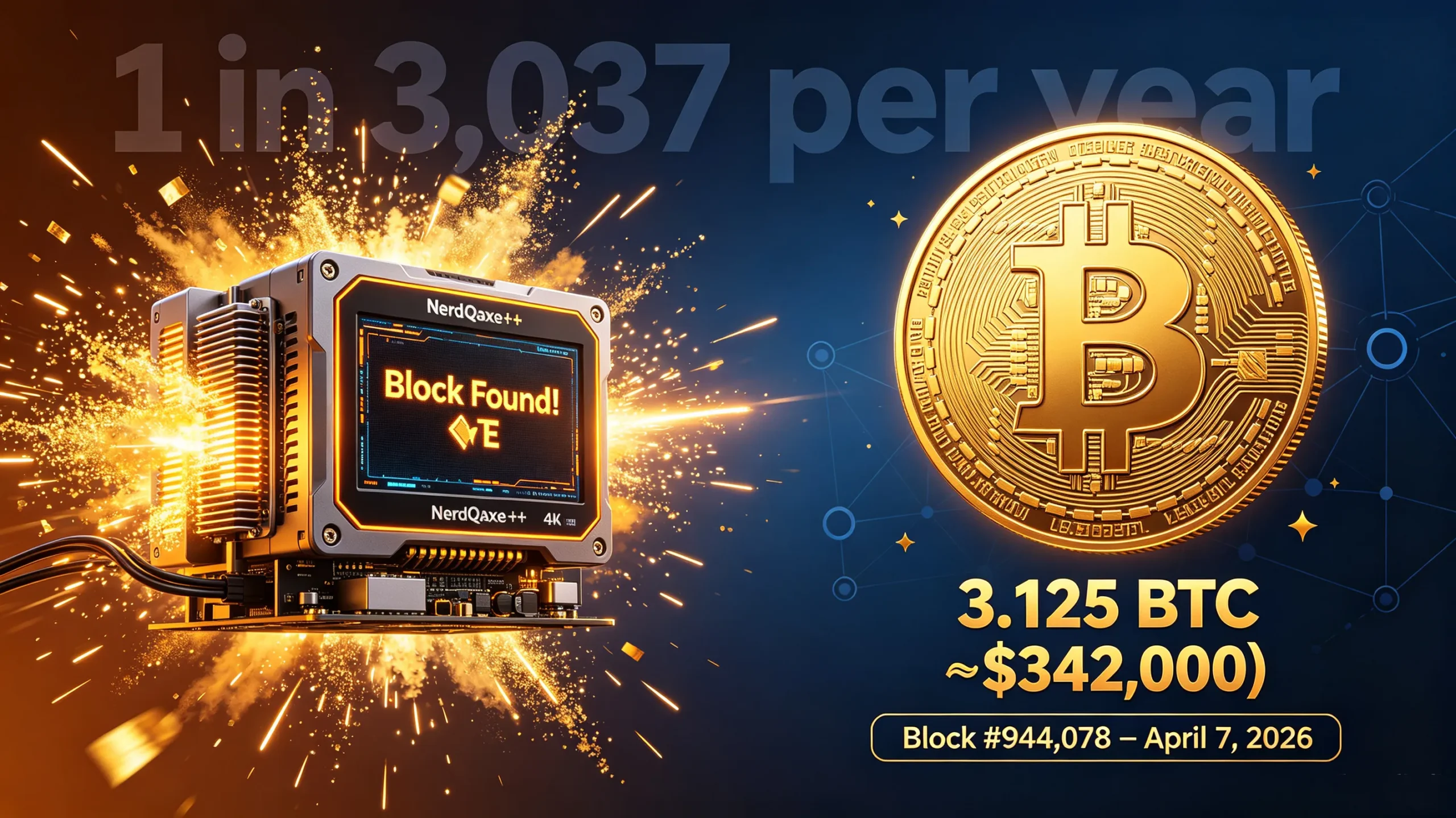
On April 7, 2026, a single NerdQAxe++ unit found Block #944,078, earning its operator 3.132 BTC—approximately $342,000 at the time. A few months earlier, a Solo Satoshi customer running six NerdQAxe++ Rev 6 units found Block #920,440, walking away with over $342,000. Combined, NerdQAxe++ units have now confirmed three Bitcoin block finds with total rewards exceeding $560,000.
This is the reality of open-source solo mining in 2026. While industrial ASIC farms dominate the Bitcoin network, a small but growing community of hobbyists and enthusiasts are proving that desk-sized miners can still hit the lottery.
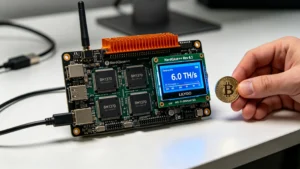
The NerdQAxe family represents the most powerful generation of open-source, standalone Bitcoin solo miners available today. Built on the same BM1370 silicon that powers Bitmain’s flagship Antminer S21 Pro, these compact devices deliver industrial-grade efficiency in a palm-sized, whisper-quiet package.
This guide covers everything you need to know: what the NerdQAxe is, the top five models available in 2026, how to overclock them safely, how to set them up, and whether solo mining with one actually makes sense.
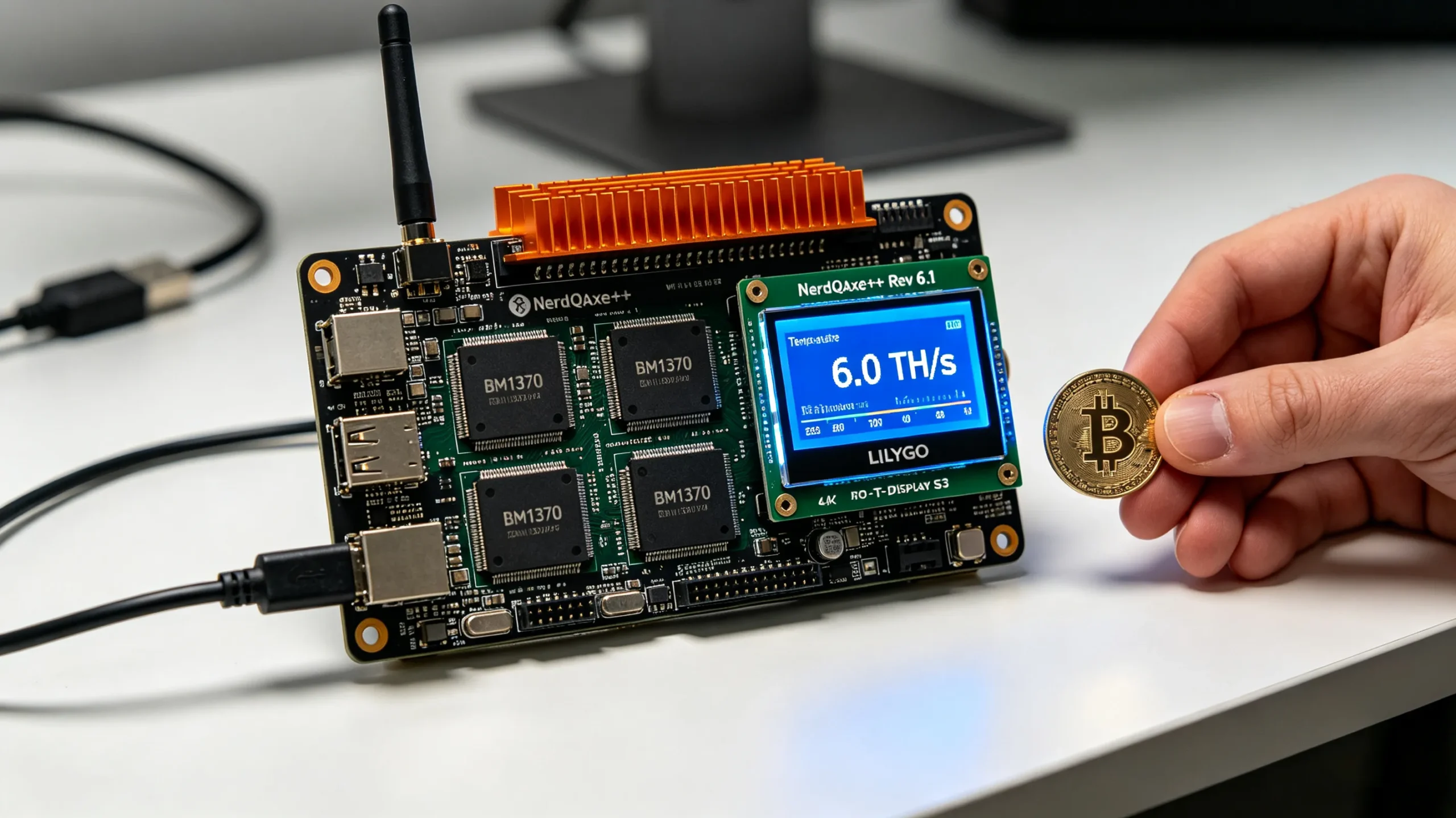
What Is a NerdQAxe Bitcoin Solo Miner?
The NerdQAxe is an open-source, multi-chip SHA-256 ASIC miner designed specifically for solo Bitcoin mining. It is part of the broader open-source mining movement that began with the Bitaxe project—a community-driven effort to democratize Bitcoin mining by putting industrial-grade ASIC silicon on accessible, open-source boards.
The Core Concept
The NerdQAxe takes the Bitaxe philosophy and scales it up. While a single-chip Bitaxe Gamma runs one BM1370 ASIC at roughly 1.2 TH/s, the NerdQAxe++ aggregates four BM1370 chips on a single board to deliver approximately 4.8 TH/s at stock settings. The NerdOCTAxe takes this further with eight chips for approximately 9.6 TH/s.
The name “NerdQAxe” breaks down simply:
-
Nerd: A nod to the community-driven, tinkerer-friendly nature of the project
-
Q: Quad (four ASIC chips)
-
Axe: From the Bitaxe project, acknowledging its roots
The Silicon: BM1370
The heart of the NerdQAxe++ is the BM1370 ASIC—the same chip used in Bitmain’s Antminer S21 Pro, S21+, and S21+ Hydro. These are 3nm chips with top-tier efficiency around 15-17 J/TH, representing the latest generation of Bitcoin mining silicon.
Each BM1370 chip typically delivers around 1.2 TH/s per die. Four chips working in parallel produce 4.8 TH/s at stock settings, consuming just 72W at 15 J/TH efficiency.
Open-Source Philosophy
The NerdQAxe is fully open-source. Schematics, PCB layouts, firmware, and bill of materials are all publicly available. This means:
-
Verifiable hardware: Anyone can audit the design
-
No vendor lock-in: You control the firmware, not a manufacturer
-
Community innovation: Improvements are shared and iterated upon
-
No remote kill switches: Unlike industrial miners, no one can shut your machine down remotely
The miner runs AxeOS (ESP-Miner firmware) on an ESP32-S3 controller, featuring a LILYGO T-Display S3 color LCD for real-time stats and WiFi 2.4GHz connectivity. No computer needed—just plug in power, configure your pool and Bitcoin address, and start hashing.
The NerdQAxe Family: Understanding the Lineup
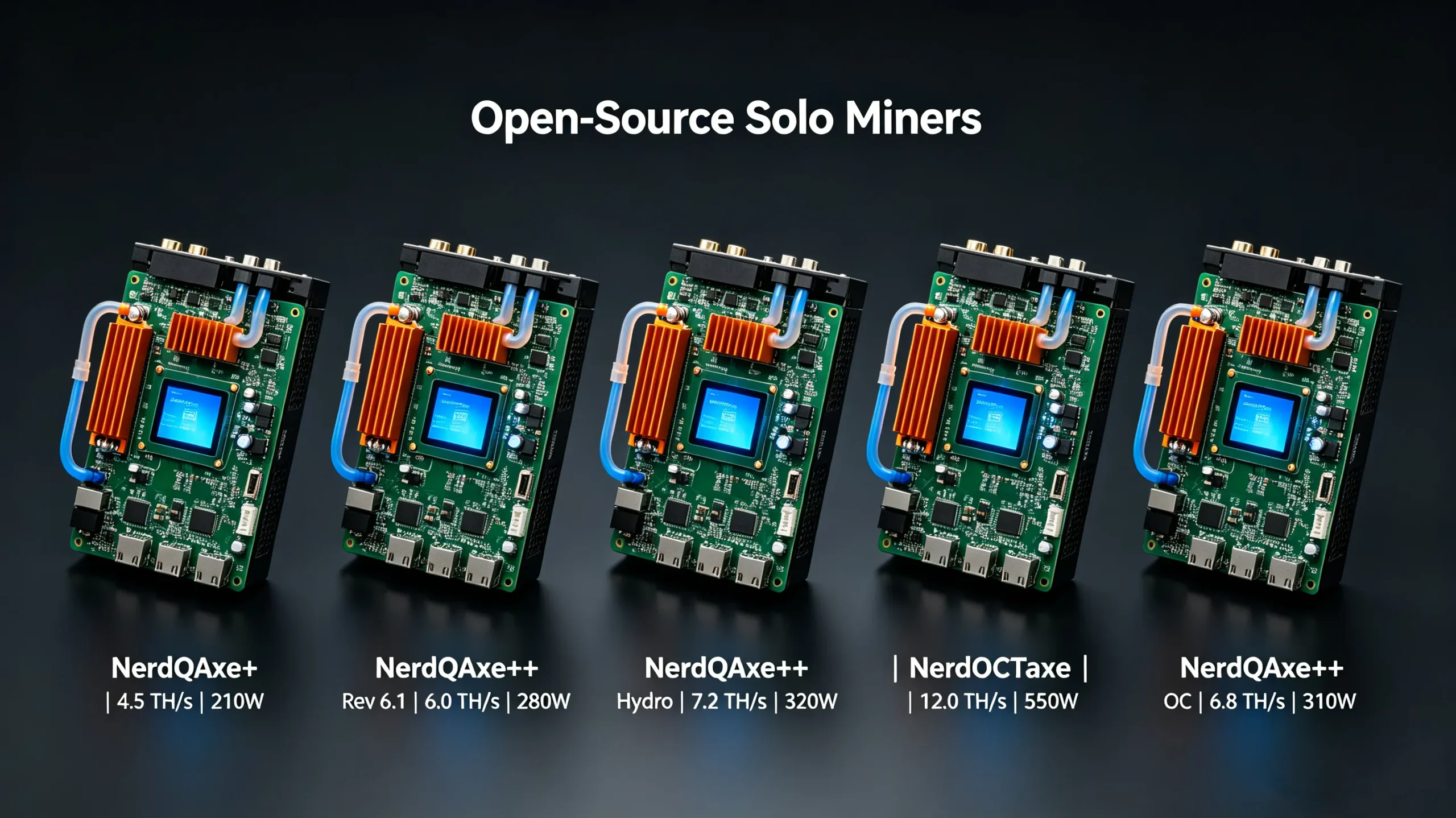
The NerdQAxe family has evolved through multiple revisions. Here is the current lineup as of 2026:
| Model | Chips | Hashrate (Stock) | Power | Efficiency |
|---|---|---|---|---|
| NerdQAxe+ | 4× BM1368 | ~2.4 TH/s | ~60-70W | ~25 J/TH |
| NerdQAxe++ | 4× BM1370 | ~4.8 TH/s | ~72-80W | ~15 J/TH |
| NerdOCTAxe | 8× BM1370 | ~9.6 TH/s | ~150-165W | ~15 J/TH |
Key Revisions
NerdQAxe+ (BM1368): The earlier generation using BM1368 chips (Antminer S19 XP generation). Lower efficiency at approximately 25 J/TH.
NerdQAxe++ (BM1370): The current sweet spot. Four BM1370 chips delivering 4.8 TH/s at approximately 15 J/TH. Rev 6.1 is the latest iteration with refined power and thermal management.
NerdOCTAxe (BM1370): Eight BM1370 chips delivering approximately 9.6 TH/s. The most powerful open-source miner you can buy.
Top 5 NerdQAxe Bitcoin Solo Miners of 2026
Here are the top five NerdQAxe miners available in 2026, ranked by value, performance, and suitability for different users.
NerdQAxe++ Rev 6.1 – The Sweet Spot
The NerdQAxe++ Rev 6.1 is the most recommended home Bitcoin miner in 2026. It delivers the best balance of hashrate, efficiency, noise, and price.
Key Specifications
| Attribute | Details |
|---|---|
| ASIC Chips | 4× Bitmain BM1370 |
| Hashrate (Stock) | 4.8 TH/s |
| Hashrate (Rev 6.1 Default) | 6.0 TH/s |
| Power Consumption | ~100W |
| Efficiency | ~16.5 J/TH |
| Noise Level | ~40 dB |
| Connectivity | WiFi 2.4 GHz |
| Display | LILYGO T-Display S3 color LCD |
Performance
The Rev 6.1 ships with a default configuration of approximately 6.0 TH/s, up from the earlier 4.8 TH/s stock rating. This represents a 25% performance improvement over the original release.
At 6 TH/s, the NerdQAxe++ delivers roughly five times the hashrate of a Bitaxe Gamma (1.2 TH/s) at approximately 100W. Efficiency sits at 16-17 J/TH—comparable to industrial miners costing tens of thousands of dollars.
Noise and Form Factor
At approximately 40 dB, the NerdQAxe++ is about as loud as a quiet desktop computer. It fits in the palm of your hand at approximately 10 × 13 × 17.5 cm and weighs just 400g.
Who It’s For
The NerdQAxe++ Rev 6.1 is for:
-
First-time solo miners
-
Home users who want meaningful hashrate without industrial noise
-
Open-source enthusiasts who value verifiable hardware
-
Anyone looking for the best hashrate-per-watt in a compact board
NerdOCTAxe Rev 3.1 – The Octo-Chip Beast
The NerdOCTAxe doubles the NerdQAxe++ to eight BM1370 chips, delivering the highest hashrate of any open-source desktop miner.
Key Specifications
| Attribute | Details |
|---|---|
| ASIC Chips | 8× Bitmain BM1370 |
| Hashrate (Stock) | ~9.6 TH/s |
| Overclocked | ~10.8 TH/s |
| Power Consumption | ~150-165W |
| Efficiency | ~15 J/TH |
| Noise Level | ~50-55 dB |
| Connectivity | WiFi 2.4 GHz |
Performance
At 9.6 TH/s stock, the NerdOCTAxe delivers twice the hashrate of the NerdQAxe++ for roughly twice the power. Overclocked, it can reach approximately 10.8 TH/s.
This is the most powerful open-source miner you can buy. It is essentially two NerdQAxe++ boards on a single PCB.
Who It’s For
The NerdOCTAxe is for:
-
Miners who want maximum hashrate from a desktop device
-
Users willing to accept slightly higher noise (~50-55 dB)
-
Those who want to double their lottery odds compared to the NerdQAxe++
NerdQAxe+ Hydro – The BM1368 Classic
The NerdQAxe+ Hydro is the earlier generation using BM1368 chips—the same silicon as the Antminer S19 XP.
Key Specifications
| Attribute | Details |
|---|---|
| ASIC Chips | 4× Bitmain BM1368 |
| Hashrate (Stock) | ~2.5 TH/s |
| Power Consumption | ~60-70W |
| Efficiency | ~25 J/TH |
Performance
At 2.4 TH/s, the NerdQAxe+ Hydro delivers roughly half the hashrate of the NerdQAxe++ for slightly less power. The efficiency gap is significant—25 J/TH vs. 15 J/TH—meaning the NerdQAxe++ is substantially more efficient.
Who It’s For
The NerdQAxe+ Hydro is for:
-
Budget-conscious buyers who can find them used
-
Those who don’t need the latest efficiency
-
Collectors or early adopters
Note: For most buyers in 2026, the NerdQAxe++ is a better value.
NerdQAxe++ Hydro – The Silent Liquid-Cooled Edition
The NerdQAxe++ Hydro is a liquid-cooled variant of the NerdQAxe++ with the same hashrate but refined thermal behavior for location-sensitive home environments.
Key Specifications
| Attribute | Details |
|---|---|
| ASIC Chips | 4× Bitmain BM1370 |
| Hashrate | 6 TH/s |
| Power Consumption | ~100W |
| Efficiency | ~16.5 J/TH |
| Noise Level | <35 dB |
| Cooling | Liquid (Hydro) |
Performance
At 6 TH/s and approximately 100W, the Hydro delivers the same hashrate as the air-cooled Rev 6.1. The difference is in the thermal behavior—liquid cooling allows for more stable temperatures and quieter operation (<35 dB).
Who It’s For
The NerdQAxe++ Hydro is for:
-
Users in noise-sensitive environments (bedrooms, offices)
-
Those who want the quietest possible operation
-
Miners in warmer climates where air cooling is less effective
NerdQAxe++ Rev 6.1 Overclocked – The 6+ TH/s Tuned Machine
The NerdQAxe++ can be overclocked from its stock performance to approximately 6.2-6.5 TH/s with moderate tuning.
Key Specifications
| Attribute | Details |
|---|---|
| ASIC Chips | 4× Bitmain BM1370 |
| Hashrate (Overclocked) | 6.2-6.5 TH/s |
| Power Consumption | ~110-115W |
| Efficiency | ~17-18 J/TH |
Performance
With the right hardware upgrades (improved power supply, upgraded cooler, higher-rated fuse), the NerdQAxe++ can safely reach 6.2-6.5 TH/s. More aggressive overclocking with upgraded cooling can push beyond 8 TH/s.
Who It’s For
The overclocked NerdQAxe++ is for:
-
Tinkerers who enjoy pushing hardware to its limits
-
Miners who have already upgraded their power supply and cooling
-
Those who want maximum hashrate from a single board
Side-by-Side Comparison Table
| Miner | Chips | Hashrate | Power | Efficiency | Noise | Price | Best For |
|---|---|---|---|---|---|---|---|
| NerdQAxe++ Rev 6.1 | 4× BM1370 | 6 TH/s | ~100W | ~16.5 J/TH | ~40 dB | ~$380-420 | Sweet spot, most buyers |
| NerdOCTAxe Rev 3.1 | 8× BM1370 | ~9.6 TH/s | ~150-165W | ~15 J/TH | ~50-55 dB | Higher | Maximum hashrate |
| NerdQAxe+ | 4× BM1368 | ~2.4 TH/s | ~60-70W | ~25 J/TH | ~40 dB | Lower | Budget/used buyers |
| NerdQAxe++ Hydro | 4× BM1370 | 6 TH/s | ~100W | ~16.5 J/TH | <35 dB | Higher | Silent operation |
| NerdQAxe++ OC | 4× BM1370 | 6.2-6.5 TH/s | ~110-115W | ~17-18 J/TH | ~45 dB | ~$420+ | Tinkerers, max performance |
How to Overclock Your NerdQAxe?
Overclocking is one of the main reasons enthusiasts choose the NerdQAxe++. However, it requires careful attention to hardware and thermal management.
The Physics of Overclocking
The BM1370 chips are incredibly efficient, typically delivering around 1.2 TH/s per die at 15-17 J/TH. In a standard NerdQAxe++ configuration, four chips produce 4.8 TH/s at 76-90W.
However, power consumption does not scale linearly with clock speed. When you increase frequency and core voltage, current draw spikes exponentially. Most standard NerdQAxe++ units ship with a 12V/10A (120W) power brick. When overclocked BM1370 chips demand massive transient current spikes, total system draw can exceed 120W, triggering the onboard over-current protection (OCP).
What You Need Before Overclocking
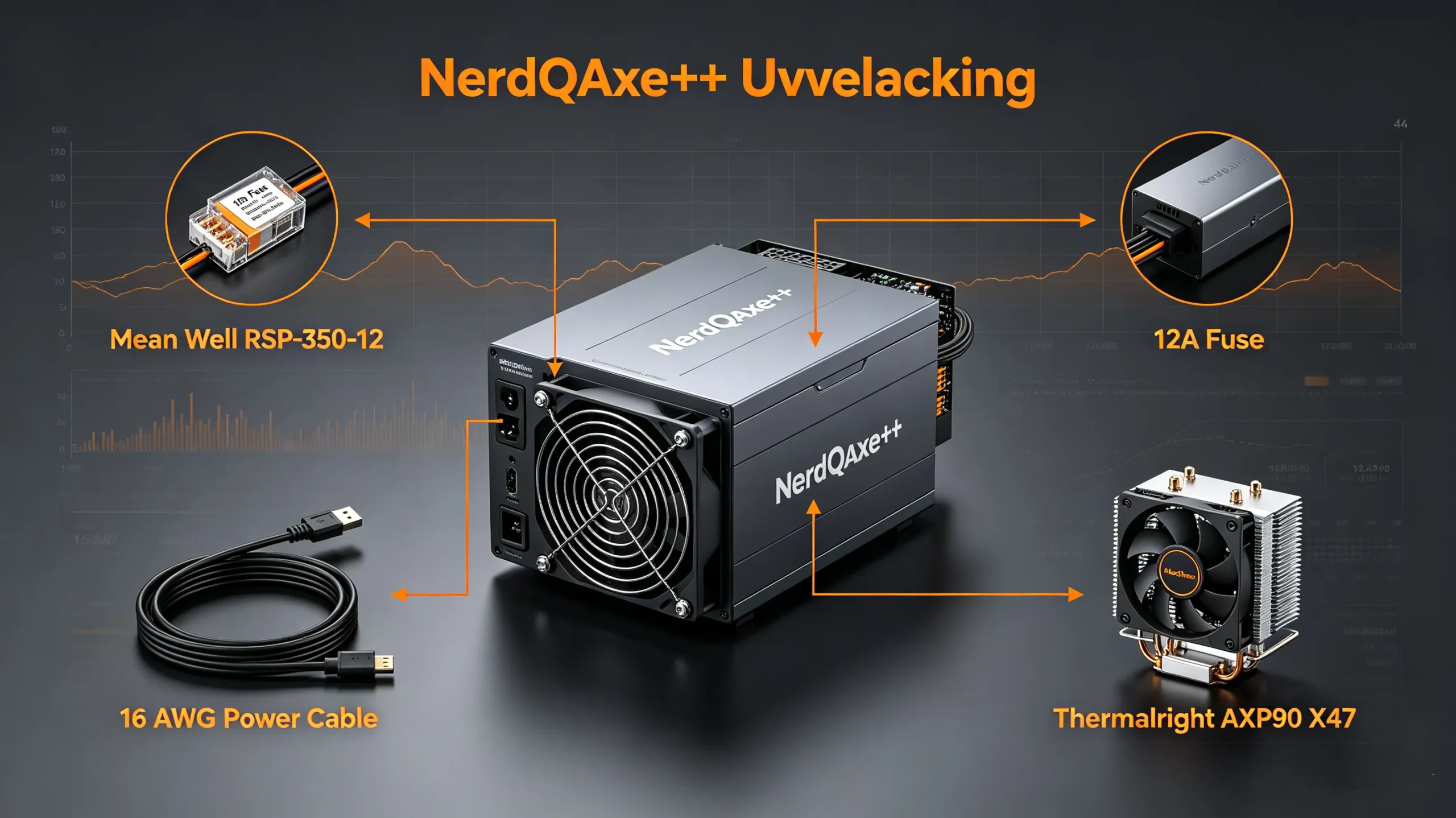
Power Supply: The stock 12V/10A PSU cannot handle overclocking. Upgrade to a Mean Well RSP-350-12 (350W, 12V) or similar to support approximately 110-115W for moderate overclocks.
Fuse: The stock 8A fuse fails above approximately 100W. Swap it for a 12A or 15A Littelfuse 451 NANO2 series.
Power Cable: Use a 16 AWG cable for approximately 110-115W overclocks. For 15A fuses, go with 14 AWG.
Cooling: The stock Thermalright AXP90 X36 cooler works up to approximately 100W but struggles beyond. Upgrade to the AXP90 X47 and consider a 3D-printed HELIX shroud with a 120mm fan to keep ASIC below 60°C.
Thermal Paste: Apply fresh thermal paste (MX-6 works well) when upgrading coolers.
Firmware Considerations
Starting from firmware version V1.0.35, the NerdQaxe++ enforces a firmware-level current limit of 100A. Ensure you are running the latest firmware from the Bitaxe GitHub for stability and overclocking support.
Step-by-Step Overclocking Guide
Step 1: Baseline Testing
Run the NerdQAxe++ at stock settings and track hashrate, ASIC temperature, and power usage via the LILYGO T-Display S3 or AxeOS. Connect to a mining pool and stress test for 1-2 hours to confirm stability.
Step 2: Access AxeOS Advanced Settings
Connect to the NerdQAxe++ via WiFi and log into the AxeOS web interface. To expose frequency and voltage fields, append ?oc to the end of your settings URL (e.g., http://192.168.1.50/#/settings?oc).
Step 3: Set a Baseline Voltage
For the BM1370, a solid starting point is 0.78V core voltage. Set your fan to Automatic Fan Control or 100% manual if you are pushing limits.
Step 4: The Frequency Climb
Start at 600 MHz and raise by 25 MHz increments (e.g., to 625 MHz, then 650 MHz). Input your new value in Settings > Frequency, save, and restart.
Step 5: Stability Testing
After each change, let the miner run for at least 20-30 minutes. Monitor:
-
Hashrate: Should remain stable (e.g., within ±250 GH/s)
-
HW Errors: A continuous stream indicates instability
-
Temperature: Critical—keep ASIC below 60°C
Step 6: Voltage Correction
If the miner crashes or hash rate drops:
-
Increase Core Voltage by small steps (e.g., 20-25mV)
-
Test again for stability
Keep voltage as low as possible to minimize heat.
Step 7: Fine-Tuning
A typical overclocking path might look like:
-
Stock: 4.8 TH/s at 600 MHz
-
Step 1: 625 MHz → ~5.1-5.3 TH/s
-
Step 2: 650 MHz → ~5.5-5.8 TH/s
-
Step 3: 675 MHz → ~6.0-6.3 TH/s
-
Step 4: 700 MHz → ~6.2-6.5 TH/s (requires upgraded cooling)
The NerdQAxe++ Rev 6.1 can typically push from 600MHz stock to 700-750MHz.
Common Overclocking Issues and Fixes
Issue: “Current Protection” Warning
Cause: The onboard Texas Instruments INA260 power meter detects abnormal load exceeding 120W and triggers over-current protection.
Fix: Upgrade your power supply (to 200W+), replace the 8A fuse with a 12A or 15A fuse, and ensure your power cable is adequately rated.
Issue: Thermal Throttling
Cause: ASIC temperature exceeding safe operating limits (typically >70-75°C).
Fix: Upgrade to a better cooler (AXP90 X47), apply fresh thermal paste, improve case airflow, or reduce frequency/voltage.
Issue: Hashrate Instability
Cause: Voltage too low for the frequency setting.
Fix: Increase core voltage by 20-25mV increments.
Issue: System Crashes
Cause: Overclock too aggressive for the silicon quality (silicon lottery).
Fix: Reduce frequency by 25MHz or increase voltage. Some chips simply cannot sustain high overclocks.
How to Set Up Your NerdQAxe Miner?
Setting up a NerdQAxe is straightforward. Here is the complete process.
What You Need Before You Start
-
A NerdQAxe miner (any model)
-
A Bitcoin wallet address
-
A mining pool account (or solo mining configuration)
-
A 12V DC power supply (120W minimum for stock, 200W+ for overclocking)
-
WiFi network (2.4 GHz)
Step 1: Power and Connect
-
Connect the power supply to the miner via the XT30 connector
-
Plug in and power on
Step 2: Connect to WiFi
-
The NerdQAxe will broadcast a WiFi access point (or connect to your network)
-
Use the LILYGO T-Display S3 to configure WiFi settings
Step 3: Find the IP Address
The IP address will be displayed on the LILYGO color LCD screen.
Step 4: Access AxeOS Dashboard
-
Enter the IP address into your browser
-
The AxeOS web dashboard will load
Step 5: Configure Mining Settings
-
Navigate to the configuration page
-
Enter your mining pool stratum URL
-
Enter your Bitcoin wallet address
-
Enter a worker name (optional)
-
Click Save
Step 6: Start Mining
The miner will restart and begin hashing. The LILYGO display will show real-time hashrate, temperature, and share count.
Step 7: Monitor Performance
Check the pool’s website to verify your worker is submitting shares. Monitor temperature and fan speeds via AxeOS or the display.
What is the probability of you winning a prize using NerdMiner?
Let’s be honest about the numbers.
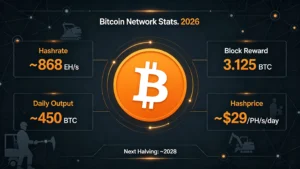
Bitcoin Network Stats (August 2026)
| Metric | Value |
|---|---|
| Network Hashrate | ~868 EH/s |
| Difficulty | ~127 trillion |
| Block Reward | 3.125 BTC |
| Blocks per Day | ~144 |
NerdQAxe++ Odds
A 6 TH/s NerdQAxe++ represents approximately 0.00000069% of the network hashrate (6 TH/s ÷ 868,000,000 TH/s).
Probability of finding a block:
-
Per day: ~0.00000069% × 144 blocks = ~0.0001%
-
Per year: ~0.033%
-
Over 5 years: ~0.16%
As one guide puts it: “A NerdQAxe++ at 4.8 TH/s has roughly a 0.45% chance of finding a Bitcoin block over 5 years”. At 6 TH/s, the odds are slightly better, but still extremely long.
Alternative: Mining BCH2
Some solo miners point their NerdQAxe at smaller SHA-256 chains like BCH2 (Bitcoin Cash 2) where the difficulty is lower. On BCH2, a NerdQAxe++ might expect a block approximately every 11 years—still long, but significantly better odds than Bitcoin.
The Bottom Line
Solo mining with a NerdQAxe is not a rational profit-maximizing strategy. It is a lottery ticket with very long odds and a very large payout if you win. As one analyst notes: “Pure profit-seekers should usually avoid it and Bitcoin enthusiasts almost universally enjoy it”.
Is a NerdQAxe Worth It in 2026?
The answer depends entirely on your goals and expectations.
The Case for Buying a NerdQAxe
Proven Wins: NerdQAxe++ units have found three real Bitcoin blocks, with combined rewards exceeding $560,000.
Industrial-Grade Silicon: BM1370 chips are the same 3nm silicon used in Bitmain’s S21 Pro.
Open-Source Freedom: Fully auditable hardware, no vendor lock-in, no remote kill switches.
Desktop-Friendly: 40 dB noise, palm-sized form factor, under 100W power.
Great Efficiency: 15-17 J/TH rivals industrial miners costing tens of thousands of dollars.
Community: Active development, continuous improvements, and a passionate community.
Low Operating Cost: At 100W and average US electricity rates, monthly operating costs are just a few dollars.
The Case Against Buying a NerdQAxe
Extremely Long Odds: A 1-in-3,037 chance per year of finding a Bitcoin block.
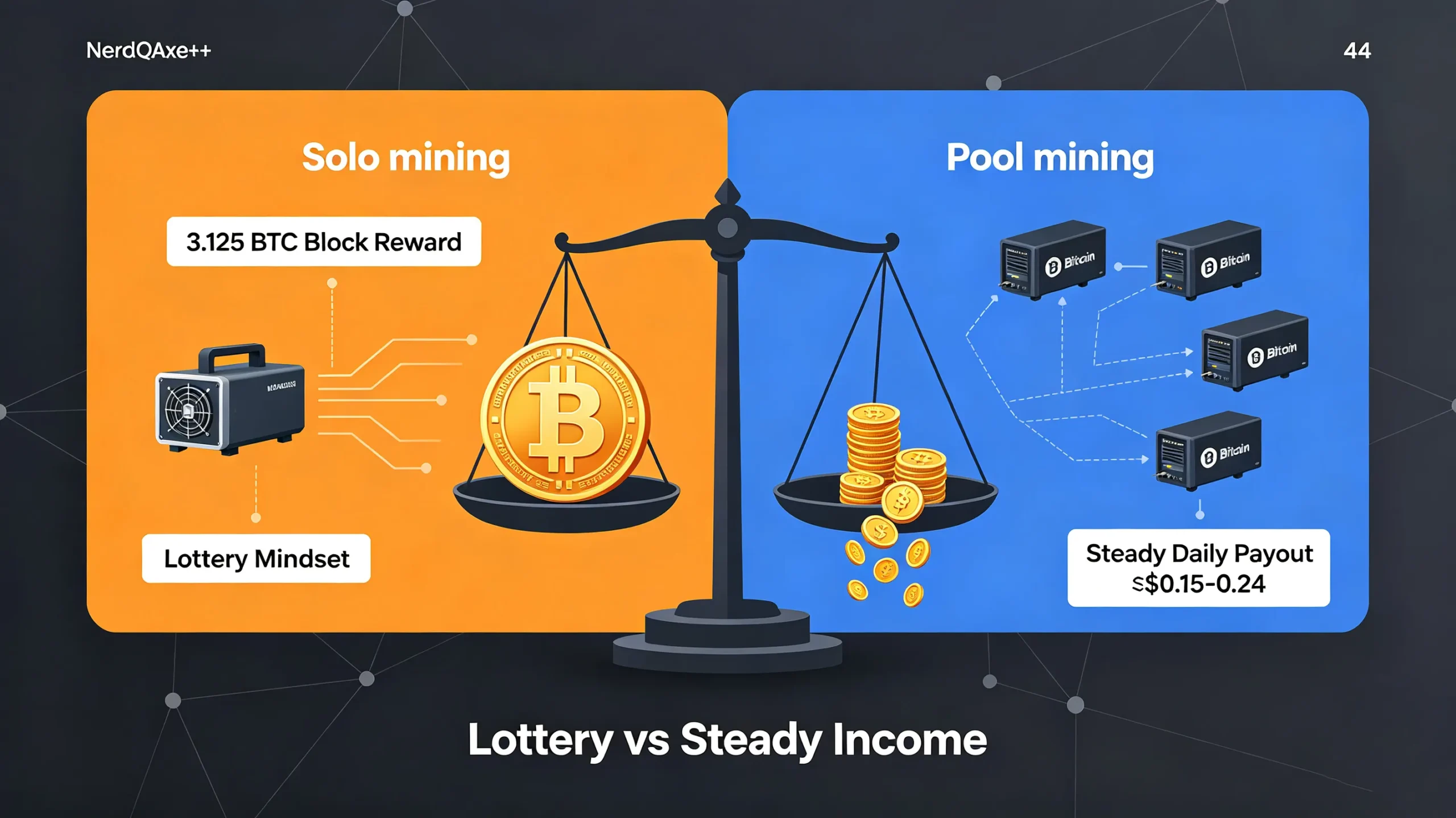
Low Pool Mining Returns: At 6 TH/s, pool mining earns approximately $0.15-0.24 per day.
Hardware Cost: $380-420 for a Rev 6.1 unit—you could buy approximately 0.006 BTC directly for the same price.
Overclocking Requires Upgrades: To push beyond stock, you need upgraded PSU, fuse, and cooling.
No Guarantee: You may mine for years and never find a block.
Who Should Buy a NerdQAxe?
Buy a NerdQAxe if you:
-
Are a Bitcoin enthusiast who wants to support the network
-
Enjoy tinkering with open-source hardware
-
Are comfortable with lottery-style odds
-
Want to learn how Bitcoin mining actually works
-
Have cheap electricity
-
Understand that this is a hobby, not an investment
Don’t buy a NerdQAxe if you:
-
Are expecting significant profits
-
Need regular, predictable income
-
Aren’t willing to deal with setup and maintenance
-
Have expensive electricity (>$0.12/kWh)
Final Verdict
The NerdQAxe represents the pinnacle of open-source Bitcoin mining in 2026. It combines industrial-grade BM1370 silicon with desktop-friendly power consumption, open-source firmware, and a passionate community.
What It Is
The NerdQAxe is a legitimate solo mining machine. It has proven itself with three confirmed Bitcoin block finds and over $560,000 in combined rewards. It runs the same chips as Bitmain’s S21 Pro at a fraction of the power and noise.
What It Is Not
The NerdQAxe is not a get-rich-quick scheme. It is not passive income. It is a lottery ticket with very long odds—approximately 1-in-3,037 per year for a Bitcoin block.
The Honest Truth
If you are mining for profit, buy Bitcoin directly. If you are mining for fun, education, community, and the thrill of potentially hitting the lottery, the NerdQAxe is the best tool for the job.
As one guide puts it: “Solo mining sits in a specific niche that pure profit-seekers should usually avoid and Bitcoin enthusiasts almost universally enjoy”.
The NerdQAxe++ Rev 6.1 is the sweet spot—the most recommended home Bitcoin miner of 2026. It offers the best balance of hashrate, efficiency, noise, and price. For those who understand the odds and embrace the philosophy, it is one of the most rewarding pieces of hardware you can own.
Disclaimer: This article is for informational purposes only and does not constitute financial advice. Cryptocurrency mining carries significant risk. Solo mining is a lottery, not an investment strategy. Always conduct your own research and consult with qualified professionals before making decisions.
Frequently Asked Questions
What is a NerdQAxe Bitcoin solo miner?
The NerdQAxe is an open-source, multi-chip SHA-256 ASIC miner designed for solo Bitcoin mining. The NerdQAxe++ uses four BM1370 chips to deliver approximately 6 TH/s at 100W.
What is the hashrate of a NerdQAxe++?
Stock hashrate is 4.8 TH/s, but the Rev 6.1 ships with a default of 6.0 TH/s. Overclocked, it can reach 6.2-6.5 TH/s.
How much power does a NerdQAxe++ use?
Approximately 100W at 6 TH/s, with efficiency around 16.5 J/TH.
How much does a NerdQAxe++ cost?
Approximately $380-420 for an assembled Rev 6.1 unit.
Can I overclock a NerdQAxe++?
Yes. With upgraded power supply, fuse, and cooling, the NerdQAxe++ can reach 6.2-6.5 TH/s.
Has a NerdQAxe ever found a Bitcoin block?
Yes. Three confirmed Bitcoin block finds by NerdQAxe++ units with combined rewards exceeding $560,000, including Block #944,078 found April 7, 2026.
Is solo mining with a NerdQAxe profitable?
Solo mining is a lottery, not a profit strategy. The odds of finding a block with a 6 TH/s miner are approximately 1-in-3,037 per year.
Should I mine in a pool or solo?
Pool mining provides regular, predictable payouts (approximately $0.15-0.24/day). Solo mining offers a chance at a full 3.125 BTC block reward but with very long odds.
What is the difference between NerdQAxe and Bitaxe?
The Bitaxe runs a single ASIC chip delivering around 1 TH/s. The NerdQAxe++ aggregates four chips to reach several terahashes per second.
What is the NerdOCTAxe?
The NerdOCTAxe uses eight BM1370 chips to deliver approximately 9.6 TH/s—the most powerful open-source desktop miner available.
Where can I buy a NerdQAxe?
NerdQAxe units are sold by various open-source hardware vendors including D-Central, DigLucky, and other community suppliers.