
The future of crypto mining hardware is a critical paradigm shift away from disposable, monolithic devices towards modular, repairable, and sustainable systems. This evolution, driven by economic pressures and environmental concerns, empowers miners with significantly longer hardware lifespans, reduced operational costs, and greater control over their investments, ultimately reshaping the profitability and footprint of the entire industry. For anyone involved in mining, from hobbyists to large-scale operators, understanding this trend is no longer optional—it’s essential for survival and success.
Cryptocurrency mining has always been an arms race. The relentless pursuit of hashrate has led to highly specialized, powerful machines like ASICs (Application-Specific Integrated Circuits). While incredibly efficient at their one task, these devices have traditionally been designed as “black boxes”—difficult to upgrade, impossible to repair, and destined for the landfill once a more powerful generation arrives. This “buy, break, discard” model is not just unsustainable; it’s a direct threat to a miner’s profitability. We are now at an inflection point where the industry is being forced to get smarter, and the hardware is evolving to match.
The Current Landscape: Why Is Change Needed in Mining Hardware?
To appreciate the future, we must first understand the limitations of the present. The current state of mining hardware is defined by a cycle of rapid obsolescence and a lack of control for the end-user. This model benefits manufacturers’ short-term sales but creates long-term problems for both miners and the environment.
The Era of Monolithic and Disposable ASICs
A monolithic ASIC is a device where all core components—hashboards, control board, and power supply unit (PSU)—are designed to work only with each other, often within a specific chassis. If a single critical component like a hashboard fails, the entire, expensive unit often becomes a paperweight. There are no standardized parts, no easy-to-source replacements, and very little documentation for third-party repairs. This design philosophy locks miners into a dependency on the original manufacturer for any potential fixes, which are often costly or non-existent, especially for older models.
The Growing E-Waste Problem in Crypto Mining Hardware
The consequence of this disposable design is a staggering amount of electronic waste. As Mining Hardware difficulty increases and new, more efficient chips are released, entire generations of miners are rendered unprofitable and discarded. These devices are packed with heavy metals and non-biodegradable materials. The environmental impact is a significant reputational risk for the entire cryptocurrency industry, attracting negative attention from regulators and the public. A move towards sustainable mining hardware isn’t just about being “green”; it’s about ensuring the long-term viability and social license of crypto itself.
How Lack of Repairability Hurts Miners’ Bottom Line
For a miner, every second of downtime is lost revenue. When a monolithic miner fails, the process is painful: diagnose the issue (if possible), ship the entire heavy unit back to the manufacturer (often internationally), wait weeks or months for repair, and pay exorbitant fees. The alternative is to simply buy a new machine. This lack of repairability directly impacts the Return on Investment (ROI) of the hardware, turning a multi-thousand-dollar asset into a ticking time bomb with a surprisingly short fuse.
What is the Shift Towards Modular and Repairable Mining Hardware?
The solution to these problems lies in a fundamental redesign of the hardware itself. Inspired by the “Right to Repair” movement seen in consumer electronics and the inherent flexibility of the PC building community, the mining world is embracing modularity.
Defining Modularity: Beyond Just Swapping Fans
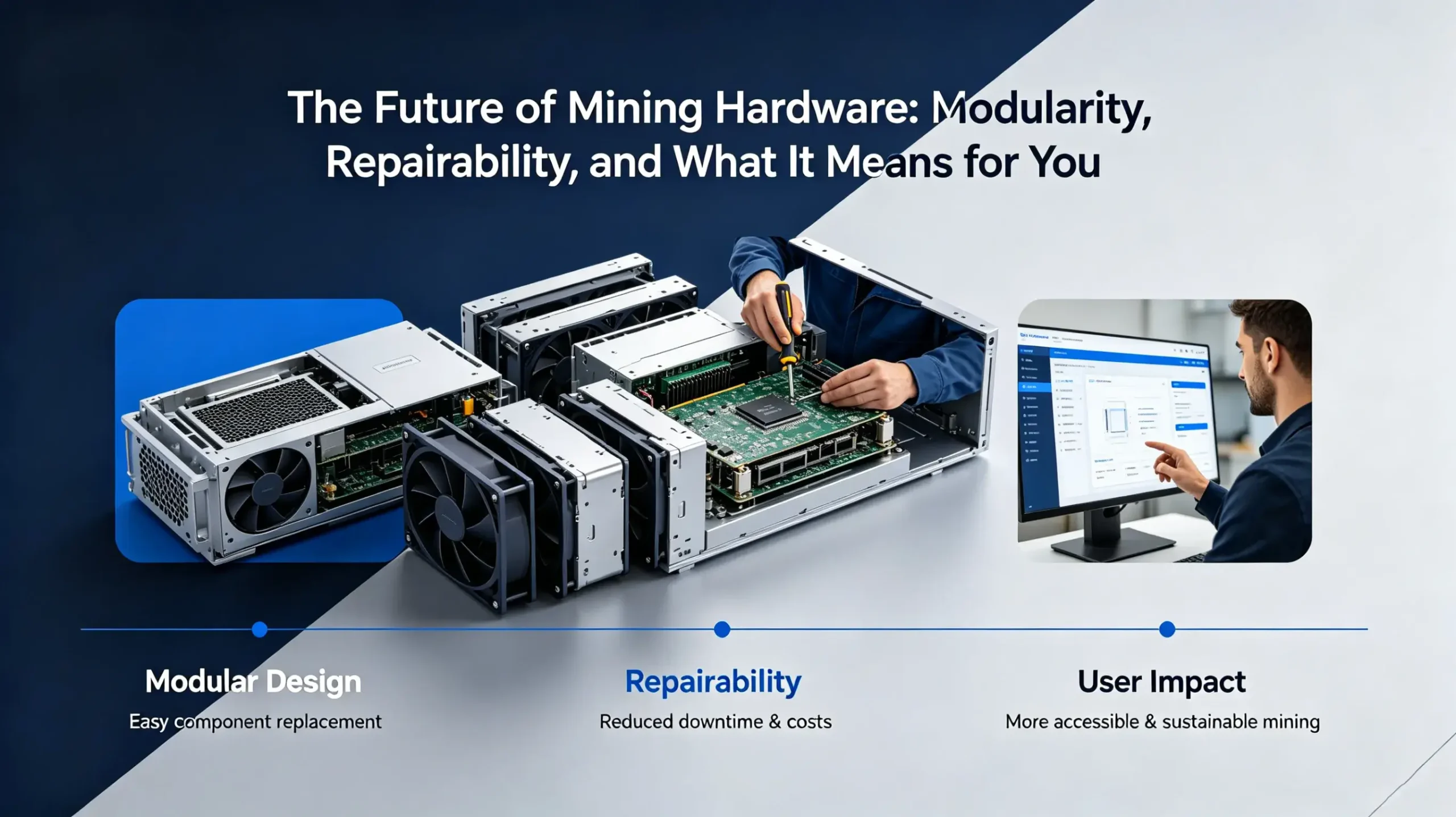
True hardware modularity goes far beyond replacing a fan or a power cable. It means designing a mining rig as a system of interoperable, independently replaceable components. Imagine a chassis that can accept different types of hashboards, or a control board that can be upgraded separately to support new firmware or features. This “plug-and-play” approach transforms the miner from a disposable appliance into a long-term, upgradable platform.
Key components in a modular system include:
- Hot-Swappable Hashboards: The ability to remove and replace the core processing units without powering down the entire system.
- Standardized Control Boards: A universal “brain” that can manage different types of hashboards, perhaps even from different manufacturers.
- Independent Power Supply Units (PSUs): Using standardized server-grade PSUs that are widely available and easy to replace.
The “Right to Repair” Movement Comes to Crypto
The “Right to Repair” is a consumer rights concept advocating that individuals and independent repair shops should have access to the parts, tools, and information needed to fix their own electronic devices. In the context of crypto mining, this means manufacturers providing schematics, selling individual components like hashing chips or capacitors, and not locking down firmware to prevent third-party modifications. This movement empowers the user and creates a secondary market for repairs and refurbishment, extending the life of every machine.
The Tangible Benefits: Why Should You Care?
This evolution from monolithic to modular isn’t just a technical curiosity; it has profound and direct financial and operational benefits for every miner.
Maximizing ROI: Extending the Lifespan of Your Investment
This is the most significant advantage. A modular rig doesn’t become obsolete all at once. When a more efficient generation of hashing chips becomes available, you don’t have to discard your entire setup. Instead, you can simply upgrade the hashboards while keeping your existing chassis, PSU, and control system. This drastically lowers the total cost of ownership and allows you to keep your operation at the cutting edge of efficiency without reinvesting from scratch every 18-24 months.
Let’s compare the two models:
| Feature | Monolithic Hardware | Modular Hardware |
|---|---|---|
| Upgradability | Low to None. Requires full unit replacement. | High. Can upgrade individual components (e.g., hashboards). |
| Repairability | Difficult and costly. Requires manufacturer support. | Easy. Components can be swapped by the user. |
| Downtime | High. A single failure can take the whole unit offline for weeks. | Low. Faulty components can be swapped in minutes. |
| Total Cost of Ownership | High, due to frequent replacement cycles. | Lower, due to extended lifespan and incremental upgrades. |
| E-Waste | High. Entire units are discarded. | Low. Only failed/obsolete components are replaced. |
Reducing Downtime: The Power of Quick Swaps and Easy Fixes
With a modular system, troubleshooting becomes incredibly simple. Is a hashboard underperforming? Just swap it with a spare one in minutes and send the faulty board for repair while the rig continues to mine at near-full capacity. This contrasts sharply with the weeks of lost revenue associated with traditional repair processes. This operational efficiency is a massive competitive advantage, ensuring your hashrate stays online and earning.
A Greener Footprint: The Sustainability Angle
By extending the usable life of the majority of a miner’s components—the chassis, wiring, fans, and PSU—modularity directly combats the e-waste crisis. A more sustainable industry is one that is more likely to thrive under future regulatory frameworks. For large-scale miners, proving a commitment to sustainability through the use of repairable hardware can also be a key factor in securing investment and favorable energy contracts.
How is the Industry Adapting? Real-World Examples and Emerging Tech
This future isn’t just theoretical. Forward-thinking companies and technologies are already paving the way for this new era of mining hardware.
Pioneers in Modular ASIC Design
While the big manufacturers have been slow to change, new players are entering the market with modularity as their core selling point. These companies are building systems with standardized backplanes and swappable hashboard “blades,” allowing for easy maintenance and future upgrades. They are proving that high performance and user-empowerment are not mutually exclusive concepts. As a miner, seeking out and supporting these innovators is crucial to accelerating the industry-wide shift.
The Role of Immersion Cooling in Extending Hardware Life
Immersion cooling, where hardware is submerged in a non-conductive dielectric fluid, is a game-changer for longevity. It eliminates the need for failure-prone fans, prevents dust and debris buildup, and provides a much more stable thermal environment for the chips. This dramatically reduces thermal stress, a leading cause of hardware failure. When combined with a modular design, immersion cooling can extend the functional lifespan of hashboards and other components even further, maximizing their value.
What Does This Future Mean for Different Types of Miners?
The benefits of modular and repairable hardware will be felt across the entire spectrum of the mining community, democratizing access to efficient and long-lasting equipment.
For the Hobbyist and At-Home Miner
For smaller miners, modularity lowers the barrier to entry and reduces risk. The initial investment can be smaller, with the option to scale up by adding or upgrading hashboards over time. The ability to perform your own repairs without specialized equipment means you can compete more effectively, keeping your rig profitable for longer without the fear of a single failure wiping out your entire investment.
For Large-Scale Mining Operations
At scale, the benefits are magnified. For a farm with thousands of units, modularity revolutionizes inventory management and maintenance logistics. Instead of stocking hundreds of complete, expensive miners as backups, an operator can stock a smaller number of cheaper, interchangeable components like hashboards and control boards. Maintenance becomes a streamlined, on-site process, drastically cutting operational overhead and maximizing the uptime of the entire facility.
Preparing for the Future: How Can You Get Ready?
As this trend accelerates, miners must adapt their purchasing strategies and mindset to stay ahead of the curve.
Questions to Ask Before Buying New Hardware
When evaluating your next miner purchase, move beyond just hashrate and efficiency. Ask these critical questions:
- Can individual hashboards be replaced easily by the user?
- Does the manufacturer sell spare parts directly to consumers?
- Is the firmware open-source or unlocked for third-party software?
- Are the power supplies and fans based on standard, easily sourced models?
- What is the manufacturer’s warranty and repair process like? Is it designed for speed and convenience?
Supporting Companies That Prioritize Modularity
Vote with your wallet. As more miners demand repairable and upgradable hardware, the market will respond. By choosing brands that champion these principles, you contribute to a healthier, more competitive, and more sustainable hardware ecosystem for everyone.
Conclusion: Building a More Resilient and Sustainable Mining Ecosystem
The future of mining hardware is intelligent, adaptable, and sustainable. The move towards modularity and repairability is an essential evolution, transforming mining equipment from a disposable commodity into a long-term, upgradable asset. This shift empowers miners with greater control, lower costs, and higher returns. It addresses the industry’s environmental challenges head-on and fosters a more decentralized and resilient network. For you, the miner, embracing this future means making smarter investments, reducing your operational headaches, and securing a more profitable and sustainable position in the ever-evolving world of cryptocurrency.