
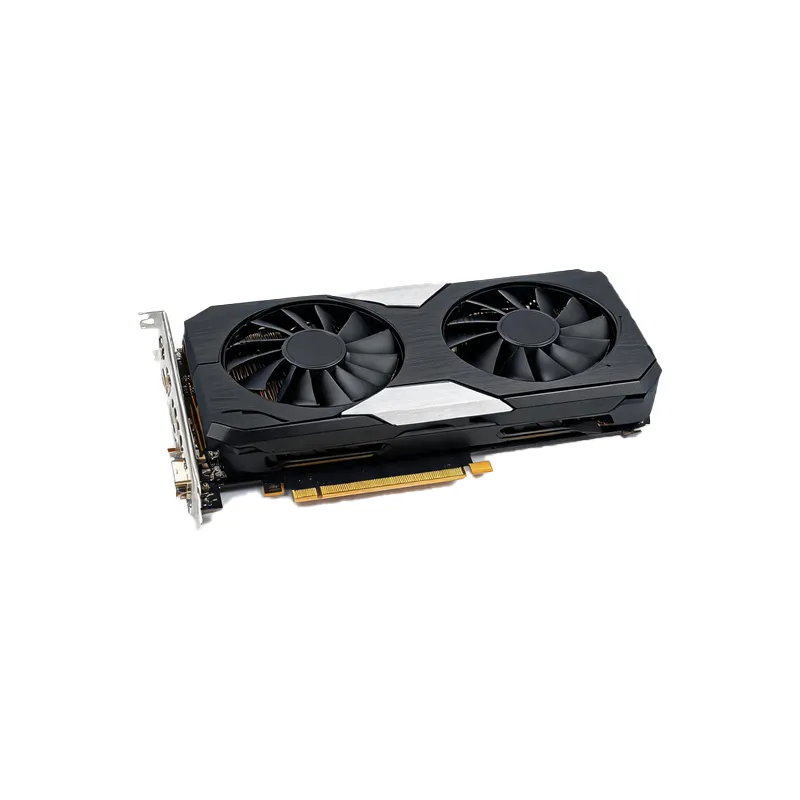
The NVIDIA GeForce RTX 5090 is the flagship Blackwell-architecture graphics card built for local AI, 4K gaming, DLSS 4 and creator workloads. It pairs 32 GB of GDDR7 memory on a 512-bit interface with 21,760 CUDA cores, fifth-generation Tensor Cores, fourth-generation Ray Tracing Cores, PCIe Gen 5 and 575 W of total graphics power in a two-slot Founders Edition design.
X-ON MINING supplies the NVIDIA GeForce RTX 5090 for AI developers, system builders, esports teams and content studios. Contact our sales team for current availability, lead times and volume quotations.
NVIDIA GeForce RTX 5090 at a Glance
- NVIDIA Blackwell architecture with new streaming multiprocessors optimized for neural shaders.
- 32 GB GDDR7 memory on a 512-bit interface for large models, high-resolution textures and heavy creative projects.
- 21,760 CUDA cores and 3,352 AI TOPS for local AI, creator and gaming workloads.
- Fifth-generation Tensor Cores and fourth-generation Ray Tracing Cores with 318 TFLOPS of RT performance.
- DLSS 4 with Super Resolution, DLAA, Ray Reconstruction, Frame Generation and Multi Frame Generation.
- PCIe Gen 5 interface with Resizable BAR support.
- 3x DisplayPort 2.1b and 1x HDMI 2.1b outputs, supporting up to four displays.
- 575 W total graphics power with a 1,000 W recommended system power supply.
NVIDIA GeForce RTX 5090 Specifications
| GPU architecture | NVIDIA Blackwell |
| CUDA cores | 21,760 |
| Tensor Cores | 5th generation, 3,352 AI TOPS |
| Ray Tracing Cores | 4th generation, 318 TFLOPS |
| Boost clock | 2.41 GHz |
| Base clock | 2.01 GHz |
| GPU memory | 32 GB GDDR7 |
| Memory interface | 512-bit |
| AV1 encode and decode | Yes, encode and decode |
| System interface | PCIe Gen 5 |
| Display connectors | 3x DisplayPort 2.1b, 1x HDMI 2.1b |
| Max digital resolution | 4K at 480 Hz or 8K at 165 Hz with DSC |
| Multi-monitor | Up to 4 displays |
| Video engines | 3x NVENC (9th generation), 2x NVDEC (6th generation) |
| Total graphics power | 575 W |
| Required system power | 1,000 W |
| Supplementary power connectors | 4x PCIe 8-pin (adapter in box) or 1x 600 W or greater PCIe Gen 5 cable |
| Card dimensions | 304 mm length, 137 mm width, 2-slot (Founders Edition) |
| Maximum GPU temperature | 90 °C |
| Graphics APIs | DirectX 12 Ultimate, Vulkan 1.4, OpenGL 4.6 |
| CUDA capability | 12.0 |
| Technologies | DLSS 4, Reflex 2, NVIDIA Broadcast, G-SYNC, NVIDIA Studio, Omniverse, RTX Remix |
Specifications are taken from NVIDIA’s official GeForce RTX 5090 product page, retrieved 9 November 2026. Figures describe the Founders Edition unless otherwise noted; board partner cards may vary in clocks, dimensions, cooling and power connectors. NVIDIA’s published spec table does not list a memory bandwidth figure for the RTX 5090, so this page does not quote one.
Why the NVIDIA GeForce RTX 5090 Fits AI and Modern Gaming PCs?
The GeForce RTX 5090 is the flagship of the RTX 50 Series: 32 GB of GDDR7 on a 512-bit interface gives large AI models, 4K textures and heavy creative projects room to stay resident in VRAM, while 3,352 AI TOPS and 21,760 CUDA cores put it well above the RTX 5080 in compute throughput. The trade-off is power and chassis planning: 575 W total graphics power and a 1,000 W recommended system power supply.
4K gaming with the NVIDIA GeForce RTX 5090
With 32 GB of GDDR7 and 21,760 CUDA cores, the RTX 5090 targets maximum-settings 4K gaming and path tracing. DLSS 4 Super Resolution and Multi Frame Generation raise frame rates in supported titles, while fourth-generation RT Cores and 318 TFLOPS of ray tracing performance handle path-traced lighting and RTX Mega Geometry scenes.
Reflex 2 and competitive low latency
NVIDIA Reflex 2 combines Low Latency Mode with Frame Warp to reduce click-to-photon latency in competitive games. For esports players running high-refresh 1440p monitors, the card’s boost clock of 2.41 GHz and PCIe Gen 5 platform keep frame pacing consistent.
Creators, AI and NVIDIA Studio
NVIDIA Studio drivers, 3,352 AI TOPS and DLSS 4 accelerate video editing, 3D rendering and generative AI tools. Three ninth-generation NVENC and two sixth-generation NVDEC engines with AV1 encode and decode support speed up export, streaming and multi-cam workflows.
Workloads and Applications
4K and high-refresh gaming
Run demanding titles at 4K with DLSS 4, or push high frame rates at 1440p with competitive settings. The 32 GB frame buffer keeps high-resolution textures and ray-traced effects resident in VRAM.
Content creation and video production
Edit 4K and 8K footage, grade color, render 3D scenes and run AI-assisted tools locally. AV1 encode and decode, 3x DisplayPort 2.1b and HDMI 2.1b support high-resolution multi-monitor studio setups.
Local AI, streaming and everyday use
3,352 AI TOPS, 32 GB of GDDR7 and CUDA capability 12.0 let developers run larger local AI models and GPU-accelerated applications. NVIDIA Broadcast, ShadowPlay and the NVIDIA app cover streaming, capture and driver management.
Compatibility, Power and Chassis Requirements
- System interface: PCIe Gen 5. Install the card in a PCIe x16 slot and confirm the motherboard’s generation and lane allocation before purchase.
- Power: 575 W total graphics power and a 1,000 W recommended system power supply. NVIDIA specifies 4x PCIe 8-pin cables (adapter in box) or 1x 600 W or greater PCIe Gen 5 cable.
- Dimensions: 304 mm long, 137 mm wide, 2-slot Founders Edition, listed by NVIDIA as an SFF-Ready Enthusiast GeForce Card. Check case clearance before ordering; partner cards vary.
- Thermals: maximum GPU temperature is 90 °C. Ensure front-to-back airflow and adequate case ventilation, especially in compact builds.
- Displays: 3x DisplayPort 2.1b and 1x HDMI 2.1b support up to four displays, 4K at 480 Hz or 8K at 165 Hz with DSC.
Software and Driver Support
NVIDIA lists DirectX 12 Ultimate, Vulkan 1.4 and OpenGL 4.6 for graphics, CUDA capability 12.0 for compute, and support for DLSS 4, Reflex 2, NVIDIA Broadcast, G-SYNC, NVIDIA Omniverse and RTX Remix. Game Ready and Studio drivers are available through the NVIDIA app, and Resizable BAR is supported on compatible platforms. NVIDIA’s spec table lists NVLink (SLI-Ready) as not supported, so multi-GPU scaling relies on PCIe rather than NVLink bridges. Confirm driver support for your specific applications before deployment.
| Weight | 3 kg |
|---|---|
| Dimensions | 30.4 × 13.7 × 4 cm |
You must be logged in to post a review.









Reviews
There are no reviews yet.