
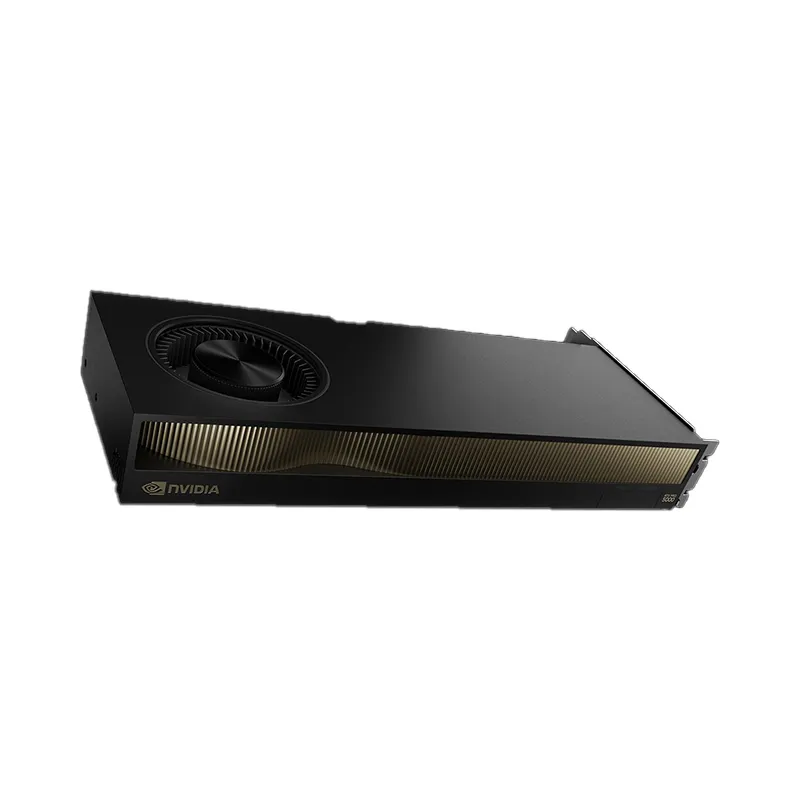
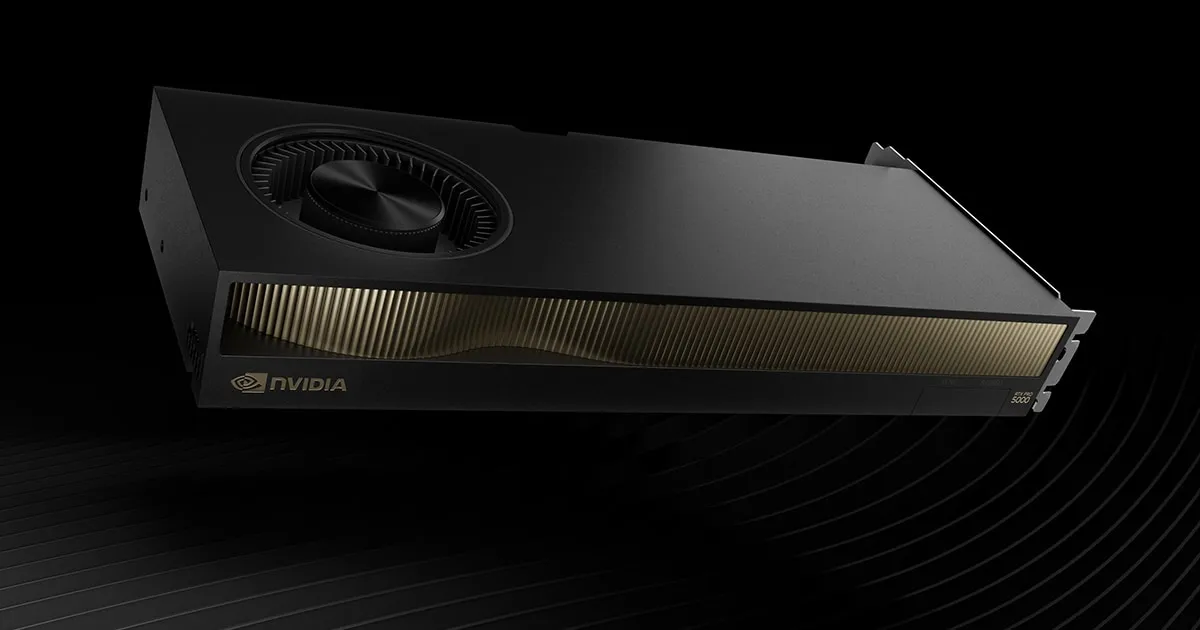
The NVIDIA RTX PRO 5000 Blackwell is a professional workstation graphics card built on the NVIDIA Blackwell architecture. It combines 48 GB of GDDR7 memory with error-correcting code (ECC), 14,080 CUDA cores, fifth-generation Tensor Cores and PCIe 5.0 connectivity in a dual-slot, actively cooled package rated at 300 W total board power. For teams running local AI inference, model fine-tuning, data science pipelines, neural rendering or virtualized workstations, the NVIDIA RTX PRO 5000 Blackwell brings data-center-class memory capacity to a desktop PCIe card.
X-ON MINING supplies the NVIDIA RTX PRO 5000 Blackwell for AI labs, rendering studios, engineering teams and enterprise workstation fleets. Contact our sales team for current availability, lead times and volume quotations.
NVIDIA RTX PRO 5000 Blackwell at a Glance
- Blackwell architecture with enhanced streaming multiprocessors built for neural shaders.
- 48 GB GDDR7 with ECC on a 384-bit memory interface, delivering 1,344 GB/s of memory bandwidth.
- 14,080 CUDA cores and 2,064 AI TOPS for AI development, fine-tuning and inference.
- Fifth-generation Tensor Cores with FP4 precision support, plus fourth-generation Ray Tracing Cores for RTX Mega Geometry.
- PCIe 5.0 x16 host interface, doubling the bandwidth of PCIe Gen 4.
- Multi-Instance GPU (MIG) support, partitioning the 48 GB card into up to two isolated 24 GB instances.
- Three ninth-generation NVENC and three sixth-generation NVDEC engines with 4:2:2 encode and decode support.
- 300 W total board power supplied through a single PCIe CEM5 16-pin connector.
NVIDIA RTX PRO 5000 Blackwell Specifications
| GPU architecture | NVIDIA Blackwell |
| CUDA cores | 14,080 |
| Tensor Cores | Fifth generation |
| Ray Tracing Cores | Fourth generation |
| AI performance | 2,064 AI TOPS |
| Single-precision performance | 65 TFLOPS |
| RT Core performance | 196 TFLOPS |
| GPU memory | 48 GB GDDR7 with ECC (a 72 GB variant is also offered by NVIDIA) |
| Memory interface | 384-bit |
| Memory bandwidth | 1,344 GB/s |
| System interface | PCIe 5.0 x16 |
| Display connectors | 4x DisplayPort 2.1b |
| Max simultaneous displays | >4x 4,096 x 2,160 @ 120 Hz; >4x 5,120 x 2,880 @ 60 Hz; >2x 7,680 x 4,320 @ 60 Hz |
| Video engines | 3x NVENC (9th generation), 3x NVDEC (6th generation) |
| MIG support | Up to 2x 24 GB isolated instances, or 1x 48 GB instance (48 GB model) |
| Total board power | 300 W |
| Power connector | 1x PCIe CEM5 16-pin |
| Thermal solution | Active |
| Form factor | 4.4 in H x 10.5 in L, dual slot, full height |
| Graphics APIs | DirectX 12, Shader Model 6.6, OpenGL 4.6, Vulkan 1.4 |
| Compute APIs | CUDA 12.8, OpenCL 3.0, DirectCompute |
Specifications are taken from NVIDIA’s official RTX PRO 5000 Blackwell product page and the RTX PRO 5000 Blackwell datasheet, retrieved 5 November 2026. Figures describe the 48 GB model unless otherwise noted. Availability and pricing are confirmed by X-ON MINING at the time of quotation.
Why the NVIDIA RTX PRO 5000 Blackwell Fits AI Workstations?
The RTX PRO 5000 Blackwell is positioned between entry-level professional cards and flagship 96 GB accelerators. Its 48 GB memory buffer and 1,344 GB/s bandwidth let a single workstation hold larger models, longer context windows and bigger scenes in GPU memory, while the Blackwell SM design and FP4-capable Tensor Cores reduce the cost of every inference pass.
Local LLM inference and fine-tuning
Fifth-generation Tensor Cores add FP4 precision, which NVIDIA states lowers memory requirements and speeds up model processing. Combined with 48 GB of GDDR7 ECC memory, the card supports local AI assistants, domain-specific model tuning and agentic AI workflows without moving data to a public cloud. Actual model fit depends on precision, quantization and context length, so validate your target model against the 48 GB budget before deployment.
Neural rendering and professional 3D
Fourth-generation Ray Tracing Cores with RTX Mega Geometry, DLSS 4 Multi Frame Generation and neural shaders accelerate photorealistic visualization, product design reviews and virtual production. Designers and architects can iterate on billion-polygon scenes on a desktop instead of booking render-farm time.
Virtualization and shared GPU capacity
MIG support splits the 48 GB card into up to two isolated 24 GB instances, each with dedicated memory, cache and compute cores plus guaranteed quality of service. That makes the RTX PRO 5000 Blackwell suitable for multi-user VDI, separate training and inference jobs, or isolating a production workload from experimentation.
Workloads and Applications
AI development, fine-tuning and inference
Prototype and run models locally with CUDA 12.8 and the NVIDIA CUDA-X libraries, including RAPIDS for GPU-accelerated data science. Use the workstation for dataset preparation, feature engineering, model evaluation and inference serving before scaling to data-center infrastructure.
Data science and HPC
Accelerate simulation, genomics, seismic modeling and financial risk analytics on the desk. 65 TFLOPS of single-precision and 196 TFLOPS of RT Core performance keep precision-critical engineering and scientific workloads interactive.
Rendering, video and streaming
Three ninth-generation NVENC and three sixth-generation NVDEC engines handle multi-stream 4:2:2 H.264 and HEVC encode and decode, while AV1 and H.265 quality improvements support live production, editing and streaming pipelines.
Compatibility, Power and Chassis Requirements
- System interface: PCIe 5.0 x16. Install the card in a full-length x16 slot and confirm the platform’s PCIe generation and lane allocation before purchase.
- Power: 300 W total board power through one PCIe CEM5 16-pin connector. Size the PSU with headroom for the GPU plus CPU, memory and storage, and verify that the PSU provides the required 16-pin cable.
- Dimensions: 4.4 in high x 10.5 in long, dual slot, full height. Check case clearance and leave room for the card’s active cooler to draw air.
- Cooling: the card uses an active thermal solution, so front-to-back airflow and adequate ambient temperature control are required in dense workstation or rack deployments.
- Displays: four DisplayPort 2.1b outputs support multi-monitor and high-resolution setups without additional adapters.
Software and Driver Support
NVIDIA lists CUDA 12.8, OpenCL 3.0 and DirectCompute as the compute APIs, with DirectX 12, Shader Model 6.6, OpenGL 4.6 and Vulkan 1.4 for graphics. RTX PRO parts run on NVIDIA’s enterprise driver branch and carry extensive ISV certifications, which matters for CAD, DCC, simulation and AI frameworks validated for professional deployment. Confirm the driver branch and ISV certification for your specific application before rollout.
| Weight | 3 kg |
|---|---|
| Dimensions | 27 × 8 × 2 cm |
You must be logged in to post a review.









Reviews
There are no reviews yet.