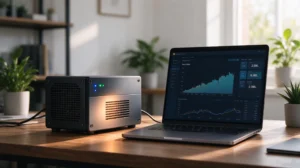
The best ASIC miner in 2026 will be defined not by raw hashrate, but by unparalleled energy efficiency. In the highly competitive, post-halving crypto landscape, the top mining rig will be a model that delivers the most computational power per watt, likely achieving a groundbreaking sub-15 Joules per Terahash (J/TH). As manufacturers like Bitmain and MicroBT push the limits of semiconductor technology, the ultimate winner for miners will be the machine that maximizes profitability by minimizing the single largest operational expense: electricity.
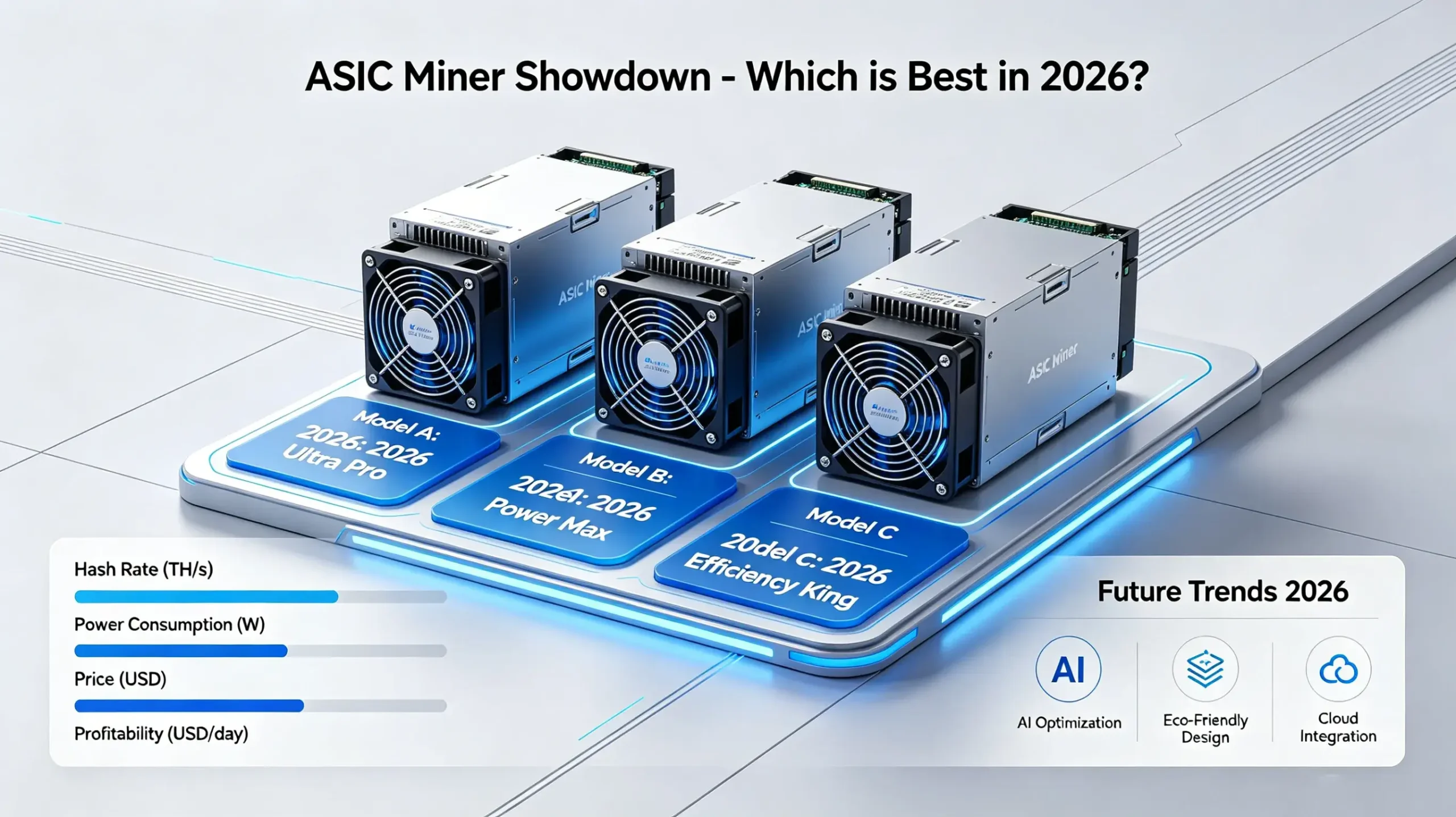
Table of Contents
- What is an ASIC Miner and Why Does It Matter in 2026?
- The 2026 ASIC Miner Landscape: Key Trends Shaping the Industry
- The Main Event: 2026 ASIC Miner Showdown
- At-a-Glance: Comparing the Projected Top ASIC Miners of 2026
- How to Choose the Best ASIC Miner for *You* in 2026
- Beyond Bitcoin: Top ASICs for Alternative Coins in 2026
- Frequently Asked Questions (FAQ)
- The Verdict: Which ASIC Miner is Truly the Best for 2026?
What is an ASIC Miner and Why Does It Matter in 2026?
An ASIC (Application-Specific Integrated Circuit) miner is a piece of powerful, specialized hardware designed for one single task: mining a specific cryptocurrency algorithm with maximum efficiency. Unlike a general-purpose computer or GPU, an ASIC can’t be used to browse the internet or play games. Its entire architecture is optimized to perform the repetitive hashing calculations required to solve blocks on a blockchain network, like Bitcoin’s SHA-256 algorithm. This single-minded focus makes them exponentially more powerful and efficient for crypto mining than any other type of hardware.
By 2026, the relevance of ASICs will be more pronounced than ever. The global hashrate, or the total computational power on the network, continues to climb to astronomical levels. This increasing network difficulty, combined with the reduced block rewards from the 2024 Bitcoin halving, means that only the most efficient hardware can operate profitably. Using anything less than a state-of-the-art ASIC for mining major cryptocurrencies like Bitcoin is no longer a viable option for serious miners. In this high-stakes environment, owning the right ASIC is not just an advantage; it’s a prerequisite for success.
The 2026 ASIC Miner Landscape: Key Trends Shaping the Industry
The ASIC market of 2026 won’t be a simple evolution of today’s technology; it will be a revolution driven by necessity. Three major trends will define the next generation of mining hardware, forcing miners to adapt their strategies and investment decisions.
The Post-Halving Efficiency Imperative
The single most important metric for any ASIC miner in 2026 will be its energy efficiency, measured in Joules per Terahash (J/TH). After the 2024 Bitcoin halving, the reward for mining a block was cut in half, instantly slashing a miner’s revenue. With income reduced, the only way to protect and grow profit margins is to aggressively cut operational costs. Since electricity is the largest ongoing expense, a miner’s efficiency rating directly translates to its long-term viability. We are entering an era where a machine with a slightly lower hashrate but a significantly better J/TH ratio will be far more desirable and profitable than a power-hungry brute. The race is on for manufacturers to break the 15 J/TH barrier and push towards the coveted single-digit efficiency milestone.
The Rise of Liquid Cooling as Standard
As ASIC chip density increases to cram more computational power into a smaller space, traditional air cooling is hitting its physical limits. The immense heat generated by next-generation miners requires a more effective thermal management solution, and liquid cooling is the answer. While once a niche, high-end feature, we project that by 2026, integrated liquid cooling systems will become the standard for flagship ASIC models. This technology allows miners to run at higher, more stable clock speeds, extends the hardware’s lifespan by reducing thermal stress, and significantly cuts down on the deafening noise produced by high-RPM air fans, making it more suitable for a wider range of environments.
Diversification Beyond Bitcoin (SHA-256)
While Bitcoin will remain the king of crypto mining, the ASIC landscape is diversifying. The explosive growth of alternative cryptocurrencies like Kaspa (using the KHeavyHash algorithm) has spurred a new arms race among manufacturers to develop specialized ASICs for these promising networks. By 2026, a savvy miner’s portfolio may include not just SHA-256 miners for Bitcoin, but also dedicated rigs for other profitable algorithms. This diversification strategy allows miners to hedge their bets and tap into new revenue streams, reducing their sole reliance on the Bitcoin network’s profitability.
The Main Event: 2026 ASIC Miner Showdown
Based on current technological trajectories and industry roadmaps, we project the battle for dominance in 2026 will be fought between the established giants. Here’s a look at the hypothetical flagship models that will likely define the market.
Contender #1: The Efficiency King (Projected: Bitmain Antminer S25 Pro)
Bitmain has long been a leader in the ASIC space, and its Antminer line is synonymous with Bitcoin mining. The projected Antminer S25 Pro will likely be their answer to the efficiency imperative. We anticipate this model to be built on a sub-5nm semiconductor process, pushing thermal and electrical efficiency to new heights. While it may not boast the absolute highest hashrate on the market, its primary selling point will be an extraordinary J/TH ratio, potentially as low as 14-16 J/TH. The S25 Pro will be the go-to choice for large-scale mining farms and individual miners in high-cost electricity regions, where every watt saved is a direct boost to the bottom line. Expect this model to feature a highly refined, integrated liquid cooling system as standard.
Contender #2: The Hashrate Powerhouse (Projected: MicroBT Whatsminer M70S++)
MicroBT’s Whatsminer series is renowned for its robust build quality and a relentless focus on raw power. The projected Whatsminer M70S++ will continue this legacy, aiming to be the undisputed hashrate champion of 2026. This machine will be for miners who want to capture the largest possible share of the network, pushing well over 450 TH/s. While its efficiency will be highly competitive (likely in the 17-19 J/TH range), its design philosophy will prioritize maximizing computational output. The M70S++ will be the weapon of choice for miners with access to cheap, abundant power, who can leverage its immense hashrate to solve blocks more frequently. It will almost certainly require a robust liquid cooling setup to manage its significant thermal output.
Contender #3: The Dark Horse Innovator (Projected: Canaan AvalonMiner 1576)
Canaan, the company that created the very first commercial ASIC miner, remains a key innovator in the industry. The projected AvalonMiner 1576 could be the dark horse that surprises the market. We predict Canaan will focus on a balanced approach, delivering a highly competitive hashrate and efficiency while potentially innovating in firmware and software. Features like advanced AI-driven frequency optimization, which automatically adjusts performance based on ambient temperature and power cost, could set the AvalonMiner 1576 apart. It may offer the best “out-of-the-box” experience, appealing to both seasoned miners and new entrants looking for a reliable, easy-to-manage, and highly optimized machine.
At-a-Glance: Comparing the Projected Top ASIC Miners of 2026
To make the differences clear, here is a speculative comparison of the flagship models we expect to see in 2026. (Note: These are forward-looking projections based on industry trends).
| Metric | Projected: Bitmain Antminer S25 Pro | Projected: MicroBT Whatsminer M70S++ | Projected: Canaan AvalonMiner 1576 |
|---|---|---|---|
| Target Algorithm | SHA-256 (Bitcoin) | SHA-256 (Bitcoin) | SHA-256 (Bitcoin) |
| Projected Hashrate | ~400 TH/s | ~475 TH/s | ~420 TH/s |
| Projected Power Consumption | ~6,200 W | ~8,550 W | ~7,140 W |
| Projected Efficiency (J/TH) | ~15.5 J/TH | ~18 J/TH | ~17 J/TH |
| Cooling System | Integrated Liquid Cooling | Integrated Liquid Cooling | Liquid/Advanced Air Cooling |
| Best For | Miners prioritizing long-term profitability and low operational costs. | Miners with access to low-cost electricity seeking maximum network share. | Miners seeking a balance of power, efficiency, and innovative software features. |
How to Choose the Best ASIC Miner for *You* in 2026
The “best” ASIC miner is not a one-size-fits-all answer. The right choice depends entirely on your specific circumstances. Before investing, you must conduct a thorough analysis of these critical factors.
Calculating Profitability: Beyond the Sticker Price
A miner’s purchase price is only the beginning. True profitability is a complex calculation that must include:
- Electricity Cost: What is your price per kilowatt-hour ($/kWh)? This is the most critical variable. A machine that is profitable at $0.05/kWh may be a money-loser at $0.12/kWh.
- Network Difficulty: As more miners join the network, the difficulty of solving a block increases, reducing individual earnings. You must factor in projections for future difficulty increases.
- Cryptocurrency Price: The market value of the coin you are mining is highly volatile. Your calculations should account for potential price swings.
- Mining Pool Fees: Most miners join a pool to earn consistent rewards. These pools typically charge a fee, usually 1-3% of your earnings.
Use a reputable online mining profitability calculator and input the specs of the miner you’re considering along with your specific electricity cost to get a realistic estimate of your potential return on investment (ROI).
Factoring in Your Environment: Heat, Noise, and Power
A 2026-era ASIC is an industrial-grade piece of equipment. You cannot simply plug it into the wall in your home office. You need to consider the physical infrastructure required. A miner consuming 7,000 watts needs a dedicated 240V circuit, similar to an electric stove or dryer. Furthermore, it will generate a tremendous amount of heat, requiring a robust ventilation or cooling solution to prevent overheating. Finally, even with liquid cooling, the system’s pumps and radiators produce a constant hum. Proper planning for power delivery, heat exhaust, and noise dampening is essential before you make a purchase.
New vs. Used: The 2026 Risk-Reward Equation
In 2026, the used ASIC market will be flooded with previous-generation miners that are no longer profitable for large-scale farms. While the low upfront cost of a used machine can be tempting, it comes with significant risks. Used ASICs have no warranty, may have reduced performance from wear-and-tear, and could be nearing the end of their operational lifespan. A brand new, top-tier miner, while expensive, comes with a manufacturer’s warranty and the guarantee of peak performance and efficiency, making it a much safer long-term investment.
Which Cryptocurrency Should You Mine?
While this article focuses heavily on Bitcoin (SHA-256), your decision might lead you elsewhere. Research the profitability and long-term potential of other ASIC-mineable coins. Networks like Kaspa or Litecoin/Dogecoin can sometimes offer higher profitability, though they may also come with higher volatility and risk. Your choice of cryptocurrency will dictate which specific model of ASIC you need to purchase, as a Bitcoin miner cannot mine Litecoin, and vice-versa.
Beyond Bitcoin: Top ASICs for Alternative Coins in 2026
The ASIC showdown isn’t limited to the Bitcoin network. Specialized miners for other popular algorithms will present lucrative opportunities for savvy investors.
Kaspa (KHeavyHash) Miners: The New Frontier
Kaspa has emerged as a major player in the mining scene due to its unique blockDAG technology. This has led to the development of powerful KHeavyHash ASICs from leading manufacturers. By 2026, we expect to see highly efficient and powerful Kaspa miners that offer an attractive alternative to Bitcoin mining. Miners will be looking for models from brands like Bitmain (Antminer KS series) or IceRiver that provide the best balance of hashrate on the KHeavyHash algorithm against their power consumption.
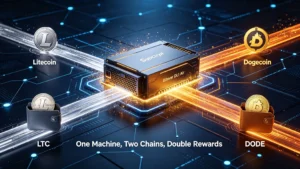
Litecoin/Dogecoin (Scrypt) Miners: The Stalwarts
The Scrypt algorithm, used for mining both Litecoin and Dogecoin (merged mining), has a long and stable history. ASICs designed for Scrypt, such as Bitmain’s Antminer L series, will continue to be a popular choice in 2026. These miners appeal to those who believe in the long-term value of Litecoin and the strong community behind Dogecoin. The key will be to find the latest-generation Scrypt ASIC that offers a significant leap in efficiency over older models, making it profitable in a mature market.
Frequently Asked Questions (FAQ)
Is crypto mining still profitable in 2026?
Yes, crypto mining can still be highly profitable in 2026, but it is contingent on two main factors: using the latest, most energy-efficient ASIC hardware and having access to low-cost electricity. The days of profitable home mining with outdated equipment are over.
How much does a top-tier ASIC miner cost?
While prices are volatile and depend on market conditions, you can expect flagship ASIC miners in 2026 to cost anywhere from $8,000 to over $20,000 USD at launch. Prices fluctuate based on supply, demand, and the current profitability of mining.
What is the most important spec to look for in an ASIC?
In 2026, the most important specification is by far the energy efficiency, measured in Joules per Terahash (J/TH). A lower J/TH number means lower electricity costs for the same amount of hashing power, which directly translates to higher profitability.
Can I mine Bitcoin with a GPU in 2026?
No. Mining Bitcoin with a GPU has not been profitable for many years and is effectively impossible in 2026. The network hashrate is so high that only specialized ASIC hardware can compete.
The Verdict: Which ASIC Miner is Truly the Best for 2026?
After analyzing the technological trends and market forces, the verdict for the best ASIC miner in 2026 is not a single model, but a profile: the best ASIC is the one that offers the highest energy efficiency that your budget and infrastructure can support.
For miners operating in regions with high electricity costs, the choice is clear: an “Efficiency King” like the projected Bitmain Antminer S25 Pro will be the undisputed champion. Its superior J/TH rating will ensure profitability even when margins are tight. For those blessed with access to cheap, abundant power, a “Hashrate Powerhouse” like the projected MicroBT Whatsminer M70S++ could provide a higher overall return by simply solving more blocks, even if its per-terahash efficiency is slightly lower.
Ultimately, the showdown of 2026 proves that the mining industry has matured. Success is no longer about just plugging in the most powerful machine; it’s a strategic business decision. It requires careful calculation, infrastructure planning, and a forward-looking investment in hardware where efficiency, not just raw power, reigns supreme.