To maximize your ASIC mining profitability, you must focus on five critical pillars: selecting a hyper-efficient miner based on its Joules per Terahash (J/TH), aggressively minimizing electricity costs by securing the lowest possible rate per kilowatt-hour (kWh), optimizing the miner’s physical environment for superior cooling and airflow, choosing a reliable mining pool with a payout structure that matches your risk tolerance, and implementing a proactive maintenance schedule to ensure maximum uptime and hardware longevity. Mastering these areas transforms mining from a hobby into a profitable enterprise. This guide provides an expert roadmap, drawing from years of experience in managing large-scale mining operations, to help you enhance your returns and build a resilient mining venture.
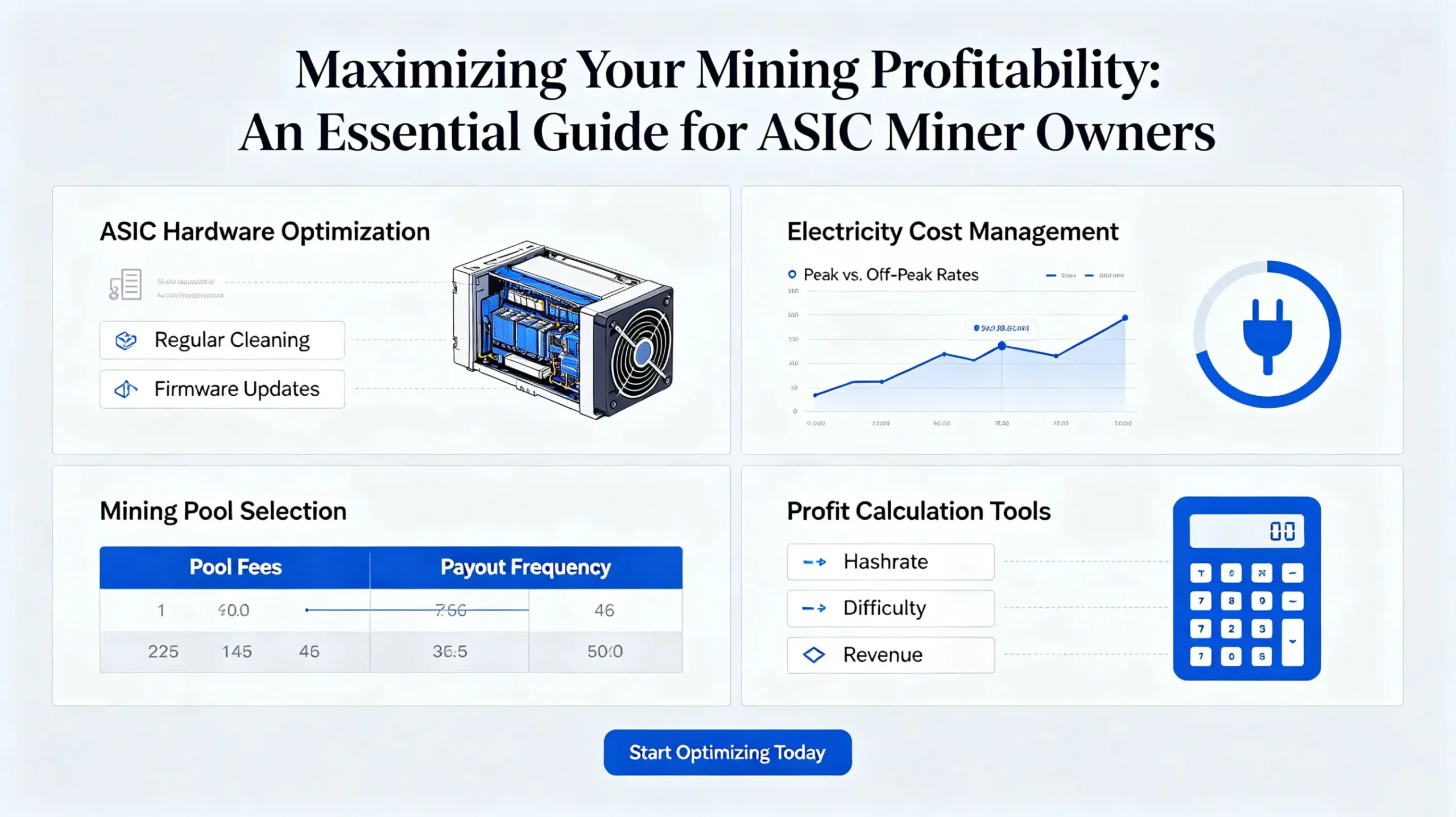
The world of cryptocurrency mining is both exhilarating and challenging. While the potential for significant returns is real, so are the obstacles of market volatility, increasing network difficulty, and ever-present operational costs. As an ASIC miner owner, your success hinges not just on the price of a coin, but on your ability to run an operation that is lean, efficient, and optimized for performance. we don’t just sell hardware; we build profitable mining solutions. This comprehensive guide will walk you through the essential strategies and insider tips you need to fine-tune your operation and maximize your profitability.
Table of Contents
- The Foundation of Profit: Choosing the Right ASIC Miner
- Taming the Beast: Mastering Your Operational Costs
- Fine-Tuning Your Operation for Peak Performance
- Strategic Management for Long-Term Profitability
- Is Professional ASIC Hosting the Key to Unlocking Maximum Profit?
- Conclusion: Your Roadmap to a More Profitable Mining Venture
The Foundation of Mining Profitability: Choosing the Right ASIC Miner
Your journey to profitability begins long before you plug anything in. The single most important decision you will make is your choice of hardware. In a competitive market, simply buying the miner with the highest hashrate is a common mistake that can lead to diminished returns. The true king of profitability is efficiency.
Why is Miner Efficiency More Important Than Raw Hashrate?
Imagine two cars: one is a gas-guzzling muscle car, and the other is a high-performance electric vehicle. The muscle car is faster off the line (higher hashrate), but its fuel costs are astronomical. The EV is still incredibly quick but uses energy far more effectively, making it cheaper to run long-term. ASIC miners are the same. Efficiency, measured in Joules per Terahash (J/TH), tells you how much power a miner consumes to produce one terahash of computing power. A lower J/TH number signifies a more efficient machine.
This metric is crucial because a highly efficient miner will remain profitable even when mining difficulty increases or cryptocurrency prices fall. It has a lower operational cost floor, giving you a significant competitive advantage and ensuring the longevity of your investment. An inefficient, power-hungry miner might generate impressive returns in a bull market, but it will be the first to become unprofitable and need to be shut down during a market correction.
Key Metrics to Compare Before You Buy
When evaluating a new ASIC, focus on three primary data points: Hashrate, Power Consumption, and the resulting Efficiency.
- Hashrate (TH/s): The raw computational power of the miner. Higher is better, but not in isolation.
- Power Consumption (Watts): The amount of electricity the unit draws from the wall. This is a direct operational cost.
- Efficiency (J/TH): Calculated by dividing Power Consumption by Hashrate. This is the most critical metric for long-term profitability.
Let’s see how this plays out in a practical comparison:
| Metric | Miner A (Older Model) | Miner B (Modern Model) | Miner C (Next-Gen Model) |
|---|---|---|---|
| Hashrate | 100 TH/s | 120 TH/s | 140 TH/s |
| Power Consumption | 3500W | 3300W | 3100W |
| Efficiency (J/TH) | 35 J/TH | 27.5 J/TH | 22.1 J/TH |
As the table clearly shows, Miner C, despite not having a dramatically higher hashrate than Miner B, is significantly more efficient. This means it will generate more profit per dollar spent on electricity. When you are ready to invest, make sure you explore our latest generation of high-efficiency ASIC miners to secure the best possible foundation for your operation.
Taming the Beast: Mastering Your Operational Costs
Once you have your hardware, the game shifts to managing your ongoing expenses. Operational costs, or OpEx, can eat into your profits if not aggressively controlled. The two largest components of your OpEx are electricity and cooling.
How to Drastically Reduce Your Electricity Expenses
Your electricity rate, measured in cents per kilowatt-hour (kWh), is the single largest variable in your profitability equation. A miner operating in a region with a $0.07/kWh rate will be vastly more profitable than the exact same machine in a region with a $0.15/kWh rate. For home miners, options can be limited. You might explore time-of-use plans to run miners during off-peak hours or investigate renewable energy solutions like solar, though the initial capital investment can be substantial.
However, the most effective strategy for securing rock-bottom electricity prices is to leverage the economy of scale offered by a professional hosting facility. These data centers are strategically located in regions with access to the world’s cheapest industrial power rates—prices that are unattainable for residential customers. By hosting your miner, you are essentially plugging into a grid of low-cost, reliable power, instantly boosting your profit margin. If high electricity costs are holding you back, learn more about Cleverobot’s competitive hosting solutions.
The Unsung Hero: Optimal Cooling and Environmental Control
Heat is the silent killer of both hashrate and hardware. ASIC miners generate an immense amount of thermal energy, and if this heat is not effectively dissipated, the miner’s chips will automatically slow down—a process known as thermal throttling—to prevent damage. This directly reduces your hashrate and, consequently, your earnings. Sustained high temperatures will also drastically shorten the lifespan of your expensive equipment.
Effective cooling is non-negotiable. For small-scale operations, this means ensuring a constant flow of cool, fresh air and a dedicated exhaust system to vent hot air away from the machine’s intake. For larger setups, a “hot aisle/cold aisle” configuration is standard practice to prevent hot exhaust air from being recycled. Beyond just temperature, you must also control for dust and humidity. Dust buildup acts as an insulator, trapping heat on components, while high humidity can lead to corrosion. A clean, cool, and dry environment is essential for peak performance and longevity.
Fine-Tuning Your Operation for Peak Performance
With your hardware and environment sorted, the next layer of optimization lies in your software and network choices. These adjustments can provide the incremental gains that separate average miners from top performers.
Which Mining Pool Payout Structure is Best for You?
Unless you’re operating a massive, multi-megawatt farm, solo mining is not viable. You need to join a mining pool, which combines the hashrate of thousands of miners to solve blocks more frequently and provide a steady, predictable income. However, not all pools are created equal. The most significant difference lies in their payout structure.
- Pay-Per-Share (PPS/PPS+): You are paid for every valid “share” of work you contribute, regardless of whether the pool finds a block. This offers a very stable, predictable payout with zero variance, but fees are typically higher to cover the pool’s risk.
- Pay-Per-Last-N-Shares (PPLNS): You are paid based on the shares you contributed only when the pool successfully finds a block. This method involves more variance (your payouts can fluctuate), but it often results in higher long-term earnings due to lower fees and rewarding pool loyalty.
| Factor | PPS / PPS+ | PPLNS |
|---|---|---|
| Reward Stability | Very High / Predictable | Variable / Based on Luck |
| Long-Term Payout | Good | Potentially Higher |
| Typical Fee | Higher (e.g., 2-4%) | Lower (e.g., 0.5-2%) |
| Best For | Miners who need consistent cash flow to pay for electricity. | Miners with lower costs who can tolerate short-term variance for higher long-term gains. |
When choosing a pool, also consider its server locations to minimize latency (ping), its historical uptime and reliability, and its reputation within the mining community.
Unlocking Potential with Firmware and Software Optimization
The default software that comes with your ASIC miner is designed for stability, but not necessarily for peak efficiency. Aftermarket or custom firmware, such as Braiins OS+ or Vnish, can unlock advanced tuning capabilities, allowing you to push your hardware beyond its stock settings. This typically involves two approaches: overclocking to increase the hashrate or under-volting to decrease power consumption at a given hashrate.
Under-volting is often the more powerful tool for profitability. By carefully reducing the voltage supplied to the hashing chips, you can significantly lower the miner’s total power consumption with only a minimal impact on its hashrate. This directly improves your all-important J/TH efficiency metric, making your machine more profitable. It is crucial, however, to proceed with caution. Using custom firmware may void your manufacturer’s warranty, and improper tuning can lead to instability or even permanent damage (“bricking”) to the device. Always make small, incremental changes and monitor your machine’s stability and temperature closely.
Strategic Management for Long-Term Profitability
Running a successful mining operation requires more than just technical skill; it requires business acumen. Your approach to asset management and maintenance can have a profound impact on your overall returns.
Beyond Mining: When and How to Manage Your Crypto Assets
Once you’ve mined your cryptocurrency, you face a critical decision: sell it immediately to cover your electricity costs and lock in a profit, or hold onto it (HODL) in anticipation of a future price increase. There is no single right answer; the best strategy depends on your financial situation, risk tolerance, and outlook on the market.
A common hybrid approach is to sell just enough of your mined coins each month to cover your operational expenses (electricity, hosting fees), and hold the rest as a long-term investment. This strategy, known as “stacking sats,” allows you to run a self-sustaining operation while building a position in the asset. Whatever you decide, it’s vital to establish a clear plan and stick to it, rather than making emotional decisions based on short-term market fluctuations.
The Importance of Proactive Maintenance
Every minute your miner is offline is a minute you are losing money. Downtime is a direct hit to your revenue. This is why a proactive maintenance schedule is not an option—it’s a necessity. Regularly power down your machines to clean dust and debris from fan blades, heatsinks, and power supplies using compressed air. Visually inspect all power cables and data connections to ensure they are secure.
Furthermore, actively monitor your miner’s dashboard. Keep an eye on the hashrate, chip temperatures, and fan speeds. Any sudden deviation from the norm can be an early warning sign of a pending issue. Addressing a failing fan or a loose connection early can prevent a catastrophic failure and save you from days of costly downtime. Consistent upkeep ensures your investment runs at its peak potential for as long as possible.
Is Professional ASIC Hosting the Key to Unlocking Maximum Mining Profitability?
As we’ve explored, maximizing profitability involves a complex interplay of variables: sourcing cheap power, engineering an optimal cooling environment, performing constant maintenance, and ensuring physical and network security. For many individuals, managing all these elements at home is simply not feasible or cost-effective. This is where professional ASIC miner hosting emerges as a powerful, all-in-one solution.
A hosting service like Cleverobot effectively outsources all the operational headaches. By placing your miner in our state-of-the-art data centers, you gain immediate access to industrial-grade infrastructure. This includes deeply discounted electricity rates that are impossible to find at a residential level, perfectly climate-controlled environments with filtered air and optimized airflow, and 24/7 on-site technicians who handle all maintenance, troubleshooting, and repairs.
Choosing to host is a strategic business decision that transforms your role from a hands-on hardware operator to a remote asset manager. You can monitor your miners’ performance from anywhere in the world, confident that they are operating in the perfect environment for peak profitability and longevity. It allows you to focus your energy on market strategy while we ensure your machines are hashing at their full potential. To see how this can revolutionize your returns, get a custom quote for our secure ASIC miner hosting services.
Conclusion: Your Roadmap to a More Mining Profitability Venture
ASIC mining profitability is not the result of a single action, but the sum of many intelligent decisions. It is a continuous process of optimization, beginning with the strategic selection of high-efficiency hardware and extending to the meticulous management of costs, performance, and maintenance. By focusing on efficiency (J/TH) over raw power, controlling your electricity and cooling costs, fine-tuning your pool and firmware settings, and adopting a proactive management strategy, you create a resilient and highly profitable mining operation.
Whether you are just starting your journey or are looking to scale an existing farm, these principles are the universal keys to success. We invite you to implement these tips and take control of your mining profitability. If you’re ready to build your operation on a foundation of expertise and efficiency, the team at Cleverobot is here to supply the hardware and provide the world-class hosting you need to thrive.